How We Achieved an Olympic Feat of Immersive Journalism
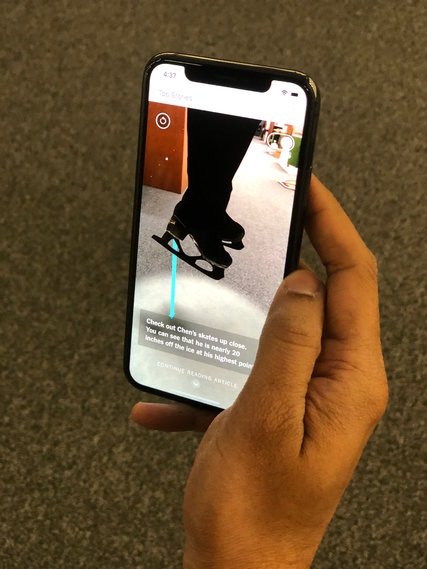 On Monday, The New York Times published its first augmented reality feature. The article, written by John Branch, includes four AR moments and is a preview of the Winter Olympics in Pyeongchang, South Korea.
Readers are able to meet world-class Olympic competitors — the figure skater Nathan Chen, the big-air snowboarder Anna Gasser, the short-track speed skater J.R. Celski and the hockey goalie Alex Rigsby — midperformance. Through your phone, the room around you looks just as it is, except the athlete is in it with you.
Another advantage is the mode of interaction we provide. Instead of the abstractions of pinch-to-zoom or swipe or click, we simply ask readers to treat the graphic as a physical object. If you want to see the form from another angle, you simply walk around to that area. If you want to see something up close, simply lean in to that spot. News becomes something you can see, literally, from all sides.
For the AR experience, we placed these scans into context — for example, placing Nathan Chen at the 20-inch height off the ground he would be midquad, based off photo reference and sometimes motion capture. In your space, this will truly be a distance of 20 inches because this is all true to scale.
Launching John Branch’s article was not just about this single piece of journalism. It was also about exploring what visual journalism may look like in the near future. We are extending stories beyond the inches of a screen — and in so doing, envisioning a world in which devices begin to disappear and the spaces around us become the information surfaces themselves.
See the full story here: https://www.nytimes.com/2018/02/08/insider/olympics-immersive-journalism-augmented-reality.html
Design Interactive and Atheer Partner to Release New Joint Augmented Reality Solution for Microsoft HoloLens: AUGMENTOR™ powered by Atheer AiR™ Enterprise

AUGMENTOR powered by Atheer AiR Enterprise allows any procedure to be authored from Atheers web accessible portal or in the field through DIs tools in the HoloLens. (PRNewsfoto/Atheer)
It brings together the AUGMENTOR™ purpose-built augmented reality troubleshooting application developed for the Microsoft HoloLens by Design Interactive (DI) and Atheer's AiR™ Enterprise augmented reality solution for industrial enterprise customers.
Atheer's award-winning AiR™ Enterprise is a breakthrough enterprise-class AR application that uses smart glasses to connect a worker's physical and digital workspaces – and provides a Web console that can be used for online step-by-step "taskflow" creation as well as secure, cloud-based data storage of those taskflows (allowing taskflow content to be accessible across the enterprise).
Any employee wearing a compatible head mounted display can livestream what they see to a remote expert. The expert can guide the employee and send them relevant drawings or procedures.
The NYT debuts its first augmented reality-enhanced story on iOS
 AR can also be used to create unique experiences within more traditional apps, too, as The New York Times is showcasing with today’s launch of its first-ever AR experiment for storytelling.
In The NYT’s iOS app for iPhone and iPad, the company is debuting its first AR-enabled article, offering a preview of the Winter Olympics.
The article focuses on top Olympic athletes, including figure skater Nathan Chen, snowboarder Anna Gasser, short track speed skater J.R. Celski, and hockey goalie Alex Rigsby.
In the app, NYT readers can view the athletes appear in the room beside them, zoom in and out, and walk around in 360 degrees to see them from every side.
This lets you get up close and personal with the Olympians, where you’re able to see things like how high Chen’s skates are off the ice when performing a jump, the offset of Celski’s skates, or how far open Alex Rigsby’s glove is when making a save.
To get started, you’ll need to give the app access to your iPhone or iPad’s camera, when requested, then point your phone at some non-reflective surface, like the floor in the room, for example. When you see the image, you can tap to place it into position, then walk up to it and around it. You can even bend down and look up at the image, too.
See the full story here: https://techcrunch.com/2018/02/06/the-nyt-debuts-its-first-augmented-reality-enhanced-story-on-ios/
Axon Sees Virtual and Augmented Reality in Its Future
 When taser and body camera maker Axon (NASDAQ:AAXN) announced on Monday that it had hired a "team of world-renowned imaging and VR/AR experts," it came as a bit of a surprise.
This group will focus on enhancing the capabilities of Axon's future wearable and in-car cameras and developing a platform for future advancements that leverage Augmented Reality (AR), Virtual Reality (VR) and Artificial Intelligence (AI).
The team had been part of Nokia, and then Microsoft, gaining industry expertise in the imaging market. But with Microsoft shutting down Nokia, the respected team of imaging engineers needed a home for their talents, which is where Axon stepped in.
How Axon views VR and AR
You see Axon's vision for its next-generation products starting to form. It invested in artificial intelligence capabilities last year, and is now adding virtual and augmented reality. Long term, I could see the company being able to create fully immersive views of incidents using the feeds from multiple Axon cameras. It's also likely their content will be searchable using artificial intelligence, meaning law enforcement would be able to find a person or item, then follow it through the video stream.
See the full story here: https://www.fool.com/investing/2018/02/07/axon-sees-virtual-and-augmented-reality-in-its-fut.aspx
BBC To Launch Augmented Reality App Civilisations AR
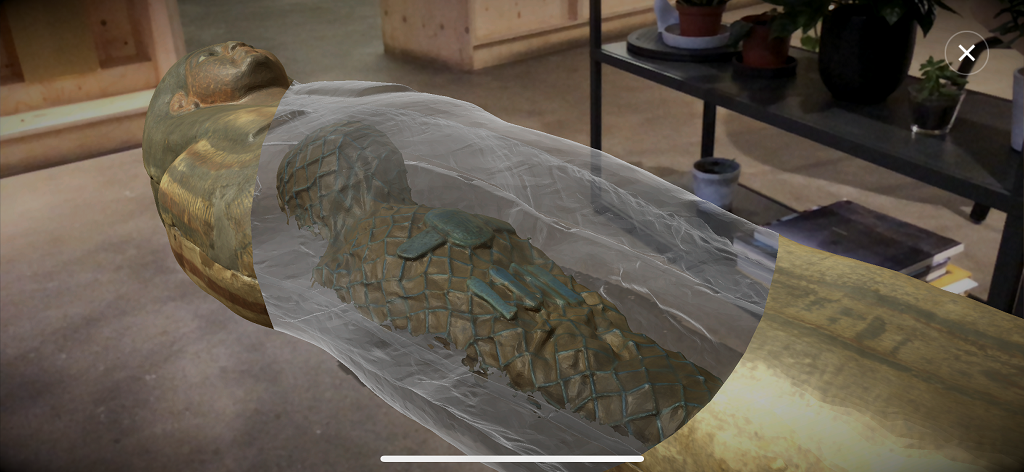 Developed by BBC Research & Development and Nexus Studios, the app is part of a major collaboration between the BBC and more than 30 museums from across the UK and to mark the launch of new landmark arts and culture series, Civilisations.
Major themes from the new Civilisations series will be incorporated into the AR app enabling people to explore some of the most important exhibits from UK museums in the comfort of their living rooms. They’ll be able to view, explore and discover a range of fascinating artefacts have been digitally scanned like an ancient Egyptian mummy from the Torquay Museum, Rodin’s The Kiss from the National Museum of Wales, The Umbrian Madonna and Child from the National Museum of Scotland.
The app will include several unique features, including ‘magic spotlight’, allowing users to uncover annotations, audio and imagery that enrich the story of each exhibit; X-ray, to see through or inside an object; Restoration, to rub through the layers of history, bringing lustre to a metal chalice or colour to a faded sculpture; and Navigation, where users can browse the exhibition geographically using an AR globe or via the themes of the series.
Civilisations AR will be available for iOS and Android from the beginning of the new series via BBC Taster. For any further updates from the BBC, keep reading VRFocus.
See the full story here: https://www.vrfocus.com/2018/02/bbc-to-launch-augmented-reality-app-civilisations-ar/
Real-time tomographic holography for augmented reality
 Abstract

The concept and instantiation of real-time tomographic holography (RTTH) for augmented reality is presented. RTTH enables natural hand–eye coordination to guide invasive medical procedures without requiring tracking or a head-mounted device. It places a real-time virtual image of an object’s cross section into its actual location, without noticeable viewpoint dependence (e.g., parallax error). The virtual image is viewed through a flat narrowband holographic optical element (HOE) with optical power that generates an in-situ virtual image (within 1m of the HOE) from a small spatial light modulator display without obscuring a direct view of the physical world. Rigidly fixed upon a medical ultrasound probe, an RTTH device could show the scan in its actual location inside the patient, even as the probe was moved relative to the patient.
------
Most medical imaging augmented-reality systems depend on tracking of the viewer relative to either the world and/or to some image-scanning device [1]. To avoid the undesirable technical and ergonomic requirements imposed by use of a tracking system [2], some researchers have previously mechanically mounted a 2D display and a half-silvered mirror in the proper positions on an ultrasound probe such that by the law of reflection the mirror produces a virtual image of the 2D display that is in situ, i.e. precisely located (registered) in 3D space with the slice of tissue scanned by the ultrasound probe, regardless of viewpoint or probe position [3, 4]. An entire 3D volume can be interrogated tomographically (i.e. in a series of slices) by moving the ultrasound probe to show multiple ultrasound slices in their correct 3D locations; the correct ultrasound data will be displayed at each point in the entire 3D volume inside the patient. This see-through autostereoscopic augmented-reality display technique has been termed Real-Time Tomographic Reflection (RTTR) [4].
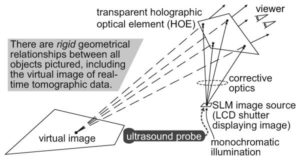
Here we present an extension of the RTTR concept, which we first proposed but had not yet implemented in [5]. By replacing the semi-transparent mirror with a narrow-band holographic optical element (HOE), as shown in Figure 1, we are able to maintain all of RTTR's above benefits without our device geometry being constrained by the law of reflection and without the substantial attenuating effects of a semi-transparent mirror. Our approach, analogously termed real-time tomographic holography (RTTH), can produce a 2D virtual image that is always correctly positioned and larger than the source spatial light modulator (SLM) display, with a less obscured view of the patient and with substantial flexibility in the position and orientation of the HOE and the (monochromatically illuminated) SLM. These benefits derive directly from the flexibility of an HOE. A flat-surface (e.g. volume phase) HOE appears transparent if it has sufficiently narrow bandwidth (Bragg window). An HOE can act as a focusing optic and simultaneously as a diffraction grating.
See the full article here: https://www.ncbi.nlm.nih.gov/pmc/articles/PMC3022476/
Video from Erick Moen: Stetten has been working on stuff like this for a while. It only works with monochromatic light, but it is widely adopted in the medical field. My brother is a PA and told me they use it in some hospitals to find veins for blood draws, etc. I found a video of it: https://www.youtube.com/watch?time_continue=114&v=ERle45xg9l8