The ambitions of VR and AR developers don’t match their financing needs
 According to the 34-page survey, 50 percent of VR and AR developers indicated that they will require more financing in the future, stating they will need additional rounds of more than $1 million. In order to raise this level of investment, companies typically need to have the ambition to achieve at least $10 million in revenue within five years. However, the average developer in the survey expects their firm to generate “only” $1.3 million.
See the full story here; https://venturebeat.com/2017/05/10/the-ambitions-of-vr-and-ar-developers-dont-match-their-financing-needs/
A VR Developer Created an Expansive Virtual World for Chickens

- Second Livestock is a unique application of virtual reality (VR) that could change animal husbandry and livestock farming.
- Developed by design professor Austin Stewart, this VR free-range farm world is a safe haven for chickens.

See the full story here: https://futurism.com/a-vr-developer-created-an-expansive-virtual-world-for-chickens/
How Alejandro G. Iñárritu Used Virtual Reality to Tackle Illegal Immigration
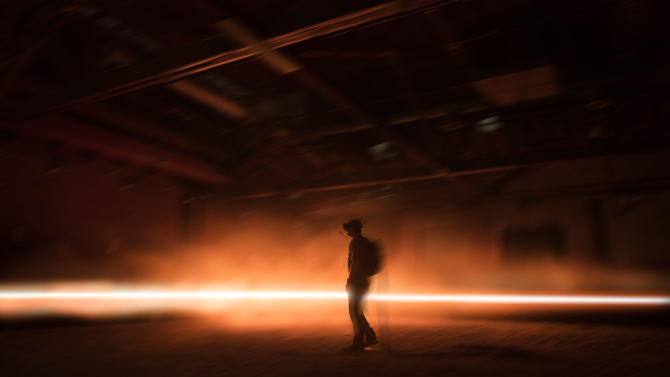 The sand is coarse under foot and the moonlight barely illuminates the way through the rocky desert terrain as you edge along the Mexican and American border. Suddenly there’s shouting. Vans hurtle forward in the distance, helicopters whirl overhead, as border guards leap out of the shadows, rifles at the ready, ordering you and your fellow immigrants to your knees.
No, this is not a ripped-from-the-headlines version of a chose your own adventure game. It’s a shattering new virtual reality experience from Alejandro G. Iñárritu and Emmanuel Lubezki called “Carne y Arena (Virtually Present, Physically Invisible),” that is being unveiled at this year’s Cannes Film Festival. Filmmakers have been toying with virtual reality for years, but there’s never been an installation of quite this size and scope. Usually, Iñárritu told Variety, the technology has been used to hawk Hollywood blockbusters, not to tackle hot button issues.
“The big mistake of VR is that it has been considered an extension of cinema,” said Iñárritu. “It has been considered a promotional tool. It has been devalued. This is an art in itself.”
The roughly six-minute experience is being backed by Legendary Entertainment and Fondazione Prada, neither of whom plan to make a penny on the installation. It will be exhibited at Fondazione Prada in Milan before coming to the Los Angeles County Art Museum.
Both men are careful to note that “Carne y Arena” is not cinema, with a director dictating where a viewer’s eye is meant to land. It’s a 360 degree experience that is its own beast. But Lubezki believes virtual reality is a natural extension of recent works such as “The Revenant” and “Birdman” that used long takes to create a feeling of verisimilitude and plunge people into a frontier landscape or backstage on Broadway.
“If the studios don’t get into it, they will be irrelevant soon,” he said. “Filmmakers will be very attracted to this.”
See the full story here: http://variety.com/2017/film/markets-festivals/alejandro-g-inarritu-virtual-reality-1202430264/
The Virtual Reality Company’s New Animated Series Raising a Rukus Gets New Premiere Date and 2D Trailer
 The Virtual Reality Company‘s original animated virtual-reality series Raising a Rukus is set to premiere at the IMAX VR Centre in Los Angeles on May 19 — and PEOPLE has an exclusive first look at a new trailer of the series.
Raising a Rukus follows two siblings and their mischievous dog Rukus as they travel to different worlds and embark on various magical adventures together.
“We’ve all seen animated stories before, but for the first time, we’re actually immersed in this world with the characters,” VRC’s co-founder and chief creative officer Robert Stromberg previously PEOPLE.
Each episode of the show will last 12 minutes and will feature branched narration, allowing viewers to follow the story from the perspective of the brother and sister.
Following the premiere, the experience will continue to rollout throughout the summer on Gear headsets and through special events.
See the full story here: http://people.com/movies/virtual-reality-company-raising-a-rukus-trailer/
Virtual reality pornography could be available in thousands of European hotels room within six months
 “The EU has always been light years ahead of the US in terms of a more mature and progressive attitude towards sex,” Alvarez said.
“Because of the proliferation of iPads and smartphones, the hotels have taken a major hit on in-room adult movies purchases, which were a massive income stream at one point.
“I believe every male guest will want to try out an adult movie in VR.”
The Sun Online has seen correspondence which shows Alvarez and his associates at other adult companies have begun talks with a firm that provides content to 6,000 hotels across Europe, with the scheme expected to begin in the autumn.
This company, which we have decided not to name, already offers lonely travellers to chance to watch very naughty “adult content”.
See the full story here: https://www.thesun.co.uk/tech/3591857/virtual-reality-pornography-could-be-available-in-thousands-of-european-hotels-room-within-six-months/
Google Is Building a New Virtual Reality Headset
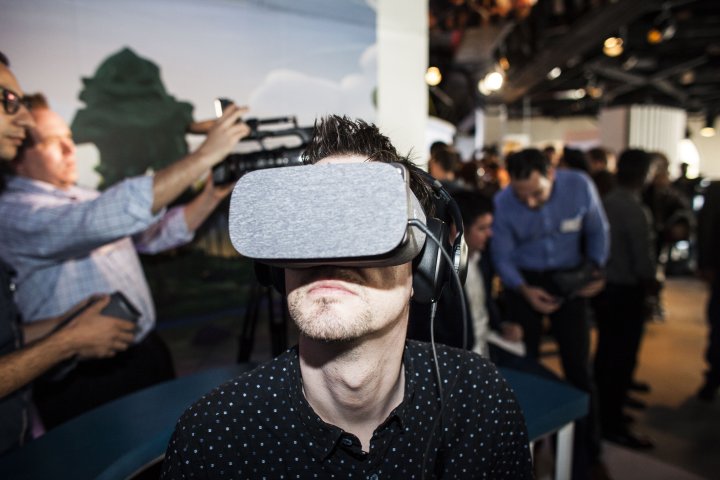
SAN FRANCISCO, CA - OCTOBER 04: A journalist uses Google's Daydream VR headset during an event to introduce Google hardware products on October 4, 2016 in San Francisco, California. Google unveils new products including the Google Pixel Phone making a jump into the mobile device market. (Photo by Ramin Talaie/Getty Images)
The search giant said Wednesday that it’s creating a new VR headset that, unlike most of its rivals, does not require a personal computer or a mobile phone to use. Google announced the new VR headset during its annual Google I/O conference for developers in Mountain View, Calif.
Google’s vice president of virtual reality products, Clay Bavor, said that the new yet-unnamed new VR headset would be “easy to use,” in contrast to many VR headsets that take time to set up and must be connected by a wire to a computer.
By building an all-in-one device, Google has configured the headset's underlying technology to solely focus on helping it display compelling virtual reality environments without any trade-offs, he explained.
Google’s current virtual reality headset, the Daydream View, must be connected to an Android-powered smartphone to function and is not capable of fully tracking a person's movements.
Bavor said Google’s new VR headset would be available to the public later in the year.
See the full story here: http://fortune.com/2017/05/17/google-daydream-virtual-reality-headset-lenovo-htc/
Why Google’s CEO Is Excited About Automating Artificial Intelligence
 AI software that can help make AI software could accelerate progress on making computers smarter.

Deep learning teaches software to be smart by passing data through layers of math loosely inspired by biology and known as artificial neural networks. Choosing the right architecture for a neural network’s web of math is a crucial part of making something that works. But it’s not easy to figure out. “We do it by intuition,” says Quoc Le, a machine-learning researcher at Google working on the AutoML project.
Last month, Le and fellow researcher Barret Zoph presented results from experiments in which they tasked a machine-learning system with figuring out the best architecture to use to have software learn to solve language and image-recognition tasks.
On the image task, their system rivaled the best architectures designed by human experts. On the language task, it beat them.
Half of SteamVR Tracking Course Attendees Using Tech for Non-gaming
 In August of last year, Valve created the SteamVR licensing program to allow any developer to create their very own SteamVR tracked object. At that time, Valve partnered with Synapse, a Seattle-area product development firm, to provide a mandatory training program for all SteamVR licensees. Road to VR met with Synapse’s electrical engineering program lead and SteamVR Tracking instructor, Doug Bruey, to talk about the tracking system and how it will be used by companies in the future.
From his experience teaching the SteamVR Tracking course, Bruey has an inside view on what companies are doing with the technology and when we might begin to see the fruits of their labor.
We had 15 courses with 149 attendees from 113 different companies.
It was really varied. I would say it’s 50% from gaming, but from the earliest classes we saw people from a variety of different markets. We’ve seen people from the automotive industry, advertising, athletics, gaming, computers, education, hospitals, industrial training and farming. We’ve had a couple different NASA contractors come through who were working on training simulations and setups for astronauts. There’s usually a pretty big part of the class that will be working on gaming and gaming accessories but the other half will come from other markets that you may not have expected.