Enterprise Augmented Reality Hardware and Software Functional Requirements
 As part of the AREA’s mission to accelerate the adoption of Enterprise Augmented Reality (AR) by creating a comprehensive ecosystem, we are pleased to share with you the world’s first AR hardware and software functional requirements.
These requirements were initially created through a collaboration between UI LABSand the AREA and delivered through a project led by Lockheed Martin, Caterpillar and Procter & Gamble.
In March 2017, 65 organizations — including industry, AR providers, universities, and government agencies — came together for a workshop to discuss the requirements and offer insights into their challenges and needs in order to further develop the guidelines.
It’s important for any new global ecosystem to agree on a baseline set of requirements. They can act as a benchmark, help to create a shared understanding and language, and provide direction to the Enterprise AR ecosystem.
For Enterprises: AR functional requirements encourage interoperability, make RFPs easier to create, and provide a clear understanding of what is required.
For AR Providers: AR functional requirements clarify what enterprises need to make AR projects successful, which can then be used to influence development roadmaps and future product launches.
The documents below include requirements outlining:
 |
Hardware: Battery life; connectivity; field of view; on-board storage; on-board operating system; environmental; inputs/outputs and safety. |
|
Software: Authoring; AR content; creating 3D content; deployment of AR content and Internet of Things. |
See the full story with links to the hardware and software rec pdfs here: http://thearea.org/ar-functional-requirements/
Hospital makes $119M bet on virtual, augmented reality training center
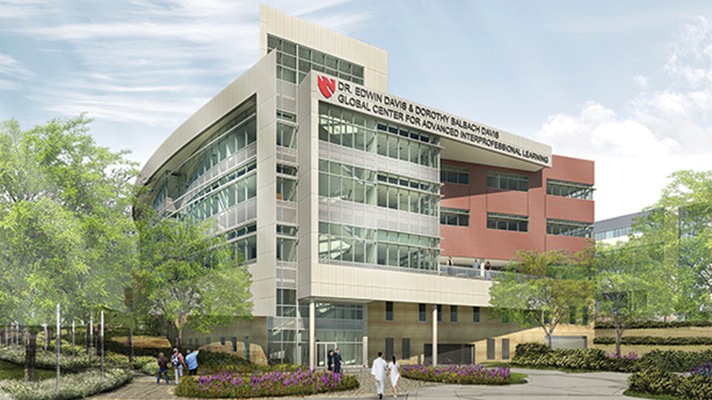 The University of Nebraska Medical Center has broken ground on a new $119 million facility meant to help physicians and nurses train for next-generation care delivery using emerging virtual and augmented reality technology.
The center's advancements will include the creation of 3D/virtual and augmented reality content for clinical and surgical training modules; leading-edge technology such as the iEXCEL Helix – an extended 280-degree curved screen creating a 2D/3D immersive environment; laser-based "3D iSpace," a five-sided virtual immersive reality environment, and a 130-seat holographic auditorium.
See the full story here: http://www.mobihealthnews.com/content/hospital-makes-119m-bet-virtual-augmented-reality-training-center
This Startup Lets Doctors Collaborate On A Surgery Remotely Through Augmented Reality
 Hachach-Haram is applying augmented reality to provide remote consultation to doctors around the world with limited resources. “We needed to find a way for technology to democratize access to surgery and really crowdsource all that knowledge into one place where we can all benefit from it,” she says.
With Proximie, a sensor overlays images of the consulting surgeon’s hand onto a video of the patient via, say, an iPad, to guide doctors through surgery in real time. For example, they can see where to make an incision.
Hachach-Haram is not the first to use augmented reality in the operating room. U.S.-based Medsights Tech develops augmented reality software for oncologists. In January 2017, Dutch giant Philips announced a similar tool for spinal and cranial surgery.
Since its launch last year, Proximie grabbed headlines when a doctor in Beirut led surgeons in Gaza through reconstructive surgery.
See the full story here: http://www.forbesmiddleeast.com/en/augmented-reality-surgery-proximie/
Jeri Ellsworth is launching a consumer-friendly augmented reality platform, castAR, this fall.
 Serial inventor and entrepreneur Ellsworth worked at Valve Software, helping to found and grow the hardware department. The hardware department teams went on to release other products including the HTC Vive and the Steam Box controller, while she focused more on augmented reality.
That augmented reality platform allowed players to wear specially-designed glasses and use a wand to interact with holographic creations that came to life on a flat surface like a tabletop, much like a real-world version of the HoloChess concept introduced in the original Star Wars back in 1977.
In 2013, Ellsworth decided to leave, and since Valve was focused on virtual reality, she asked Valve president and owner Gabe Newell if she and colleague/programmer Rick Johnson could take that still-early prototype technology with them. He agreed, and castAR was born.
“What I learned from working at Valve and some of the amazing people there was that the company is hyper-focused on the customer experience,” Ellsworth said. “Almost every decision that’s made is studied under the microscope of how it impacts the end-user experience.”
...
“Andy told us to refund the Kickstarter backers’ money and focus on the future,” Ellsworth said. “We decided to give back their money and give them a free pair of the fully-integrated glasses when they’re ready. Our CFO had a hard time with us giving away hundreds of thousands of dollars in free AR glasses, but the marketing guys said this was great for marketing the technology.”
....
See the full story here: https://www.entrepreneur.com/article/292500
Gene Munster And His Crazy Crystal Ball
 Before leaving at the end of last year to form Loup, the Tony Stark of investors spent 21 years as a top analyst for Piper Jaffray, where he covered tech companies such as Apple Inc.AAPL 1.03%, Alphabet Inc GOOG 0.26% GOOGL 0.3% and Facebook Inc. FB 0.89%. He’s perhaps best known for picking Apple to take off in 2004.
“I would say 70 percent of what I do is what I did before. The part I don’t like is the business operation side (human resources, legal issues, etc.).”
During a panel of college students assembled for input on augmented reality, he said a young woman described an angst-filled dream in which every person she met was viewable as a set of likability metrics.
See the full story here: https://www.benzinga.com/fintech/17/04/9258400/gene-munster-and-his-crazy-crystal-ball
Facebook To Bring South Korea VR/AR Startups Under Its Wing
 Via the new agreement, the Facebook Korea office in Seoul will reportedly be teaming up with Korea Innovation Center of the Ministry of Science, ICT and Future Planning along with the Institute for Information & Communications Technology Promotion to choose 10 promising AR and VR firms in Korea. Employees of those 10 firms will spend 10 weeks in Silicon Valley learning tech and business from Oculus VR engineers.
“Outstanding technologies and companies may be considered by the Facebook headquarters for future M&A or supply pool,” Park Dae-sung, head of policy at Facebook Korea, is reported as saying. “We hope to see some very innovative products from killer content to hardware through this program.”
Facebook’s CSO Alex Stamos adds “Korean companies have a fantastic advantage due to the technical and intellectual infrastructure in these areas” after he made his first trip to Seoul to celebrate the new partnership.
See the full story here: https://uploadvr.com/facebook-helps-korea-startups/
This College Acceptance Letter Came With A VR Viewer
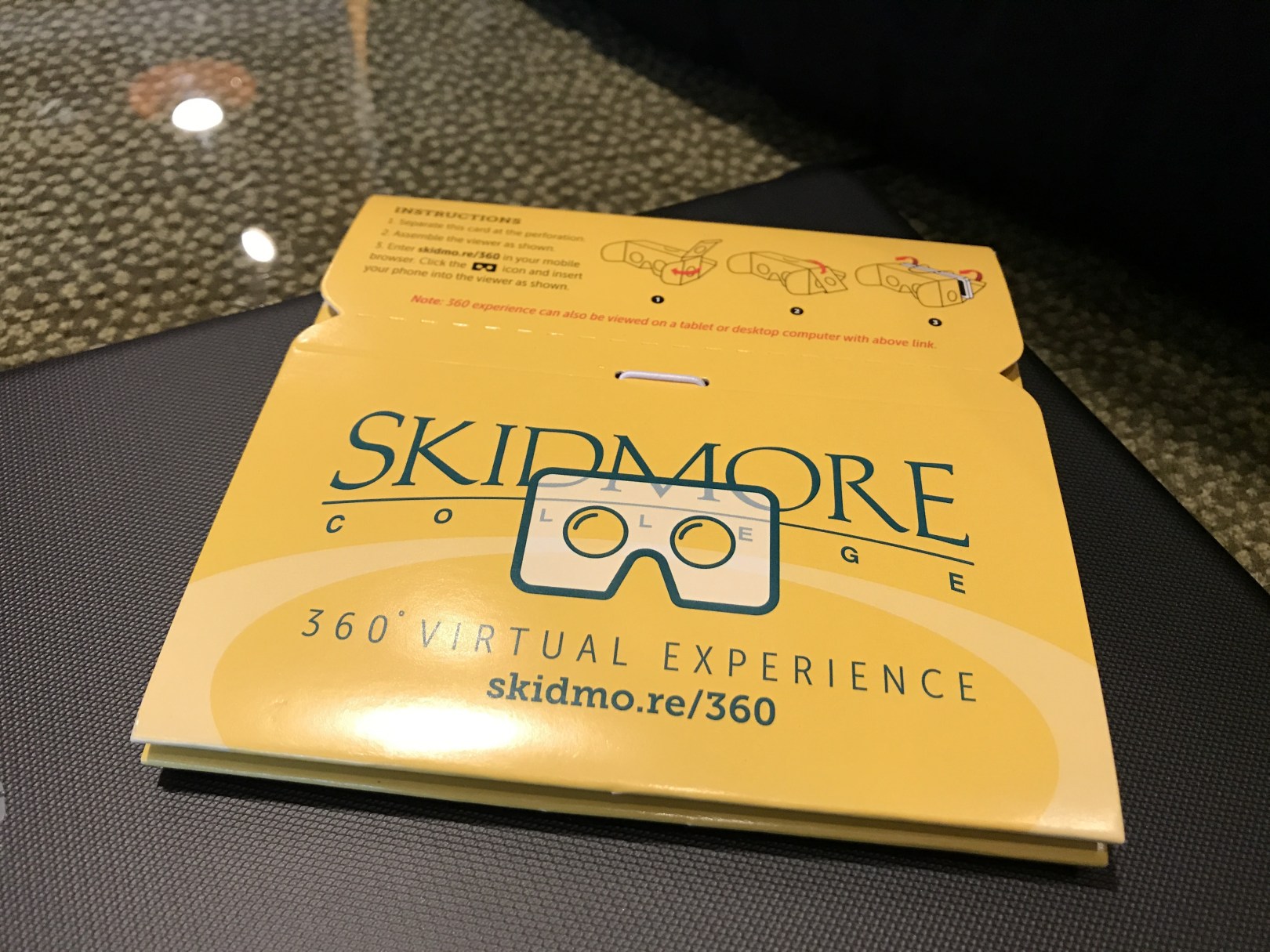 This VR acceptance letter makeover goes beyond just a typical college tour. Luke Meyer, Director of Marketing and Engagement says, “this was a chance to answer one of the top questions accepted candidates ask, which is what is it like to be a Skidmore student when I’m not in class.” The college communications team felt that using immersive video was the best way to answer that question, “why not use something like 360VR to bring Skidmore student life to the accepted candidate,” said Meyer.
The Skidmore Communications team knew students had already toured the campus, sat in on classes, and talked with faculty. So it was about giving the accepted candidates something more, something a letter or booklet couldn’t provide.
See the video and the full story here: http://vrscout.com/news/college-vr-acceptance-letter/