Toshiba’s distribution deal with Vuzix has interesting timing
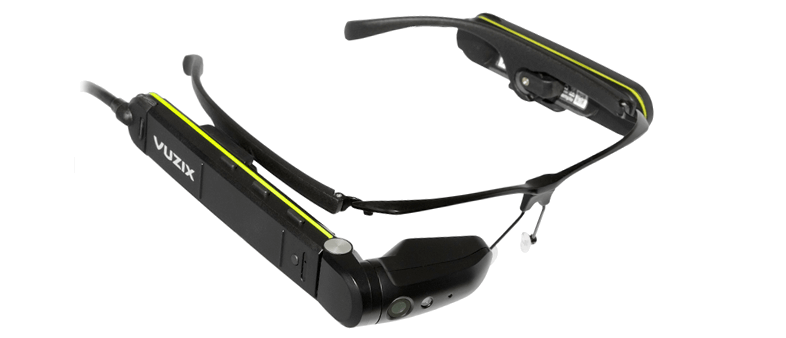 Vuzix expects to sell thousands of pairs of smart glasses in its distribution deal with Toshiba. The deal based on Vuzix M300 Smart Glasses will provide Toshiba with smart glass technology, this comes after the company canceled its own line of smart glasses.
Vuzix’s glasses delivers a “hands-free” digital world; its built-in HD camera records, stores, and plays back still pictures and video, along with expandable memory and wireless connectivity capabilities.
The glasses also have an integrated head tracking and GPS system that provide apps with your location the direction and angle of your current view.
Much like Vuzix smart glasses, Snapchat’s spectacles are also considered augmented reality glasses. If Snap’s spectacles get Vuzix’s technology behind them, the world of AR is about to get a lot more interesting.
[Philip Lelyveld note: except Snap glasses don't have positional tracking, which makes them not-really AR.]
Could Toshiba be gearing up to roll out next generation smart glasses for Snapchat? No one can say for sure, but between Toshiba’s distribution channels and Vuzix’s proven technology, it would seem like a lucrative step in the right direction.
See the full story here: https://thenextweb.com/augmented-reality/2017/03/05/snapchats-ipo-toshibas-distribution-deal-vuzix-interesting-timing/#.tnw_HrVGu7Be
What experts are saying about Apple’s next big thing
But perhaps the most interesting feature currently rumored for the so-called "iPhone 8" is a new "3D" camera. ...the first step towards a technology called "augmented reality,"
[Tim Cook]...earlier this year, he said it could "be as big as the smartphone,"..
Steven Milunovich, UBS
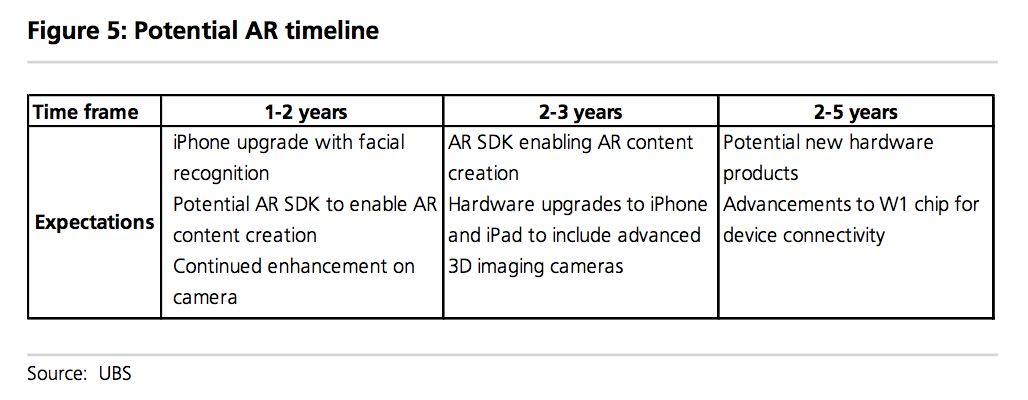 He writes that Apple has an advantage over companies like Magic Leap, Google, and Microsoft for AR for four reasons:
- "hardware expertise and superior hardware/software integration;
- consistent updated releases with most customers on the latest version of iOS compared with the fragmented Android OS base;
- an installed base of iPhone and iPad customers that can use AR rather than starting from scratch; and
- a cloud infrastructure that facilitates data gathering."
Milunovich also writes that "Apple's experience designing its own chips could present an opportunity."
Andrew Gardiner and team, Barclays
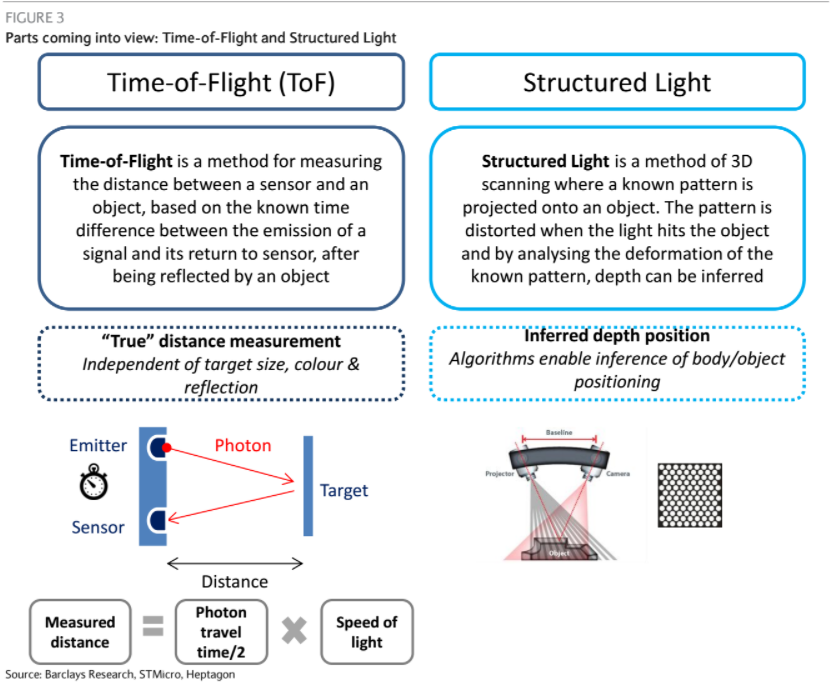 He believes chipmakers like AMS, STMicroelectronics, Lumentum, and II-VI may be big winners as Apple includes a 3D sensor in 10s of millions of iPhones.
Ultimately, the big question for Gardiner is whether Apple will use a time-of-flight sensor or structured light sensor. He thinks Apple will use a combination of the two.
Apple currently includes a "time-of-flight" sensor in current iPhones.
Morgan Stanley
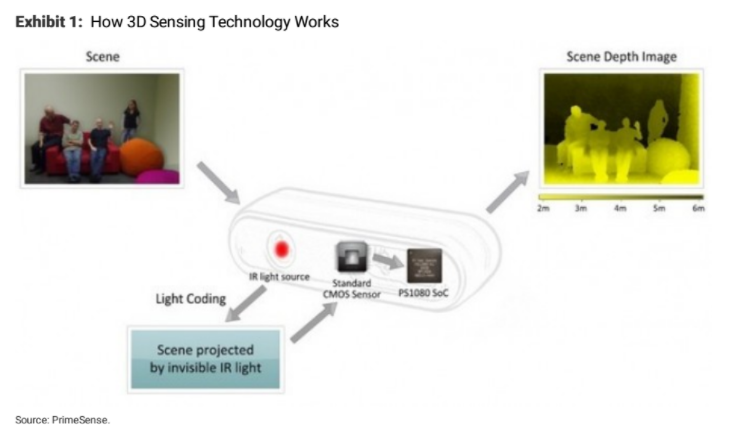 They include a diagram courtesy of Primesense, an Israeli company that Apple bought in 2013.
Morgan Stanley cites AMS, a current Apple supplier, for potential applications for this technology, including "augmented reality and virtual reality, gesture, face recognition biometrics, improved 2D and video images, body measurement as well as autonomous driving."
But Morgan Stanley questions the consumer appeal of AR and the viability of the requisite 3D camera technology, including whether most smartphones will have the necessary horsepower to do get the job done. Many people in the AR industry have told me that the power consumption and heat generated by processors are critical roadblocks.
Ming-Chi Kuo, KGI Securities
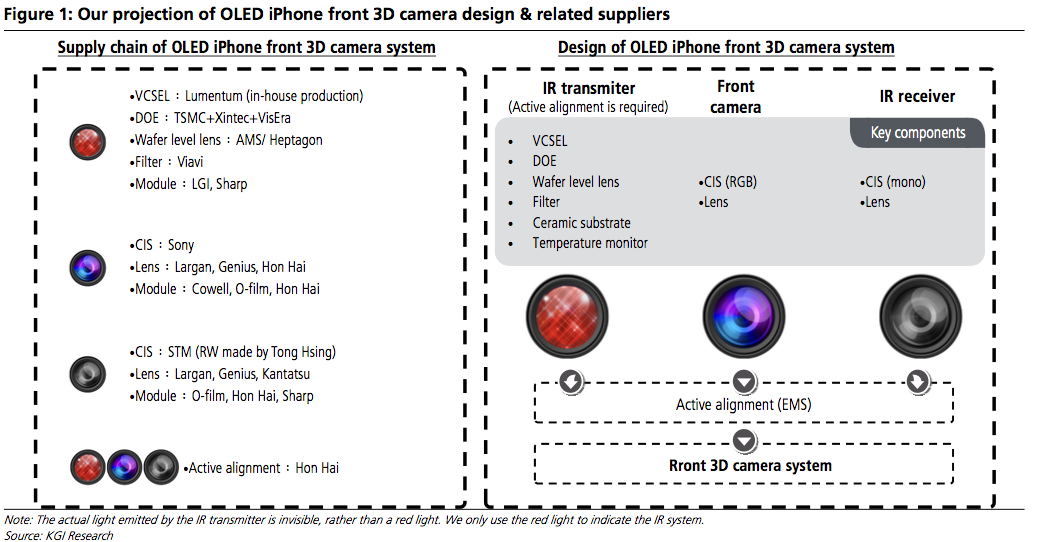 He believes that the 3D camera on the upcoming phone will actually take the place of the front sensor, and will be composed of three modules.
AR is related to all Apple’s current businesses; the key is that AR is an innovative human-machine interface that could be used in various devices & applications. All of Apple’s past successes were related to human-machine interfaces, such as mouse for Mac, click wheel for iPod, and multi-touch for iPhone and iPad.
See the full story here: http://www.businessinsider.com/what-you-need-to-know-about-apples-new-3d-camera-2017-2
Toe-Tapping Tech: The World’s First Virtual Reality Musical
 Unlike a typical film that utilizes extras as background filler behind the main shot, in VR the people in the background could easily move to the foreground, depending on what the viewer decides to set their gaze upon. While you can attempt to guide their view through action and movement, being overly prescriptive with this defeats the purpose of the virtual reality experience—viewers are supposed to have curious eyes, otherwise it might as well be on a traditional screen. If extras are static characters, the realism of the experience is suddenly thrown off balance.
Because of this, Howard and his team decided to write individual story arcs for every single person in the film—all 36 of them. “We never really called them ‘extras,’ they were really more of a supporting cast,” he says. “The replayability factor of this is interesting, because while the film may only last four minutes, if you want to watch every story arc and uncover all the details, it might be a 45-minute experience.”
See the full story here: https://www.ceros.com/blog/vr-musical/
SXSW Will Feature 8K Video Virtual-Reality Motion Ride That Requires No Headset
 Unlike other virtual-reality implementations, the 8K VR motion ride at the Austin Convention Center will not require a head-mounted display or headphones — instead, it uses a hemispherical screen and surround sound to provide the VR experience.
The two-seat ride is produced by a group of Japanese media and entertainment companies, led by NHK Enterprises and NHK Media Technology, which are affiliates of Japan’s public broadcaster, NHK. They worked with spherical-screen technology vendor Wonder Vision Techno Laboratory and RecoChoku Labo (the R&D department of digital-music provider RecoChoku) to develop the five-minute ride, which is described as a “celebration of Tokyo” as the host city for the 2020 Summer Olympic Games.
See the full story here: http://variety.com/2017/digital/news/sxsw-nhk-demo-virtual-reality-ride-8k-1202002735/
Game Developers Conference: What’s Next in VR Storytelling
 VR leaders gathered for day two of the Game Developers Conference in San Francisco last week. Many of the talks addressed techniques for dealing with a medium in which you present a story and a world to the ‘visitor,’ but you have limited control over how the visitor experiences it. The “Job Simulator” team created microstories bounded by story pinchpoints within a macrostory. The HBO “Westworld” VR and Baobab Studios teams rewarded visitors for taking actions that advance the story, but embedded triggers that advance the story when the visitor misses the cues. The “Trials on Tatooine” team learned that understanding and accommodating visitors with varying physical abilities can not only improve user experience design, but inform story development.
See the full story here: http://www.etcentric.org/game-developers-conference-whats-next-in-vr-storytelling/
Mixed Reality Technology Is Coming to Xbox Game Consoles
Microsoft released new details on one of the headsets made with its Windows Mixed Reality tech. Acer is making a Windows Mixed Reality Development Edition headset, which has external cameras to display real-world images as part of AR experiences. It also has two 1440 x 1440 displays and can refresh at a rate of 90 fps to provide high quality imaging for both AR and VR experiences.
Currently, the headset can only run on a PC with Windows 10. The Mixed Reality Development Edition headset has a USB and a HDMI 2 port for connecting to other gadgets.
Microsoft will start shipping the new development kits in the next few weeks. The company says it is partnering with device makers such as Dell, HP, Lenovo and 3Glasses on new headsets.
See the full story here: http://www.etcentric.org/mixed-reality-technology-is-coming-to-xbox-game-consoles/
 As we announced last year, we’re partnering with leading device makers including Acer, ASUS, Dell, HP, Lenovo, and 3Glasses on a wide range of headsets that pair with your Windows Mixed Reality-ready PC.
The specifications for the Acer Windows Mixed Reality Development Edition headset include:
- Two high-resolution liquid crystal displays at 1440 x 1440
- Display refresh rate up to 90 Hz (native)
- Built-in audio out and microphone support through 3.5mm jack
- Single cable with HDMI 2.0 (display) and USB 3.0 (data) for connectivity
See the full story here: https://blogs.windows.com/windowsexperience/2017/03/01/windows-mixed-reality-dev-kits-shipping-month/#mhjDjKg6uWkfXMwS.97
Bjork VR experiences in LA in May, 2017
 See the catalog of Bjork VR experiences at this multi-day ticketed event at The Reef, near downtown LA.
http://www.laphil.com/tickets/bjork-digital-overview?sctp=email&scvn=house&scsrc=email&sckw=na&utm_source=Email&utm_campaign=WD1617_Dedicated_-_Bjork_170221&cmp=1&utm_medium=HTMLEmail