The real life Q: Ralph Osterhout on how smart glasses will change our lives
 So far, augmented reality has mainly come via mobile devices and has been used as a marketing gimmick by companies like Ikea, which allowed users to see how the Swedish giant's furniture would look inside their home by scanning the catalogue.
But Mr Osterhout credited Google with bringing the concept of head-worn technology into the mainstream.
He said it would inevitably become part of everyday life, from using facial recognition to remind wearers who they were talking to when they ran into old acquaintances, to providing directions when travelling, to calling for help in emergencies.
He said doctors and other emergency personnel would also be able to immediately identify injuries and recall treatments.
Mr Osterhout said smart glasses for military would also incorporate so-called Doppler technology, which he claimed could see through walls and detect a beating heart from up to 150 metres away.
"Now you don't see their form, you see their beating heart, you see their lungs expanding and contracting as Doppler radar detects movement."
He said the head-worn technology industry could be worth hundreds of billions of dollars.
"Those that are in it and committed to it and do it right will run naked through the streets of opportunity," he said.
See the full story here: http://www.abc.net.au/news/2015-10-14/ralph-osterhout-augmented-reality/6854314
I Watched the Debate in Virtual Reality. Things Got Weird
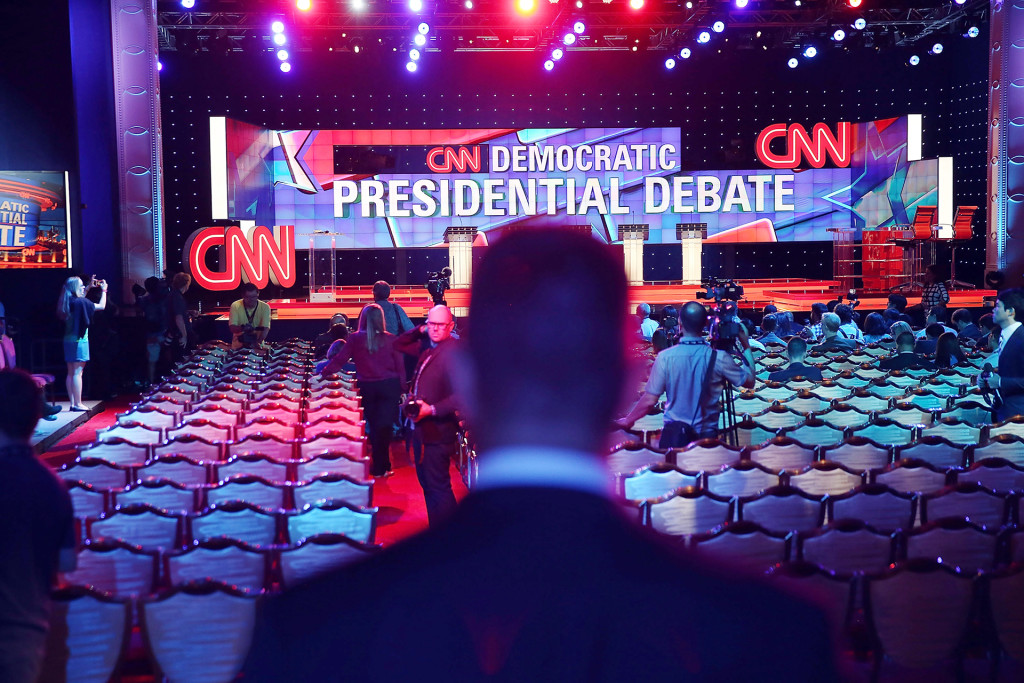 Last night, CNN aired the first Democratic debate of the 2016 election to millions of TV viewers, and to an indeterminate but undoubtedly much smaller number of virtual-reality headset owners. CNN worked with California company NextVR, which is building a live-broadcast infrastructure for the VR community. Using Oculus’s software and Samsung’s hardware, they brought a real-time broadcast to face-computer-wearing viewers everywhere.
Roller says NextVR is working on ways to integrate graphics, social media, and even broadcasters into the stream. He thinks that when it works right, virtual reality can combine the best of being there with the best of TV, in a single experience.
“Ultimately, we have the ability to have people go to the debate,” he says, “where you’re at your house and I’m at my house, but we’re both watching the debate together from better than a front-row seat. And we’re able to stop it, and start it, and ultimately—hey, did you see someone do that? And then rewind and see it again.”
Forget Twitter—what if we were all there, at the Wynn, together in the audience? Someday, I think, virtual reality will enable that. But there’s a long way to go. The screen resolution, the camera setup, the entire industry’s understanding of how virtual reality is supposed to work when it’s streamed live to everyone’s face-computer. Oh, and one more thing: It needs to not overheat my phone right in the middle of closing arguments.
See the full story here: http://www.wired.com/2015/10/dnc-debate-virtual-reality-gear-vr/
Sony Acquires Belgian 3D Sensor Firm SoftKinetic
 Continuing efforts to focus on its successful image sensor business, Sony announced today that it has completed the acquisition of SoftKinetic Systems for an undisclosed amount. The eight-year-old, Belgium-based business develops 3D vision technology for gaming, imaging and other applications.
Among the SoftKinetic technologies Sony is interested is the "time-of-flight" range image sensors, which use light to determine distances to objects. Sony said that it plans to combine that sensor technology with its own to develop "the next generation of range image sensors and solutions," according to a statement released today.
"We will continue to refine the hardware from various aspects, while working alongside third-party developers and publishers and SCE Worldwide Studios, in order to bring content that deliver exciting experiences only made possible with VR," said EVP Masayasu Ito, division president of the PlayStation Product Business and vice president of the Software Design Division, in a statement at that time.
See the full story here: http://www.cio-today.com/article/index.php?story_id=021000OCFVA6
Virtual reality: Microsoft experiments with multi-user technology codenamed Comradre
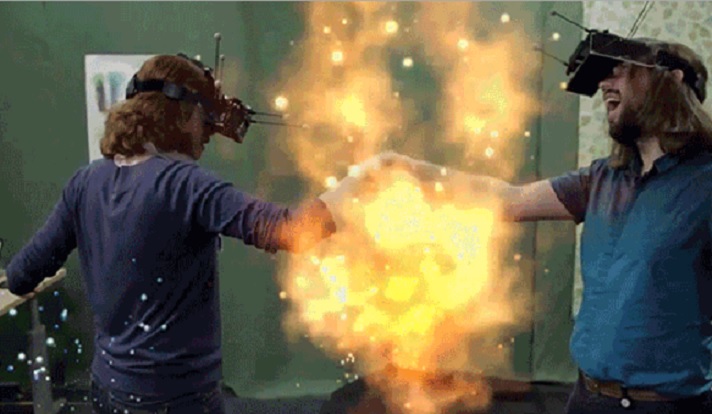 Microsoft is experimenting with multi-person virtual reality that allows people to interact and share virtual worlds with other people for the first time, according to reports. The Comradre project (pronounced "comradery"), led by Jaron Lanier, has already involved several projects in which more than one person experiences and interacts with the same object in virtual reality.
The VR experimentation is not connected to Microsoft's HoloLens holographic computer, Technology Review reports, instead it uses custom headsets made from smartphones and laptop computers. The exact applications that Microsoft plans to use the technology for are not yet clear, though it is expected to find use in gaming and communications.
Within virtual worlds, multiple users would potentially be able to find new and innovative ways to handle and access information, allowing for more immersive collaborative projects. Researchers involved in the project have so far developed a wide-range of applications, ranging from a way to visualise mathematical equations, to a platform for children to play together in virtual reality.
According to the researchers, the main factor currently holding back multi-person virtual reality is the limitations of technology used to track users. "The critical aspect for multi-person virtual reality is that you have to track everybody's movements very accurately in their own scene," said Jeremy Bailson, founding director of Stanford University's Virtual Human Interaction Lab.
With the Comradre devices, external sensors track the wearer's head movements, while the headset monitors the movement of the other user. Microsoft is yet to respond to a request from IBTimes UK for more information about the Comradre project.
See the full story here: http://www.ibtimes.co.uk/virtual-reality-microsoft-experiments-multi-user-technology-codenamed-comradre-1523566
A NEW REPORT SUGGESTS AR WILL BE EVENTUALLY WORTH FOUR TIMES AS MUCH AS VR.
See the full story, with more charts, here: http://www.fastcompany.com/3052209/tech-forecast/vr-and-augmented-reality-will-soon-be-worth-150-billion-here-are-the-major-pla#3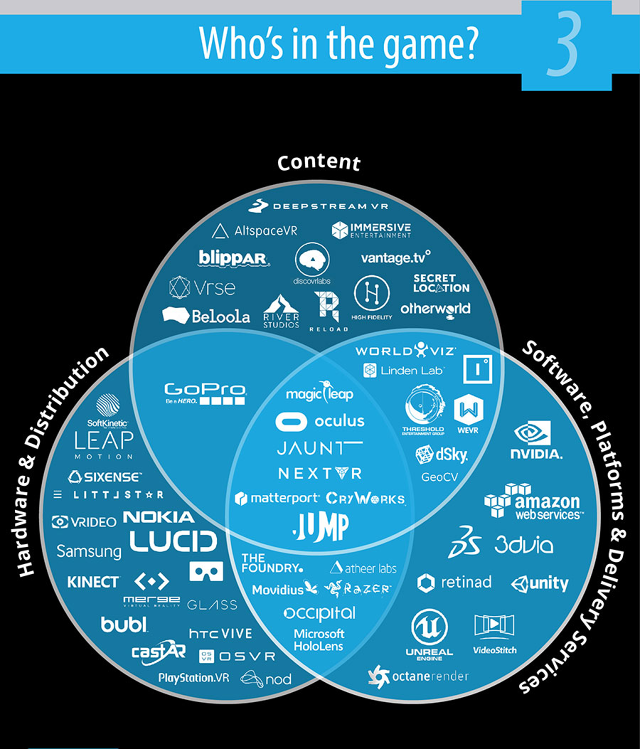
Bringing Google Cardboard and VR to the world
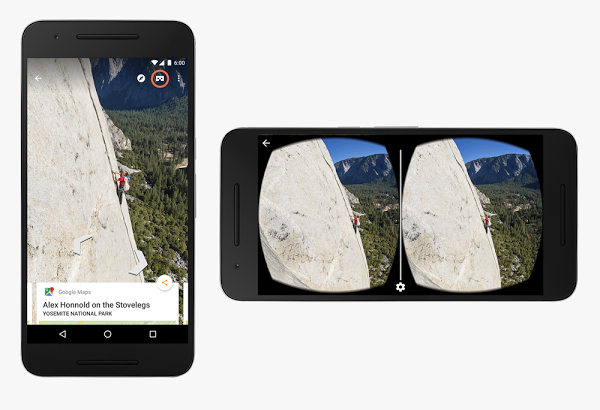 Google Cardboard is bringing virtual reality worldwide. Starting today, the Google Cardboard app is available in 39 languages and over 100 countries on both Android and iOS devices. Additionally, the Cardboard developer docs are now published in 10 languages to help developers build great VR experiences. With more than 15 million installs of Cardboard apps from Google Play, we're excited to bring VR to even more people around the world.
See the full story here; http://googledevelopers.blogspot.com/2015/10/bringing-google-cardboard-and-vr-to.html
Virtual reality mine safety program takes out award for tech startups
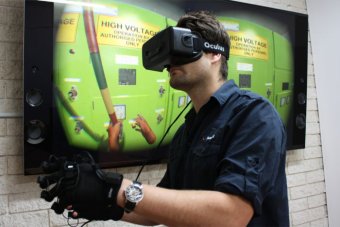 Western Australian - A virtual reality program that delivers mine safety training in 3D has won a national competition for tech startup companies.
Sentient Computing collected $100,000 as the overall winner of the KPMG Energise Accelerator for its MXV program.
The 12 week program helps companies develop so-called disruptive technologies for the mining, oil and gas industries.
Sentient managing director Doug Bester says companies need to cut costs, but not corners, on safety training.
The KPMG Energise Accelerator chose eight startups out of 80 applicants Australia wide, with a particular focus on the energy and natural resources sector.
"In an incubator you might do things like providing space for an organisation to grow, you might provide funding," Mr Smith said.
"The accelerator takes it one step further and actually educates and matures the organisation.
A similar program in Perth in 2014, called 'Unearthed' also attracted startups looking to innovate in the mining, oil and gas sectors.
See the full story here: http://www.abc.net.au/news/2015-10-09/tech-start-ups-in-resources-sector/6836864