The reality of marketing a VR game in a 2D world
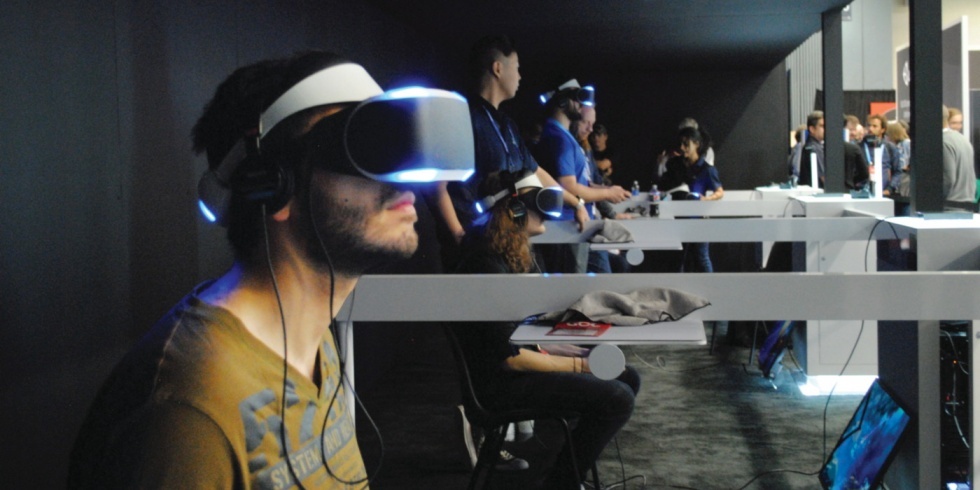 Experiential is obviously the way to go? Well yes, and now that we’re fast approaching launch expect the major headset players to attend the main consumer shows such as EGX or Paris Games Week in a big way, or set up their own hands-on events, such as HTC’s current tour of the Vive in North America. These experiential opportunities will be the key focus for the hardware manufacturers to get headsets on as many heads as possible, and create the evangelists and desire for their product.
However experiential isn’t going to be an available option for everyone, especially your smaller studios.
In reality, once VR has become a part of all our lives and everyone is interacting with content on a daily basis, much of the marketing will be done within the headset where it’ll be at its most effective and where viewers can interact with what you’re selling to them. Technology will have figured out a way to do this cheaply and effectively – as we do now with our 2D assets – and the next thing you know we are all Wade Watts living in a virtual world…
In the meantime: Stick to your 2D trailers, maybe do a bit of picture-in-picture if it works for your product and you have the resource. Otherwise, don’t worry, the VR early adopters will get it and it’ll come down to how good your content looks, not how fancy the marketing is. Then cross your fingers that the first parties do a great job with their experiential events and come this time next year everyone is a virtual reality expert.
VRstudios raises $1.3M, quietly looks to build virtual reality powerhouse in Seattle
 We’ve heard about part of the company before, called VRcade. But there’s more to the story. VRstudios is a larger organization that has three product lines: VRcade, which focuses on video games, VRdesign, which is for architects, and VRsolutions, which offers custom services for VR deployments.
Jamie Kelly and Dave Ruddell, who co-founded VRcade, are listed as VRstudios president and CTO, respectively.
See the full story here: http://www.geekwire.com/2015/vrstudios-raises-1-3m-as-it-quietly-builds-virtual-reality-powerhouse-in-seattle/
Here’s Why Google Should Buy Vuforia From Qualcomm
 As Re/code’s Ina Fried wrote yesterday, Qualcomm is thinking about spinning off or selling its augmented reality platform, Vuforia.
That would be a big deal for the nascent community of software developers making applications for AR, which is expected to grow to a $120 billion market by 2020. In May, Apple bought Vuforia’s biggest competition, Metaio, shutting down the public face of the company and bringing its team in-house. Vuforia now claims to have more than 175,000 developers registered on its platform.
According to several executives working in augmented reality, if Qualcomm is going to sell Vuforia to another company (and not spin it out into an independent entity as it did with Gimbal), the best home for Vuforia would be Google.
Other possible acquirers active in the AR space include Intel, which has a computer vision platform called RealSense; HP, which runs an AR platform slightly smaller than Vuforia called Aurasma; or Microsoft, which is exploring how Windows 10 might support augmented reality — and its close cousin, mixed reality — via the upcoming HoloLens glasses.
That might be Apple, but it’s something Google has proven it can do. In addition, Google has the market clout of Android and the technical expertise of initiatives like Project Tango and Google Glass, the latter of which is said to be getting an overhaul behind closed doors under the leadership of Nest CEO Tony Fadell.
See the full story here: http://recode.net/2015/09/05/heres-why-google-should-buy-vuforia-from-qualcomm/
Marines Explore ‘Augmented Reality’
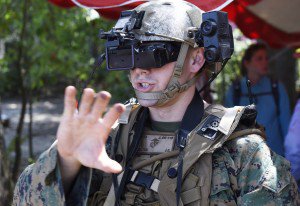 While virtual reality puts the user in a completely computer-generated environment, augmented reality superimposes computer-generated elements — say, a tank, a helicopter, or a building — on the real world. That lets troops go through the actual, physical motions of the skill they’re training for and build muscle memory, without restricting the targets and support units.
The system tested in Quantico, the Augmented Immersive Team Trainer (AITT), is primarily meant to train troops to call in airstrikes and artillery barrages. That’s one of the hardest kinds of training to do live. Real aircraft and artillery batteries are expensive and often unavailable when other units want to train with them. Real bombs, missiles, shells, and targets can be used only once. Augmented reality training replaces all these costly components while keeping the crucial one — the human being — with his boots on the actual ground.
AITT could be used for other training in the future. After four years of development and testing, the service will conduct “a large-scale demonstration [and] assessment” this October. The project will move from the Office of Naval Research to the regular Marine procurement system, which will decide whether to buy augmented reality in bulk.
See the full story here: http://breakingdefense.com/2015/09/marines-explore-augmented-reality-training/
4DX 4D Movie Theater Planned In Chicago
 Since debuting in 2010, 4DX now operates in 187 theaters in 34 countries including Brazil, China, Korea, Russia, UAE and the UK. It was launched in the U.S. at Los Angeles' AEG-owned Regal Cinemas L.A. LIVE Stadium 14 in June 2014. During its first year, the 104-seat 4DX auditorium generated $1.7 million in revenue. As previously announced, two Manhattan locations are slated to open later this year, at Regal Union Square Stadium 14 and Regal E-Walk 13.
See the full story here: http://www.hollywoodreporter.com/behind-screen/4dx-4d-movie-theater-planned-819349
Bringing Beethoven to the Masses with Virtual Reality
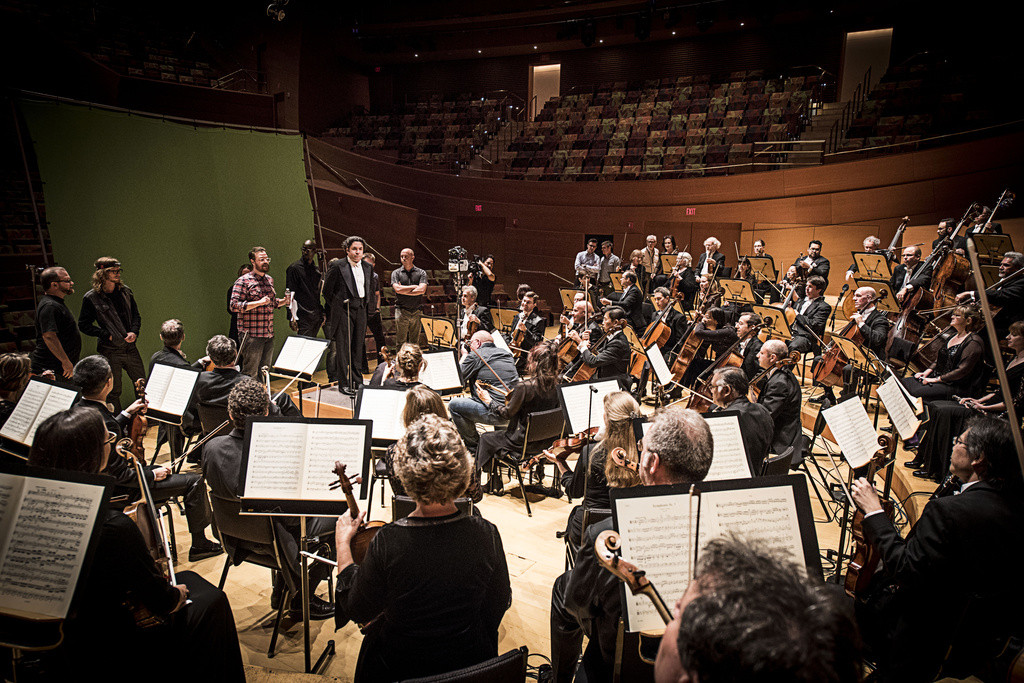 LA Philharmonic is launching a mobile virtual reality orchestral experience tour utilizing the Oculus Rift in select locations around Los Angeles.
The entire VR experience on wheels is being dubbed the VAN Beethoven(because a van/truck) and will run from September 11th to October 18th.
The VAN Beethoven customized truck will give visitors an opportunity to experience the first minutes of Beethoven’s timeless Symphony No. 5, led by Gustavo Dudamel at Walt Disney Concert Hall, in an immersive 360-degree environment.
Visitors will climb aboard the VAN Beethoven truck, complete with carpet and seating from Walt Disney Concert Hall, and put on an Oculus Rift headset connected to the Orchestra VR virtual reality app. Shot with binaural audio capture, users will get the full augmented soundtrack that adapts to the viewer’s perspective.
The VAN Beethoven experience will be available as a free app called Orchestra VR in the Oculus and Samsung Gear VR app stores starting this September.
See the full story here: http://vrscout.com/projects/beethoven-virtual-reality/