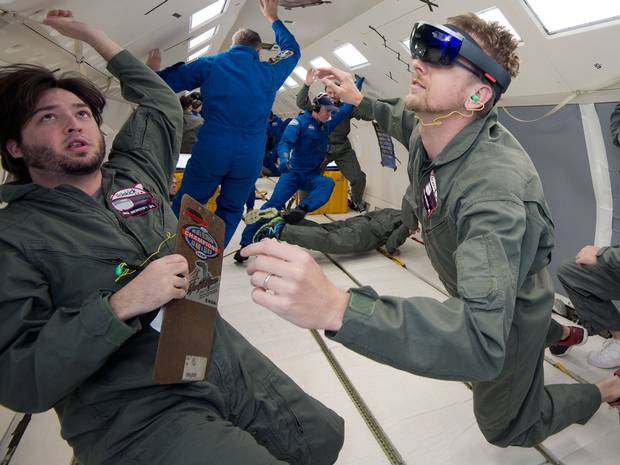
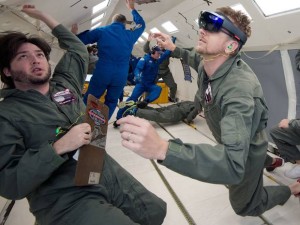
 The headsets will be used in two modes: Remote Expert Mode and Procedure Mode. Remote Expert Mode uses Skype to let ground operators see through the eyes of an astronaut, letting them give instructions and even draw on the augmented reality world that the crew member is seeing. Procedure Mode puts special illustrations on top of objects in the space station, potentially reducing the amount of training needed and helping out astronauts on long missions deep into space where they might not be able to talk to ground control.
See the full story here: http://www.independent.co.uk/life-style/gadgets-and-tech/news/nasa-astronauts-to-take-microsofts-hololens-augmented-reality-headset-to-space-10347554.html
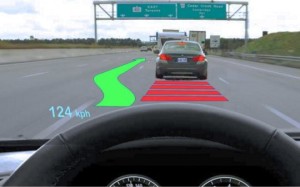 [Philip Lelyveld Comment: while the story title is accurate, another way to think of it is that the study gives guidance to heads-up display UI design.]
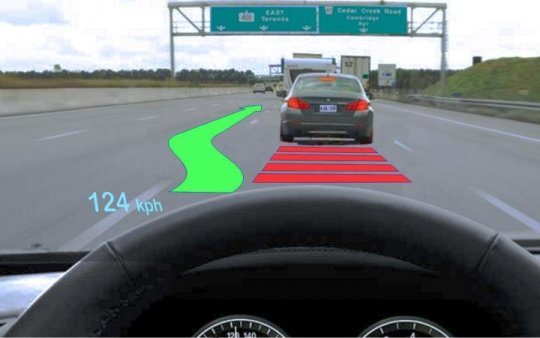
When the number of spots increased, the rate climbed to one in 10 instances, suggesting that if attention is increasingly occupied by the primary task, participants will have more difficulty attending to the secondary task stimulus. The accuracy of the number of spots reported also diminished as the number of spots increased, suggesting that as a primary task becomes more demanding both tasks compete with and interfere with each other.
In a real-life situation -- such as driving a vehicle -- even more is demanded of a driver. It is not enough to simply see something unexpected, one must identify what is seen and respond appropriately.
"It would be necessary to distinguish, for example, between warnings of a collision and a recommendation to make a turn," said Spence. "Otherwise competing warnings may be more dangerous than no warning at all."
See the full story here: http://www.pddnet.com/news/2015/06/digital-messages-vehicle-windshields-make-driving-less-safe
 Matterport has raised $30 million in growth funding from Qualcomm and Singapore’s GIC to expand its virtual reality and augmented reality content creation platform.
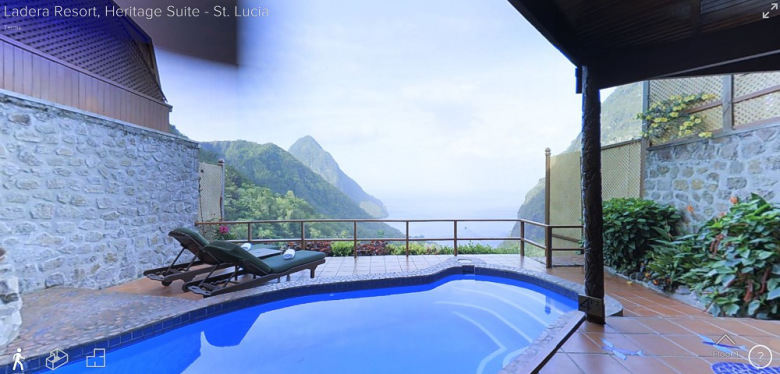
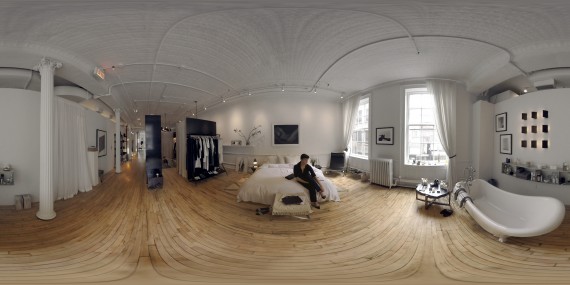
Mountain View, Calif.-based Matterport makes a $4,500 Pro Camera that can capture an environment in 360 degrees. It also makes the cloud software to stitch the content into a virtual reality or augmented reality experience. The target market has been realtors looking to show off homes for sale in 3D.
Matterport began selling the application platform for realtors in July 2014. So far, Brown said that the company has sold thousands of VR cameras to real estate agents, and those videos are getting about 1.2 million unique views per month. Most of the major brokerage companies are customers.
Over time, Brown hopes to reduce the cost of content creation and eventually enable consumers with 3D-sensor-enabled smartphones to record and publish their own virtual reality visual experiences. A consumer could, for instance, create a virtual tour of their own home.
Matterport has raised $56 million to date, and it now has more than 80 employees.
See the full story here: http://venturebeat.com/2015/06/25/matterport-raises-30m-for-virtual-reality-real-estate-tours-and-more/
See the full story here: http://www.iol.co.za/scitech/technology/gaming/a-brief-history-of-virtual-reality-1.1875647#.VYrrmmBiBrg
Virtual reality 1935
Like many great technological advances, virtual reality was envisaged in science fiction long before it became fact. In Pygmalion's Spectacles, a 1935 short story by Stanley Grauman Weinbaum, a strange man in Central Park, New York, invites the protagonist to use a pair of VR glasses to travel to the utopian world of Paracosma.
1962
Mort Heilig, a US film-maker, unveiled Sensorama, an arcade system with a vibrating seat, 3D display and even a scent nozzle. Viewers sitting in a giant cupboard could “ride” a motorbike through New York, sensing wind, bumps and smells. But high costs meant that the first true VR experience remained a novelty and died.
1968
Ivan Sutherland created a head-mounted computer using early elements of virtual reality and augmented reality (the overlaying of virtual elements over a real-world view). But the graphics were still rudimentary, and the device was so heavy that it had to be suspended from a ceiling while the user wore it. Meanwhile, at an air base in Ohio, military engineer Thomas Furness was starting work on new flight simulators that would later use VR.
1977
Scientists at Massachusetts Institute of Technology drove around Aspen, Colorado, with cameras on a car roof, photographing every inch of the city. Decades before Google Street View, they stitched the images together to create a digital recreation of every street, which the viewer could navigate by computer. Financed with Pentagon money, it was supposed to give armies a way to remotely familiarise themselves with new terrain.
1985
Jaron Lanier set about popularising VR devices with his company, VPL Research. His “Data Glove” paired with a set of “Eye Phones” allowed users to explore and manipulate crudely-drawn worlds. Toy company Mattel bought into it, but VPL was never more than a novelty.
1990
Devices including “Virtuality” launched a VR boom as developers made immersive games to be played on heavy headsets. Sega introduced VR arcade games to its consoles, but the graphics did not match the hardware and VR retreated to industrial uses and functional applications.– Independent
 Searching for Hell, directed by Pawel Nazaruk &Tomasz Adamski, Darek Barecki, Yuki Nakamura, Gloria Kurnik and James Kenney has become the first long documentary film screened and distributed in Virtual Reality Cinema.
The project is penned by Pawel Nazaruk who elaborated the original concept and is the executive producer. Searching for Hell is a production of Poland’s Filmmakers Pond / Dogfilm Studio. The film tries to understand what Hell is today in different parts of the world (Russia, USA, Japan, Indonesia and Congo) through five different stories made by five different teams.
The film is now available worldwide exclusively in Virtual Reality Cinema CINEVEO until 1 October 2015.
See the full story here: http://www.filmneweurope.com/news/poland-news/item/110754-searching-for-hell-world-s-first-long-documentary-screened-in-virtual-reality-cinema
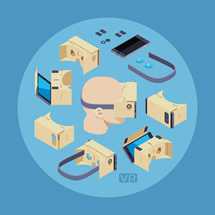 The Mathson students are just completing their first year learning with the zSpace STEM lab, which includes a set of student virtual reality stations and a teacher station, each outfitted with an interactive stylus as well as a wide variety of educational software ranging from science and physics to engineering. Virtual-holographic images can be “lifted” from the screen and manipulated with the stylus.
The impact of zSpace for students and teachers is exciting, particularly because many students using the system have special needs, and have experienced frustration learning in the traditional way.
With two or three students at each virtual reality desktop, students collaborate in teams and use critical thinking skills to solve complex challenges.
They can perform highly engaging tasks that are often impossible in the real world, like exploring a volcano or experimenting with zero gravity.
See the full story here: http://www.eschoolnews.com/2015/06/24/san-jose-virtual-093/
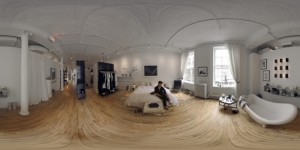 For this experience, SapientNitro enlisted WEVR to create the technology and shoot all the 360 video. Our technology and creative allows the Apartment to come to life in a way that was true to the design and the feel of the brand while making it perfectly fit for the VR medium. We have gaze based, animated, and customizable “story triggers” as part of the system we built from the ground up that renders content in high definition. Real-time, positional audio is triggered by our interactive gaze technology. We also engineered in functionality that allows for state based interactions that are used to fulfill the project’s objective as being a prototype for the future of shopping in VR.
See the full story here: http://wevr.com/in-cannes-wevr-releases-an-early-prototype-of-their-interactive-virtual-reality-video-technology-with-sapientnitro-474
March 19, 2013
Awarded to Apple today by the U.S. Patent and Trademark Office, a patent dubbed "Synchronized, interactive augmented reality displays for multifunction devices" highlights an augmented-reality system that would capture a live video feed of a real object to display on a portable device. The technology would then overlay information about that object on the device.
In one example cited in the patent, a user could point the camera of a portable device at a computer circuit board. The live video feed would display images of the board overlaid with annotations describing its various parts. Those annotations could include information from a local or network database, an online library, or a Web site.
The AR display would be interactive. You could create your own annotations by writing or drawing them on your portable device. You could even share those annotations with other people as a virtual way of collaborating on the same information.
A touch-sensitive phone or tablet would come into play if you wanted to create your own annotations for the object being viewed.
See the full story here: http://www.cnet.com/news/apple-patents-augmented-reality-system/
See the patent here: http://patft.uspto.gov/netacgi/nph-Parser?Sect1=PTO2&Sect2=HITOFF&u=%2Fnetahtml%2FPTO%2Fsearch-adv.htm&r=39&p=1&f=G&l=50&d=PTXT&S1=%28apple.ASNM.+AND+20130319.PD.%29&OS=an/apple+and+isd/3/19/2013&RS=%28AN/apple+AND+ISD/20130319%29%22
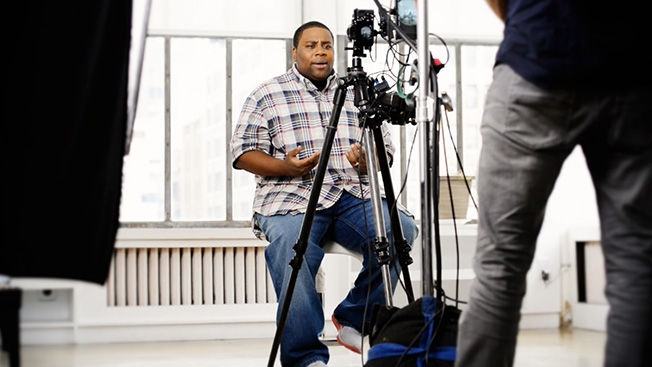
 [Phil Lelyveld comment; People have stated that comedy wouldn’t work in VR because comedy depends on timing and you can’t count on a VR end-user looking in the right place at the right time. As with so many other things in VR, once people actually try to do it - versus talking about it - the language for VR comedy will emerge.]
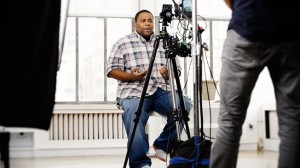
Thompson discusses virtual reality and explains how it works, snapping his fingers to make characters appear and disappear at will. Turn around, however, and there's Thompson playing the film's pretentious and increasingly frustrated director, along with his camera crew.
Looking up, down or anywhere around makes viewers feel like they're quite literally in the center of the action. It can be disconcerting but also quite amusing.
All of CBS Interactive's 25 brands, including TV.com and Last.fm, "are ripe for virtual reality experiences," said Christy Tanner, svp and gm of CBS Interactive Media Group, suggesting cooking demos on Chowhound and set visits on TVGuide.com as possibilities.
To that end, Studio 61, CBS Interactive's branded content studio launched earlier this year, partnered with the Uprising Creative production company, which suggested a comedy short.
"This short is trying to be a showcase for how to do comedy in VR. The Uprising Creative really felt that comedy was an underserved area, if it's served at all, and this was an opportunity for us to pioneer what's funny in VR," she said. "We know what's scary in VR, what's cool, what takes you to the scene of a news event, but I don't think it has been widely explored what's funny in it."
The virtual reality presentation will be followed by a panel including Thompson, Uprising Creative's Jeff Nicholas and Jonathan Craven, Kendell Ostrow of UTA (which packaged the short), and Anthony Batt from virtual-reality firm WEVR (which handled the film's technology and editing).
See the full story here: http://www.adweek.com/news/technology/cbs-interactive-debuts-virtual-reality-comedy-short-cannes-lions-165504
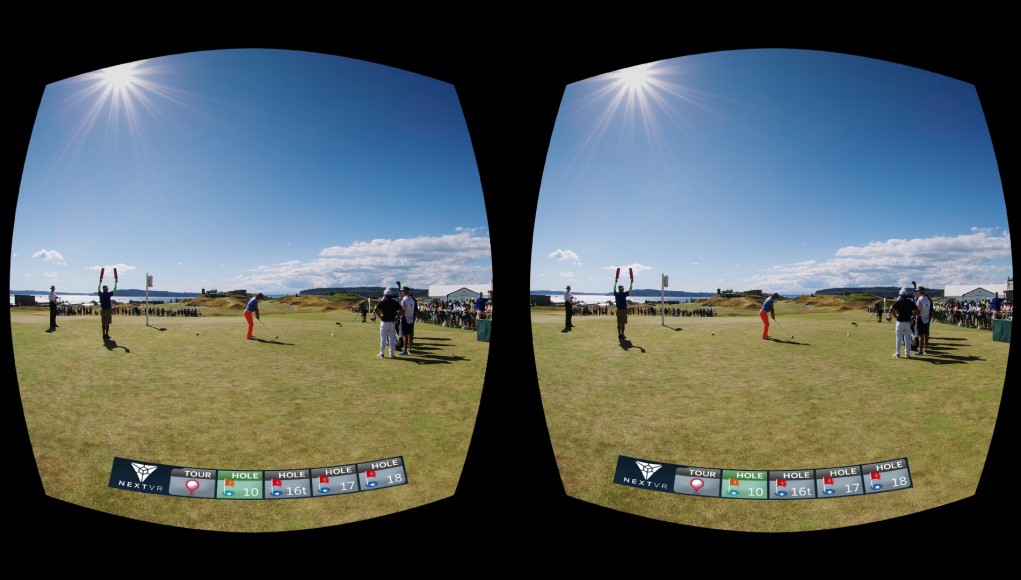
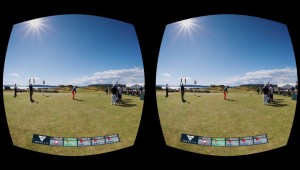 NextVR’s live broadcast of the U.S. Open is second only to being there yourself. The cameras are closer to the action than the audience at the course itself.
The company is also pulling HUD elements into the broadcast. Down below the horizon is an indicator showing which hole/camera you’re viewing. Some of the feeds also have picture-in-picture cameras and leaderboards.
The stereoscopic capture is important to VR video and NextVR is doing it as well as anyone else to my eyes, but it isn’t yet perfected. The company recently introduced a light field component to enhance their stereoscopic reconstruction.
NextVR’s portal, which the company says will be available on all virtual reality devices (Oculus, Samsung, Sony and others), will host U.S. Open 2015 highlights and other immersive video events. The company maintains that current home and mobile Internet connections will be sufficient to livestream their selection of premium VR content.
See the full story here: http://www.roadtovr.com/nextvr-livestreams-us-open-golf-tournament-vr-app-coming-vr-devices/