Mediamation VR4D 2-seater experience
 In concert with the 4D theater presentation, MediaMation unveiled what they dubbed in a tag line - 'VR4D' "The Ultimate Immersive and Interactive Entertainment Experience." Introducing a demonstrational prototype created in partnership with developer RUST LLC, the twin seat 'EFX' system harnessed two Oculus VR Rift DK2 (Development Kit 2) head-mounted displays (HMD) - enabling players to take part in a sweeping space-based travel game. This configuration allowed players to use their head positioning to spot and collect virtual "gems." The aforementioned technology was promoted in MMI marketing messaging as "game-changing," and was linked to future projects using immersive pods, thus adding interactivity and immersion to their 4D and 5D experiences.
See the full story here: http://www.mediamation.com/pdf/MMIStingerReportcoverageJan2015.pdf
Industrial Light & Magic wants to bring virtual reality to the movies
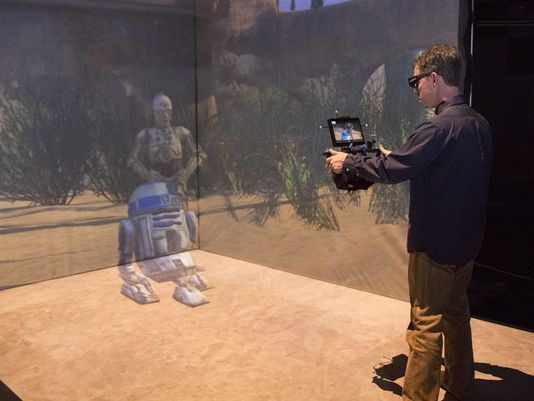 ILM's Experience Lab, or ILMxLab, will combine the technical assets of ILM, Skywalker Sound and Lucasfilm to create immersive experiences that allow fans to participate in their favorite movie worlds.
Although video games pegged to movies have promised a similar experience, this new tech will be different: non-competitive and using photo-realism rather than animation.
The division's debut products will be Star Wars-based and debut later this year. The company is also working with other filmmakers to bring their projects into the virtual space. Disney, which bought Lucasfilm in 2013 for $3 billion, may use the resulting assets for everything from marketing to theme park attractions.
Enter ILMxLab, which is testing a variety of iPad- and Oculus Rift-based technology that allows movie aficionados to enter specific scenes of a movie and navigate through them at will. ILMxLab executives say the tech is most likely to make its debut in association with J.J. Abrams' Star Wars: The Force Awakens in December.
"What we're aiming for is to open the two-dimensional world of the movies and allow fans to walk into those worlds with the same visual fidelity," says John Gaeta, ILMxLab's creative director.
In an exclusive demo for USA TODAY, Gaeta fired up a Star Wars-inspired scene where R2D2 and C-3PO are hiding from Storm Troopers in a dusty village. Instead of just watching the scene on a screen, a visitor holding an iPad can turn 360-degrees and see all around the main characters' world.
The difference between a video game and ILMxLab's world are immediately apparent. Rather than the goal being beating a rival, the end game is to put the viewer inside the movie in order to explore story lines perhaps not pursued by the director in the feature film itself.
"Apple, Google, Intel, they all have moonshot projects around AR and VR, but they're still just figuring it out," Gaeta says. "Our standards for world-building are very high, and we intend to use our technology to give people experiences that they haven't yet dreamed of."
See the full story here: http://www.usatoday.com/story/tech/2015/06/12/ilm-creates-xlab-for-bring-virtual-reality-to-movie-experience/71064884/
Occipital wants to interrupt virtual-reality scenes with what’s coming at you in real life to prevent surprises and spills
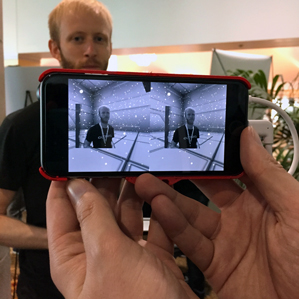
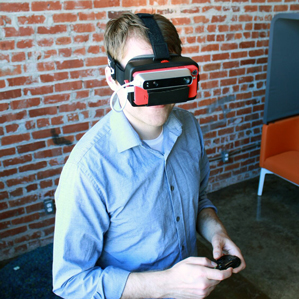 Occipital’s sensor works by projecting a laser pattern onto your immediate environment. Its infrared camera picks up that pattern and uses it to measure the distance to objects in the scene so that software can rebuild those objects in three dimensions. To add bits of the real world to a virtual one, Occipital takes video captured by the regular camera on the iPad (or, in a demonstration I saw using a different kind of sensor mount, an iPhone) and measures its depth; when an object in the real world—say a trash can—comes within a preset distance, the software will basically cut out the image of the can and insert it atop the 3-D virtual scene.
I got a look at what Occipital is trying to do during the Augmented World Expo in Santa Clara, California, this week. Powers placed a Homidoheadset onto my head—basically a generic version of Samsung’s Gear VR headset, which requires a smartphone to show virtual reality apps—into which he had slid an iPhone 6 that was connected to an Occipital 3-D sensor and had a wide-angle lens atop its normal rear camera. The view within Occipital’s virtual world was odd: I was standing within a vast, mostly empty gray room with yellowy dust particles slowly falling all around me, but after walking forward a few feet, the gray expanse was interrupted by a pixelated-looking black railing that appeared in front of me. Unlike the room, the railing was the real thing, marking the edge of the floor we were standing on in the Santa Clara Convention Center.
A moment later, Powers walked in front of me, and when he got within three or four feet, I could see him from head to torso, roughly, through the goggles: pixelated and rendered in black and white, but looking more like an actual human than an animated one. It was strange, but compelling.
Oculus’s Virtual-Reality Headset to Simulate Touch, Gestures
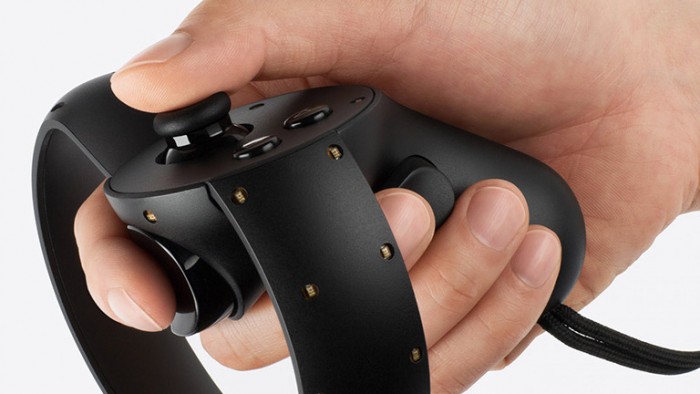
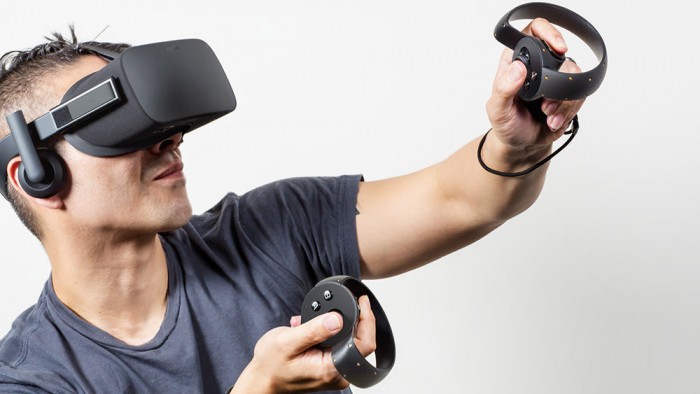 The touch controllers unveiled Thursday by Oculus founder Palmer Luckey are designed to enable people to pick up guns, throw Frisbees or carry out other actions within the fantasy scenes they see through a virtual reality headset called the Rift. The controllers also will make it possible to point, wave inside the video games being played on the Rift, according to Luckey.
The half-moon shaped controllers, called Oculus Touch, will be showcased along with the Rift headset next week in Los Angeles at the Electronic Entertainment Expo, or E3, a major video game conference.
It's a lightweight device that will fit on top of a person's head like a helmet.
The Rift's price hasn't been announced yet, although Oculus has previously said the headset and a personal computer need to power the technology will cost less than $1,500. The Rift package will also include a wireless controller and adapter for the new alliance with Microsoft, which is branching into another emerging niche of technology niche known as "augmented" reality with its own HoloLens headset.
The Rift's initial target market will be avid video game players.
See the full story here: http://www.inc.com/associated-press/oculus-virtual-reality-headset-to-simulate-touch-gestures.html
New VR Theme Parks from Landmark Entertainment Group to “Fuse Art, Culture, and Retail with Virtual Reality”
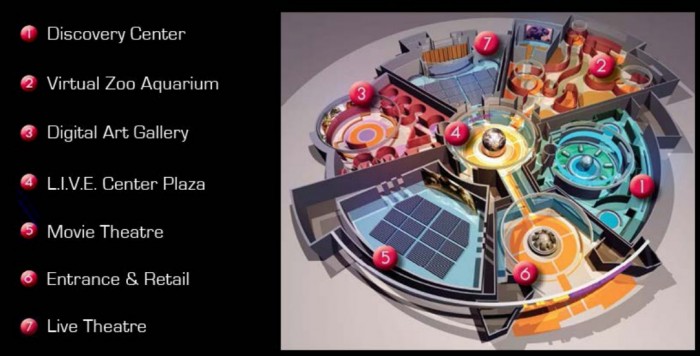 Landmark’s so called L.I.V.E. Center (Landmark Interactive Virtual Experience) is going to offer park-goers a “mixed reality entertainment destination,” that promises to “fuse art, culture and retail with virtual reality, augmented reality and themed architecture and design.”
The first Center, which plans to break ground in China in the next 12-18 months with the help of a Chinese investor group, will include an interactive museum, a virtual zoo, a virtual aquarium, a digital art gallery, a live entertainment stage, an immersive movie theater, and themed experience retail spaces. There’s no word yet on what specific headsets or systems they have in mind for these VR/AR spaces.
...the center represents a large step not only for the Chinese market into virtual reality spaces, but for out-of-home VR locations in general like newly planned out-of-home park, The Void, currently in development just outside Salt Lake City in Pleasant Grove, Utah.
See the full story here: http://www.roadtovr.com/vr-theme-park-landmark-entertainment-group-to-fuse-art-culture-and-retail-with-virtual-reality/
Augmented reality nail art
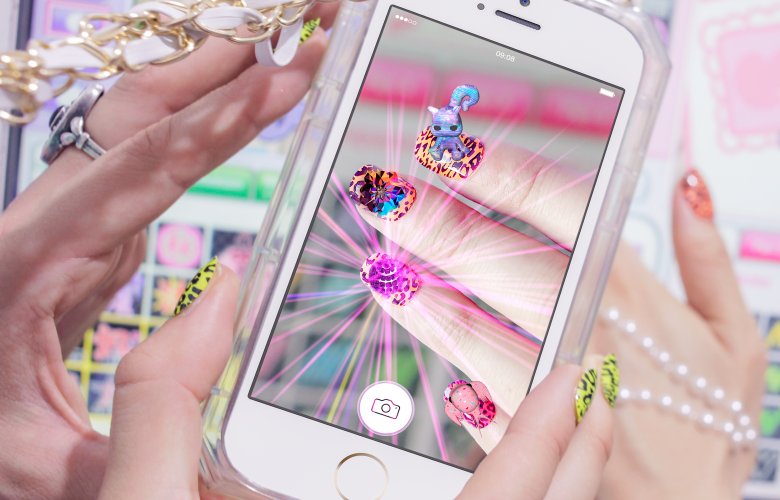 The project is an initiative of Metaverse Makeovers, a start-up comprising artists, technologists and engineers based in Melbourne, Shanghai and Hong Kong.
Thea Baumann, Metaverse’s founder and chief executive officer, says its ethos is “collaborative and female-led”. “We’re artists as engineers, which gives us a different way to bring our technology directly into the hands of young women,” she says.
Metaverse Nails’ dizzying synthesis of artifice and reality is what makes the app so addictive. Baumann admits the project is probably a little too sparkly for the mainstream Australian market, so the company is instead conducting on-the-ground research for entry into the lucrative Chinese market, where the popularity of nail bars may make it more of a natural fit.
...the company has already received $750,000 from venture capital group Melbourne Angels, as well as funding from Queensland University of Technology’s Creative Enterprise Fund and a number of investors in China.
Salvador Dali is widely acknowledged as one of the first artists to explore holography as an artistic medium in 1973, when he depicted a rotating, three-dimensional image of a bejewelled Alice Cooper cradling a miniature statue of the Venus de Milo while a plaster sculpture of Cooper’s brain, adorned with an eclair crawling with live ants, loomed in the background.
See the full story here: http://www.thesaturdaypaper.com.au/2015/06/06/augmented-reality-nail-art/14335128001958#.VXHo4GBiBrg