[Philip Lelyveld comment: it is only a kickstarter program, but the feature set it interesting.]
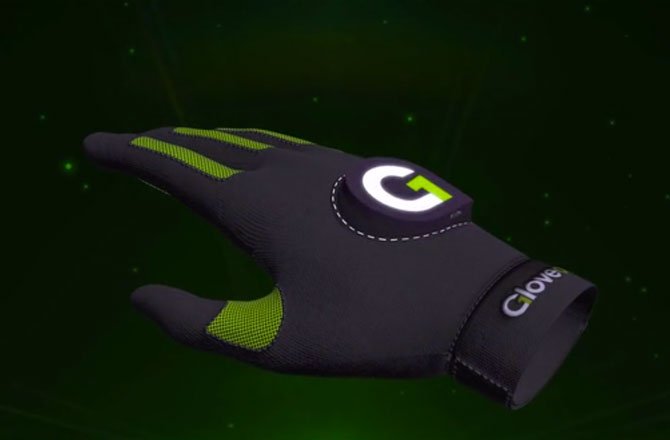
The gloves also include a 9-Axis inertial measurement unity (IMU) sensor, which can be placed beneath the gloves. An IMU sensor, often used to maneuver satellites or other aircraft, can record velocity, orientation and gravitational forces using accelerometers, gyroscopes and magnetometers.
In the Glovone, the IMU sensor will tracking your hands within the virtual world to offer a more realistic experience. However, right now the gloves do not offer movement resistance.
On the Kickstarter page, the company describes the sensation of wearing these gloves as a “realistic perceptual illusion,” meaning that you can’t feel the weight of a virtual object the same as it is in real life, but you can compare weights within the virtual world.
The gloves, which people can buy fitted in three sizes. Each "antibacterial, sweat-proof" pair features a Bluetooth wireless connection, and should offer more than 4 hours of battery life.
Sketchfab, a platform for publishing, discovering, and sharing three-dimensional renderings of objects...
"Every big brand in tech is figuring out how to get into this area," says Denoyel. "We are ideally positioned for this, because we have been working on optimizing 3D files so you can embed them anywhere." The company’s big vision is to enable seamless sharing across VR, AR, and the web, a bridge between today's computing and the platforms of the future.
Sketchfab has pivoted not just its focus, but its business model as well. "We’ve pretty recently shifted to be a content platform, not a tool. Originally it was going to be a software as a service business where we charged users to upload files. But as we grew, it became clear there was more value in helping to distribute this content than charging people to host it." The company removed the barriers to upload and no longer charges for storage, except on its pro version for private files. "We have doctors using Sketchfab to share scans of teeth and stuff like that, they want to keep confidential, and we can monetize a little."
Microsoft imagines people will sculpt and shape objects and then share them with fellow designers.
In the last few months, big name brands like HTC and Activision Blizzard have begun using Sketchfab to share 3D models of their new phones and game characters on Facebook. In the future, AR is expected to be a hotbed for commerce, with people browsing through holographic items in their own living room instead of heading for the mall.
Sketchfab has a big dream, this technology that can bridge the gap between the web we use today and the various realities that are in the near future. "It’s not going to be as easy as they make it sound," says Taussig. "But the long-term vision makes a lot of sense."
Icarus, a virtual reality-enabled workout station created by German design firm HYVE to work seamlessly with a VR headset, simulating flying, rollercoasters, and deep sea dives all while burning calories and toning muscles.
The simple design works on balance alone, with accelerometers sending your movements within the machine into the virtual world, effectively tricking your brain into beliving the virtual scenarios designed by HYVE's companion animation studio, Lumacode. "When you are doing a steep descent in VR you are also doing it in reality, blood rushes into your head and you are sucked into the virtual environment. This enables people to stay in virtual worlds longer, without getting 'simulator sick.'"
...the next VRLA Expo, this time at the Los Angeles Convention Center and with a target capacity of 3000 people.
The adjustment in scope for the event, which will take place on August 29th, is a reflection of the growing fascination the creative community in Los Angeles has with virtual reality. Last year saw the first developers conference for the Facebook-owned Oculus VR held in Hollywood, which isn't exactly the first community you think of when you think of computer programmers.
The Virtual Reality Foundation capitalized on that event with their own awards ceremony, The Proto Awards, and they are indeed following through with a second edition this September.
...the high percentage (70%) of trades that are done with algorithms, and they occur in a fraction of a second.
"3D graphs that represent stock price over a day or over a few hours, they fundamentally fail in their ability to represent what's actually happening in the market," he said.
The idea behind Visual Order Book is to allow for representation of those split second timescales. "It's really the first time that you can actually see the stock market from the point of view of an algorithm," he said
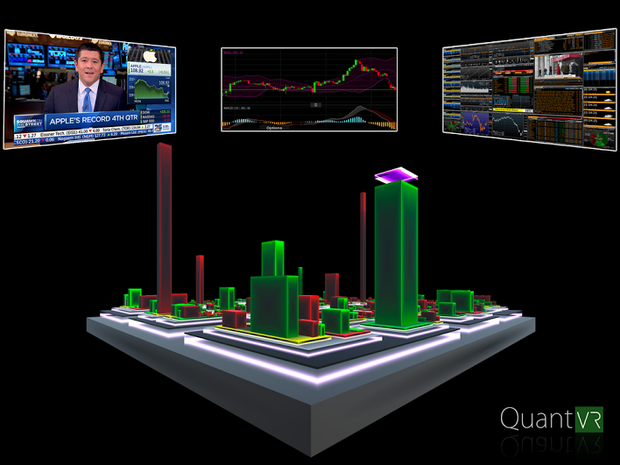
There's also Stockscape. It does two things: Lets users set up multiple screens, and also creates a large, navigable graphic that looks like a city where the 2,000 most highly-traded stocks on the US exchanges are divided by industry sector, subdivided into industry groups, and further subdivided into high performing, mutually performing, and poorly performing stocks. The height of individual stock blocks represent different metrics like market cap, volatility, and price.
Alpha Canvas allows users to enter a trading strategy in the form of a graphical element. Greenbaum said that for traders who want to design an algorithm, but don't know how to code, they can draw a filter that will function like an algorithm.
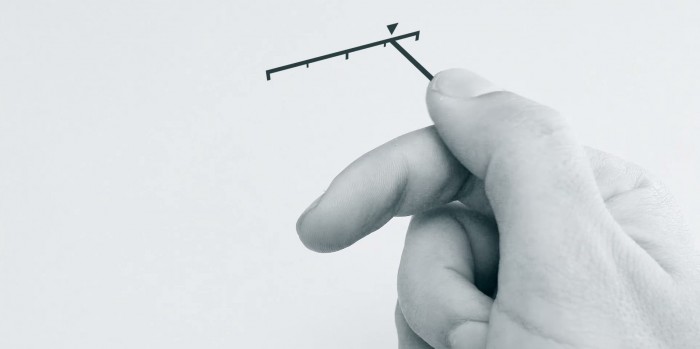
Project Soli uses radar (RAdio Detection And Ranging) to detect micro-movements in your hands and fingers. The pipeline translates reflected signals from you, say, rubbing your index finger and thumb together and recognises that as a gesture or action and redirect that gesture as input to an application.
The technology has thus far been developed to enable the hardware transmitting and receiving these radio waves to fit onto a single chip, embeddable into mobile devices or any other type of hardware.
[this could be used to fine-tune a graphic image, once the broad strokes have been created using other tracking systems.]
Churchill Club Top 10 Tech Trends 2015 Debate
“What new trends will emerge in the next several years with the potential for explosive growth in about five years' time?” Five VCs are chosen by the Churchill Club to submit two Tech Trends, aggregating to a Top 10 list. We then debate the issues on stage and the audience votes in real time.
I have done this for ten years now, and it gets progressively more difficult to come up with two new trends each year that are important, and non-obvious, and likely to come true.
This year, my fellow panelists were Bill Gurley of Benchmark, Jenny Lee of GGV, Rebecca Lynn of Canvas, and Shervin Pishevar of Shepa Ventures.
1. On-Demand Ambient Computing.
On-Demand Ambient Computing driven by AI will usher in a world of invisible computing that will drive efficiencies across many industries. Growth will come from API's/algorithms across mobile platforms; AI will predict human intent and deliver items/information at the speed of human thought. [Shervin Pishevar]
2. Traditional Banks Will Continue Losing Share to Startups while Bitcoin Fades in Relevance.
Financial-services institutions will continue to be disintermediated, and will either act as the back-end infrastructure or co-exist as they do in the Lending Club model. Meanwhile, Bitcoin as a currency and remittance solution will lose steam. [Rebecca Lynn]
3. The Virtual Me.
Advances in hardware and sensors and the adoption of connected devices will create an explosion of personal data in the next 5 years. With increased data processing capabilities and smarter predictive software, all this data will be aggregated into personal digital profiles – the virtual you – which will know even more about you than you do. [Jenny Lee]
4. The Skynet Economy: broadband access for the unconnected billions.
From thousands of satellites orbiting around the poles, and new airborne transponders, the entire Earth will be bathed in broadband, bringing an unprecedented influx of human talent to the global economy. [Steve Jurvetson]
5. The End of the Auto Nation.
For the better part of a century, the United States has designed its cities around the notion of individual car ownership. This has resulted in massive waste, congestion, pollution, long commute times, remarkably underutilized capital assets, and over 30,000 deaths per year. Suburban sprawl reached its ultimate limit, and the trends are all rebounding around a new urbanization. [Bill Gurley]
6. 5th Mode of Transportation.
5th Mode of Transportation will be unlocked in the next 5 years. Technologies like Hyperloop will skip over 19th and 20th century transportation modes and do what wireless mobile communication did to fixed line telecommunications in places like Africa. [Shervin Pishevar]
7. Reemergence of Women in Tech.
In the next 5 years, 50% of computer-science students will be women – surpassing the previous high set in 1984. This means you’ll increasingly see more female technology startup founders and Fortune-500 CEOs. [Rebecca Lynn]
8. The Economy of Me.
By 2020, mobile will bring the next 2 billion people online and make the online economy more powerful than the offline. This shift will breed decentralized business models. Commerce and services will skip the middle man and revolve around the individual consumer. Welcome to the personal economy. [Jenny Lee]
9. Rise of the Robocars: Driven by a Machine [the winning trend].
By 2020 we will no longer debate the inevitability of autonomous electric vehicles when we first experience the convenience and efficiency of urban autonomous driving services. [Steve Jurvetson]
10. The Native Mobile Application Platform Dominates the “Mobile Web”.
Consumers drastically prefer mobile applications to the mobile web because they are WAY better. The majority of incremental Internet users will be exclusively on smartphones. The aging search/browser platform will be stifled as a fertile ground for new innovation. [Bill Gurley]
Following up on our debate about the inevitability of autonomous electric vehicles, the IMF just released a study tabulating the subsidy that fossil fuel companies receive: over $14 billion per day. "The IMF calls the revelation shocking and says the figure is an extremely robust estimate of the true cost of fossil fuels. The $5.3tn subsidy estimated for 2015 is greater than the total health spending of all the world’s governments." — form http://www.theguardian.com/…/fossil-fuel-companies-getting-…
The key is that the 3D Systems ProJet 4500 provides the power 3D Systems is known for instilling in its 3D printers, along with the unique ability to produce flexible and strong parts in full color. Users on all levels can carry complex concepts to the digital phase and then 3D print impressive prototypes for product verification and far, far more.
What Google just announced at its I/O developer conference is a bombshell for the future of the company. For years the search giant has witnessed the chipping away of its core product — search — due to the rise of mobile applications and their siloed-off experiences. Users are engaging more and more with programs that have no attachment and often no requirement for search on the broad web, and as a result Google's position as the owner of our habits, interests, and needs across the internet has looked increasingly at risk.
The company demoed a new feature within its Android OS which allows the Now service (a dashboard of notifications focused on your life and interests) to plug in as a layer that essentially hovers above any app running on your phone or tablet. Activated by the home button, it's always there. This means that you can get contextual search information around almost anything you're doing, provided there is text and data that Google can pull from the app itself. And the best part is that developers won't have to make any changes to their existing software to allow the new service — dubbed Now on Tap — to bring search and context into the user's view.
This is a major move for two reasons. The first is that it really brings Google back to a place of dominance as the glue that holds your digital life together.
But secondly, it starts to show how Google can be an interconnecting layer between the apps themselves — a kind of neutral staging ground between one action and another.
Virtual reality headsets and content will be “the next mega tech theme” and a market worth more than $60 billion in a decade, according to Piper Jaffray Cos.
“The diverse applications of VR in combination with accelerating technological improvements will lead to mainstream adoption over the next 10 years,” Piper Jaffray analysts including Gene Munster and Erinn Murphy wrote in a May report.
Because keyboard and mouse input isn’t optimal for use with VR goggles, there will be a new market for peripheral devices that bring users’ hands and feet into virtual reality, according to Piper Jaffray. Haptic devices that give physical feedback from interactions in virtual space will follow.
Gaming will be the first application, because of a user base that already owns PCs and consoles powerful enough to handle VR content, according to the report. Content will expand to include courtside seats at a basketball game, 360-degree movies and professional applications from hospitals to courtrooms.
 [Philip Lelyveld comment: it is only a kickstarter program, but the feature set it interesting.]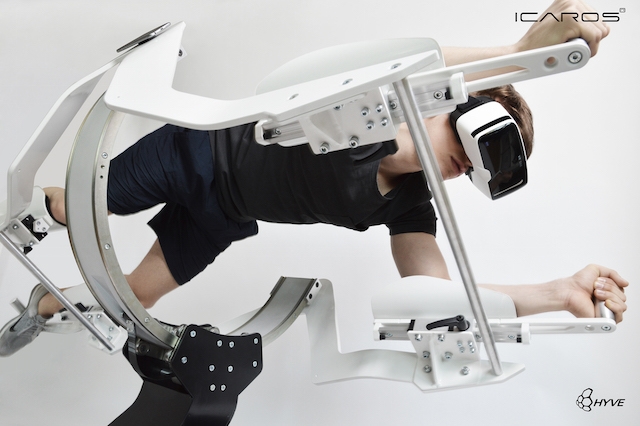
 ...the high percentage (70%) of trades that are done with algorithms, and they occur in a fraction of a second.
 Project Soli uses radar (RAdio Detection And Ranging) to detect micro-movements in your hands and fingers. The pipeline translates reflected signals from you, say, rubbing your index finger and thumb together and recognises that as a gesture or action and redirect that gesture as input to an application.
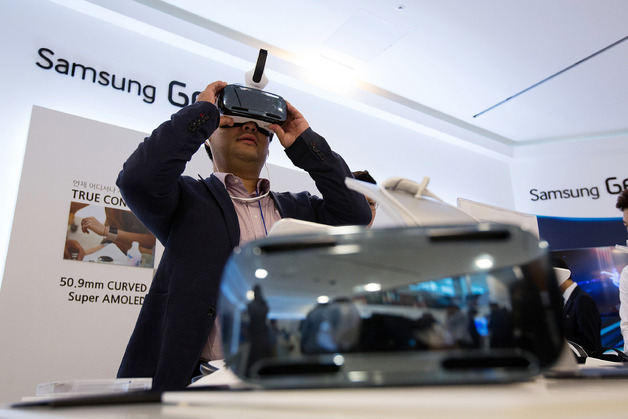 Virtual reality headsets and content will be “the next mega tech theme” and a market worth more than $60 billion in a decade, according to Piper Jaffray Cos.