Nimble Sense Nears End of Kickstarter Campaign, Reaches First $120,000 Stretch Goal
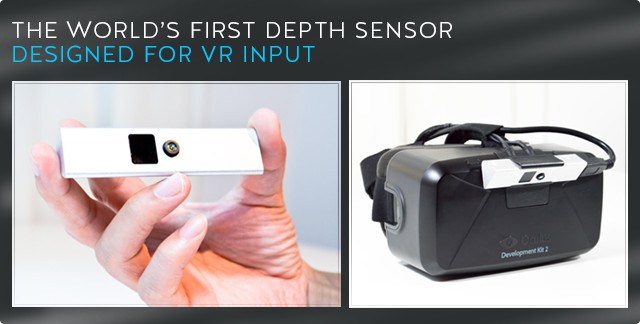 Nimble Sense, the hand tracking controller designed to work with head mounted displays, has surpassed its first stretch goal of $120,000,...
Now that the Kickstarter campaign has eked past its stretch goal, Nimble VR is expanding the device’s functionality (without overclocking it) and opening up the camera’s settings up to make it “a hacker/developer/computer vision-friendly camera.”
To keep within a nominal operating levels however (i.e. not lighting your head on fire) they’ve opted to keep the same power settings. To accommodate this limiting factor, they’re exchanging a lower frame-rate for a longer camera exposure time which will effectively give the device a longer viewing range. The team plans on supporting three specific ranges; 2.3ft/70cm, 3.25ft/100cm, and 4.92ft/150cm — most likely pushing the little USB device’s capability to the very edge of usability.
See the full story here: http://www.roadtovr.com/nimble-sense-nears-end-kickstarter-campaign-reaches-first-120000-stretch-goal/
“Nanobuds” Could Turn Almost Any Surface Into a Touch Sensor
 Touch screens are usually made by overlaying a display screen with a transparent sheet of indium tin oxide. This material is brittle, however, and can’t be used on anything other than a flat surface.
Carbon nanobuds are better because the ball-like appendages are particularly good at emitting electrons, which improves those electrical connections.
Canatu has 40 prototype products in the works. It recently built its first full-scale manufacturing equipment, which can produce enough film to cover hundreds of thousands of smartphone touch screens every month. Next year the company plans to install enough machines to supply millions of smartphones.
The material isn’t a good fit for all applications, though. The conductivity isn’t high enough for very large screens, for example.
Inside Look at 3DRudder, Feet-Controlled Navigation Device Headed to CES 2015
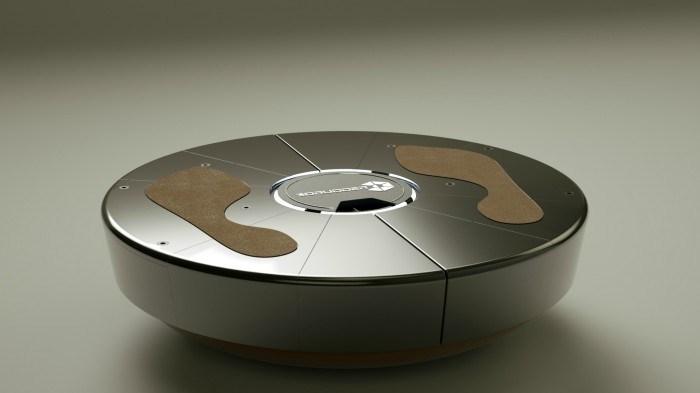
And although it’s intended to be used while seated, the fairly compact USB device introduces a novel way of navigating 3D environments that could help bridge the divide between passive gaming and the ultimate ideal of full-body tracking in VR.
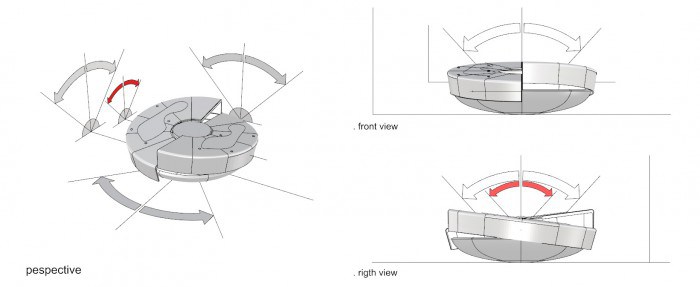
The 3DRudder is meant to entirely replace the mouse/joystick/WASD paradigm, and utilizes its flat top and rounded ‘weeble wobble’ base so the user can position their weight in any direction, allowing for 3D navigation through a virtual environment. Walking is as simple as lightly tilting the weight of both feet in the intended direction of travel: forward for forward and right for right etc.—to run, you just shift your weight a little more. Turning (yawing) is equally as simple, requiring the user to pivot the device, which we’re hoping doesn’t lead to any uncomfortable positions considering many of us sit in wheely office chairs that could negatively impact its usability.
The device also boasts several other degrees of freedom including up/down elevation and pitch (nosing up or down) and is probably where the ‘rudder’ part comes in.
See the full story here: http://www.roadtovr.com/new-feet-controlled-navigation-motion-controller-heading-ces-2015-3drudder-device-preview/
See it, touch it, feel it: Team develops invisible 3-D haptic shape (w/ Video)
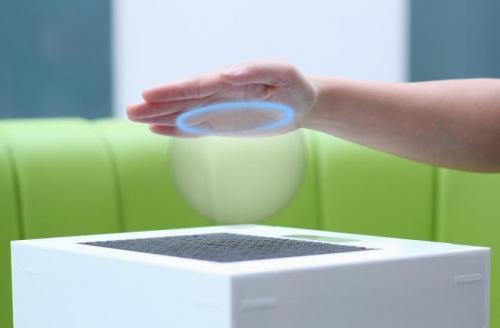 The method uses ultrasound, which is focussed onto hands above the device and that can be felt. By focussing complex patterns of ultrasound, the air disturbances can be seen as floating 3D shapes. Visually, the researchers have demonstrated the ultrasound patterns by directing the device at a thin layer of oil so that the depressions in the surface can be seen as spots when lit by a lamp.
The system generates an invisible 3D shape that can be added to 3D displays to create something that can be seen and felt. The research team have also shown that users can match a picture of a 3D shape to the shape created by the system.
Read more at: http://phys.org/news/2014-12-team-invisible-d-haptic-video.html#jCp
GE Marks $500M Subsea Research Project Launch With VR Experience from Studio Kite & Lightning
 [Philip Lelyveld comment: this is a virtual world simulation like Second Life. I guess the new aspect is the level of detail.]
GE (General Electric) are celebrating the launch of a brand new $500 million facility in Rio, Brazil dedicated to researching the future of ‘subsea factories’ to mine oil and gas. The company decided to commission virtual experience auteurs Kite & Lightning (of Senza Peso and other well-known VR experiences) to build a VR experience to illustrate some of the extreme challenges involved.
They commissioned renowned virtual reality pioneers Kite & Lightning to create an experience which plunges the player to the sea floor at depths of 4 miles in a futuristic submersible. The journey is filled with snatches of information and facts on the kinds of pressures underwater equipment has to withstand at these depths and ideas on how the underwater factories might function in the future.
This is ostensibly an educational ‘on rails’ theme park ride and its subject matter could have potentially erred on the side of dull if handled poorly, but by plunging the the player’s virtual body miles below the sea, it somehow focuses the mind wonderfully. The busy interior of the pod buzzes with snippets of video as augmented reality style heads-up information is overlaid atop the scene beyond the submersible’s glass. It’s all rather effective.
Virtual reality’s innate ability to focus the mind and present information in new and hitherto unimaginably effective ways really shouldn’t be underestimated.
See the full story here: http://www.roadtovr.com/ge-marks-500m-subsea-research-project-launch-kite-lightning-vr-experience/
Comcast NBCUniversal Hosts Hackathon in Hollywood, VR Demos Emerge
Challenges were organized by sponsors that included several large media-related companies interested in what the local development community could put together in a day or so. Corporations like the movie ticketing platform Fandango, the American Spanish television network Telemundo, and the science fiction franchise Battlestar Galactica offered up cash and a variety of goodies for those who had the best ideas. The grand prize was $15,000 and the opportunity to pitch NBCUniversal Media Labs to continue development of the winning prototype.
NBCUniversal provided five Oculus Rift DK2’s which could be used by developers to build their ideas.
Team Rules: Fast Oculus 7

This trivia VR game was developed by a group of University of Southern California students. The idea was to increase engagement with brands of television shows and films from Universal Pictures. The experience put individuals into a virtual room with red psychedelically patterned carpet. Various video clips played on the walls as questions appeared in front of the player which would ask general ‘What would you do if this happened?’ style scenarios. ...
Two female fans produced an amazing ‘second-screen’ experience for the Battlestar Galacticaseries that puts the user inside the futuristic world of the show. ...
During the Q&A part of their presentation, Peter Marx (CIO of the city of Los Angeles, and one of the judges) asked, “what would you do if you had a show that was actually shot to be used in VR?” This got everyone in the room thinking, ...
a developer at the hackathon named Partha created a game where players could drive the actual cars seen in the forthcoming Fast & Furious movie, Furious 7 (2015).
His program was coded in Unity and utilized a couple of vehicles downloaded from the asset store. The goal was create something that could be installed inside movie theaters before the release of the film. ...
The other experience was a virtual reality program that interfaced with a gesture control input system known as Myo. As seen in Battlestar Galactica, futuristic warships are controlled through a central operated command area known at the Combat Information Center (CIC). This faintly-circular room was recreated virtually by the mentors at the hackathon who utilized the interconnected Myo device, which senses electrical pulses being sent through the body when flexing certain muscles in the arm. The armband gadget would be strapped on, along with the Oculus Rift, and could be used activate items within the room. ...
See the full story here: http://www.roadtovr.com/comcast-nbcuniversal-hosts-hackathon-hollywood-vr-demos-emerge/
How Magic Leap Is Secretly Creating a New Alternate Reality
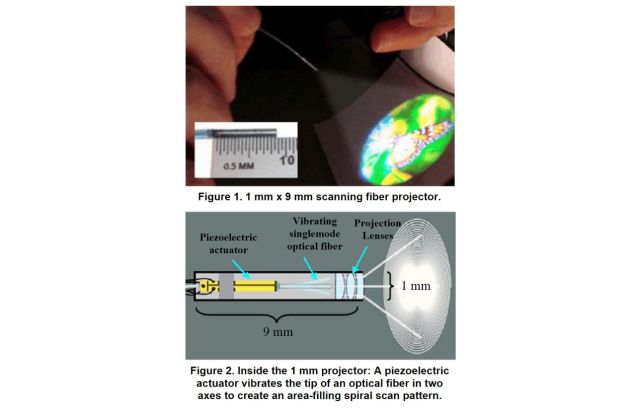 ...if you're already firing light down a vibrating optical fiber in a spiral pattern to form an image, that exact same system can double as a fiber optic projector. And that's where things get interesting.
Seibel's team was working on just such a projector. They even tried it out in some prototype head-mounted displays. They found that it could be way more practical and cheaper than tiny LCD or OLED panels, with the added benefit that you can run the fibers down to a pocket-sized pack instead of wearing them on your head. They theorized that it could even get small enough to fit inside a pair of glasses.
Which is probably why Magic Leap hired Seibel's research partner Brian Schowengerdt. And also probably why Schowengerdt helped Magic Leap win a $150,000 grant from the Department of Defense to create an ultra high-res 4K version of the fiber-scanning display tech. And lastly, it's almost definitely why many of Magic Leap's patent applications are about how to bounce the light from those fibers into your eyes in a convincing way.
Because you need to see the real world, you obviously can't have a projector covering the front of the glasses: that light has to be bounced in from the side, which generally results in a narrow field of view.
And of course, you need some way to track your head and your surroundings so that CG objects appear to occupy a real place in the world, instead of looking like a flat image...
Magic Leap's patent applications cover potential solutions for all these issues. This one explains how the company could use an LCD "occlusion mask" to block light from the real world at exactly the same places as the CG objects, so those objects won't appear ghostly. This one is for a waveguide which can allegedly bounce light across nice big eyeglass-sized lenses, letting you theoretically see those CG animals anywhere in your field of view.
This one, licensed from NASA, is all about letting the software know where you are in the real world with only a pair of externally mounted cameras, and this one is about changing how the CG objects look depending on where they are in your field of view. So if Magic Leap shows you a shark floating in midair, you might be able to walk around it and view it from any angle without the software losing track of you.
This one describes how Magic Leap could use a pair of cameras inside the glasses to track your eyes and figure out where they're focusing, which could help enable the most important thing Magic Leap wants to do: use digital light field technology to make CG objects appear to take up real depth inside the real world.
Using fancy optical hardware like microreflectors or diffraction patterning devices or perhaps deformable membrane mirrors—which Schowengerdt had been successfully experimenting with for some time—Magic Leap apparently believes it can let you focus your eyes on a virtual 3D object the same way they focus on objects in real life. Seemingly, it'll do so by cutting its 3D objects into slices corresponding to the depth of your gaze, and showing the appropriate one based on where your eyes are actually looking.
Last but not least, there's also this patent application for a "tactile glove" which lets you literally rub two fingers together to steer a pair of robots while using the headgear, which could more generally be a way to let you interact with the things Magic Leap lets you see. Among Magic Leap's patent filings, this one is especially intriguing; it admits that the company has actually already built and tested this glove in a research study. Plus, it mentions how the headgear can transition between a see-through augmented reality mode and an opaque one for virtual reality. We could be looking at Google Glass and Oculus Rift competitors in a single device.
See the full story here: http://gizmodo.com/how-magic-leap-is-secretly-creating-a-new-alternate-rea-1660441103?curator=MediaREDEF