[Philip Lelyveld comment: 15 seconds into this video the developer shows how you could effectively integrate VR into the movie-viewing experience. In the Disney 3D movie G-Force, the animators slowly reduced the height of the letterbox in one scene so that when popcorn flew towards the audience it looked like it flew beyond the boundaries of the frame. At 15-25 seconds into the video, this developer shows how flying through stars (or light rays) could extend out of the image to the world around you as a storytelling device. This plays into the Oculus story a few days ago about creating a movie-theatre viewing VR experience for the rift.]
The project fused Leap Motion skeletal hand tracking with Oculus Rift DK2 positional tracking to produce an impressively intuitive VR interface. Now, a new video of the interface shows impressive progress.
World of Comenius seems to be that rarest of projects, one that takes new technology and harnesses it to break ground in areas that may prove beneficial to society in general. It’s the first project of its kind that has demonstrated to me a killer app for Leap Motion in VR and at the same time shows the possibilities for VR outside of traditional games and media consumption.
The two sides in the net neutrality debate sometimes seem to speak two different languages, rooted in two different ways of seeing the Internet. Their contrasting perspectives reflect the fact that the Internet arose in an ad hoc fashion; there is no Internet constitution to cite.
When Tim Wu talked about net neutrality a decade ago, he framed it as a way of ensuring maximum competition on the Internet. But in the current debate, that rationale is in danger of being coöpted into a protectionist defense of the status quo. If there’s anything the Internet’s evolution has taught us, it’s that innovation comes rapidly, and in unexpected ways. We need a net neutrality strategy that prevents the big Internet service providers from abusing their power—but still allows them to optimize the Internet for the next wave of innovation and efficiency.
Slowly but surely, Hollywood is dipping its toes into the VR waters:
• At this summer’s annual International Comic-Con in San Diego, attendees were able to experience an Oculus Rift VR experience for “Sleepy Hallow,” “X-Men: Days of Future Past,” “Pacific Rim” and “Into the Storm.”
• Ahead of and after the early November theatrical release of Christopher Nolan’s ”Interstellar,” Paramount is partnering with IMAX and AMC to show off a “first-of-its-kind” VR experience of the film, using the Oculus Rift Development Kit 2. The experience promises a virtual zero gravity immersion, inside the spacecraft from the film.
• Warner Bros. and DC Entertainment have partnered with visual effects company Otoy to put together a VR experience for “Batman: The Animated Series,” an Emmy-winning series that aired on Fox from 1992-1995. The interactive, holographic experience promises a first-hand tour of the Batcave, and will be geared toward both the Oculus Rift and Samsung Gear VR.
• Brisbane, Calif.-based technology start-up Condition One is set to release the first 100% virtual reality movie, Zero Point, a film shot in 3D, 360-degree video, optimized for the Oculus Rift.
Zero Point creator and director Danfung Dennis (a 2012 Oscar Best Documentary Feature nominee for “Hell and Back Again”) said it’s not a question of if, but when VR takes off. “And when it does emerge, it will be a major platform shift in computing with the potential to fundamentally transform entertainment and communication,” he said.
• Indie animation studio Reel FX — whose original films includes this month’s Fox release “The Book of Life,” has launched a dedicated VR division, Reel FX VR. The new arm will create VR content for platforms including the Samsung Gear VR. The studio was responsible for the “Pacific Rim” VR experience at Comic-Con
• In late August, Palo Alto, Calif.-based tech company Jaunt announced it has secured nearly $28 million in funding for its full-stack hardware and software solution for cinematic VR.
Arnaud Retureau, VP of product for M-Go — the transactional VOD entertainment service co-owned by Technicolor and DreamWorks Animation — told the Media & Entertainment Services Alliance that VR differs from 3D because more can be done with it.
As a puppeteer moves one arm, the other mimics it exactly, with no bounce back, stuttering and an imperceptible delay. The result is accurate, natural motion with impressive precision. That could lead to more convincing movie monsters, animatronic attractions without the usual stiff jitters and perhaps even more life-like fully autonomous robots that are less awkward tointeract with.
What Magic Leap does is not entirely clear yet, but it appears to be a highly realistic form of virtual reality or augmented reality. The company calls it “Cinematic Reality,” with a trademark symbol. The splash screen on its website shows a very photorealistic, tiny, animated elephant moving around in a person’s cupped palms.
[Philip Lelyveld comment: Remember how early TV shows were just transmitted stage/vaudeville shows. Well here we go again. Marshall Mcluhen would be thrilled. ]
For the past two years, developers large and small have been toiling away hoping to create the app that becomes synonymous with VR and helps the technology really take off -- its "killer app," as it's called.
That may have already happened, and it isn't a game, a panoramic photo application or a calming simulation of a beach scene; it's movies. As VR technology begins its march to store shelves, manufacturers like Oculus are recognizing the potential for their immersive technologies to deliver the works of Hollywood.
A study Samsung conducted revealed that many users were comfortable wearing VR goggles for two hours or longer. That research helped convince longtime Samsung video partner M-GO to build a movie app for the Gear VR.
"Here you are in an environment that's even more immersive than 3D was," said Arnaud Retureau, vice president of product for M-GO. "We were a bit concerned initially, and we were thinking about [offering only] trailers or short content."
To do this, the cinema app puts users in the middle of a movie theater -- that perfect middle seat almost no one ever gets in the real world. Look around and you see rows of seats and walls, just like you would inside a movie theater. The movie plays on a simulated screen, with the light bouncing off the seats in the audience, just as it would in the real world.
Users can choose their theater, ranging from a standard one to a simulated home theater to an IMAX-sized screen, which appears large but is actually being simulated on a piece of glass that fits in your palm. There's even a movie theater on the moon, complete with light bouncing off the rocks to your left, or the Apollo lander to your right.
The technology could also go further. Right now, the seats within the theatre are empty, but the people at Oculus imagine an experience where a friend or family member watching the same video even from the other side of the world could digitally sit next to you, giving people an opportunity to experience the social aspect of watching movies as well. Or users could watch the Dreamworks movie "Madagascar," with characters from the movie sitting in the theater, right next to you.
HBO chairman and CEO Richard Plepler made the announcement while addressing an investor meeting for parent company Time Warner. The executive first presented HBO’s domestic returns, then noted there are 10 million broadband-only homes—a number that’s expected to increase.
“That is a large and growing opportunity that should no longer be left untapped,” Plepler said. “It is time to remove all barriers to those who want HBO. So, in 2015, we will launch a stand-alone, over-the-top, HBO service in the United States. We will work with our current partners. And, we will explore models with new partners. All in, there are 80 million homes that do not have HBO and we will use all means at our disposal to go after them.”
Plepler ran down three potential distribution models for the streaming service. The first is to sell the online-only service through HBO’s existing cable providers. (For example, if you have broadband service through Time Warner or Comcast and want the network’s streaming service, you would be able to purchase the online service without having any cable channels.) The second is to distribute the service via new partners like Amazon, Google or Microsoft. The third method would be to attempt the Netflix model, whereby HBO markets its streaming service direct to consumers and skips the middlemen.
The companies participating in Disney Accelerator are:
ChoreMonster - ChoreMonster unites parents and kids with the most ridiculously fun and motivating family framework, so every home is a joyful place. choremonster.com
Codarica - Codarica creates seriously fun games that teach kids to code. codarica.com
Jogg - Jogg is a mobile video platform that changes the direction of how we engage our audience. joggapp.co
Naritiv - Naritiv is a marketing and analytics platform for micro-content, starting with Snapchat. naritiv.com
Sidelines - Sidelines is a people-powered content marketing platform that drives brand influence through discussions by expert fans. sidelinesapp.com
Smart Toy - Smart Toy is a learning toy that talks and listens to kids. Smart Toy can be customized to know your child’s name, teach lessons, and much more.smarttoylabs.com
SnowShoe - SnowShoe creates magic with a touch of plastic. SnowShoe-powered objects unlock digital content through your smartphone. snowshoestamp.com
Sphero - Sphero is the connected play company, fusing digital and physical play by creating toys and robots that you control with a smart device. gosphero.com
Twigtale - Twigtale builds happier families through personalization and expert-fueled storytelling. twigtale.com
TYFFON - TYFFON makes entertaining apps that put you in the center of the fun -- founded by the creators of the ZombieBooth series, with over 30 million downloads. tyffon.com
With the Loupe, researchers suggest, the obvious act of holding it up to your eye, rather than gazing into the distance as you would with a head-up display, makes it easier to signal to someone that you’re using it. This could make people around you more comfortable, since they know whether or not you’re paying attention to them—a common concern with devices like Google Glass.
The device includes a proximity sensor to tell when it’s being held in front of your eye, and a magnetometer, gyroscope, and accelerometer help determine its orientation and measure changes so the display can always appear upright to the user. The current version of the Loupe is also tethered to a computer running Android and an Arduino microcontroller.
The design immediately calls up memories of the first Alien (1979) movie, bright whites and distinctive sculpted walls glide past your eyes in glorious low persistence. Then it hits you; the rooms and corridors on these ships are really small! This is perhaps a statement of dazzling obviousness, but it’s not until you’re put into the ship, completely surrounded by it does it really come home. The power of VR to convey scale is really drawn upon here...
Skipping story spoilers, you eventually end up on the vast space stationSevastopol where the mood shifts sharply and where A:I excellent lighting system starts to become the real monster of the game. The station’s in trouble, broken fiery gas jets, severed electrical cables spitting sparks and, most of all, acres of dark shadows. I mention this last point as here is where the Oculus Rift DK2′s OLED panel and the enclosed nature of the headset becomes absolutely critical – when it’s dark it’s really dark! Another seemingly fatuous statement, but when you wander off the beaten track or the room’s lighting system fails and you’re plunged into blackness, it is truly terrifying even without the presence of anything or anyone nearby. In VR, your human responses are evoked much more readily and being dropped into darkness on a scary distant space station will naturally evoke fear, I just wasn’t quite prepared for how much fear.

 HBO chairman and CEO Richard Plepler made the announcement while addressing an investor meeting for parent company Time Warner. The executive first presented HBO’s domestic returns, then noted there are 10 million broadband-only homes—a number that’s expected to increase.
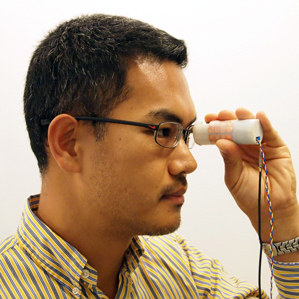 With the Loupe, researchers suggest, the obvious act of holding it up to your eye, rather than gazing into the distance as you would with a head-up display, makes it easier to signal to someone that you’re using it. This could make people around you more comfortable, since they know whether or not you’re paying attention to them—a common concern with devices like Google Glass.
 The design immediately calls up memories of the first Alien (1979) movie, bright whites and distinctive sculpted walls glide past your eyes in glorious low persistence. Then it hits you; the rooms and corridors on these ships are really small! This is perhaps a statement of dazzling obviousness, but it’s not until you’re put into the ship, completely surrounded by it does it really come home. The power of VR to convey scale is really drawn upon here...