Leap Motion ’3D Jam’ Dev Contest Offers $75k in Prizes for Leap-Based Experiences, Starts October 19th
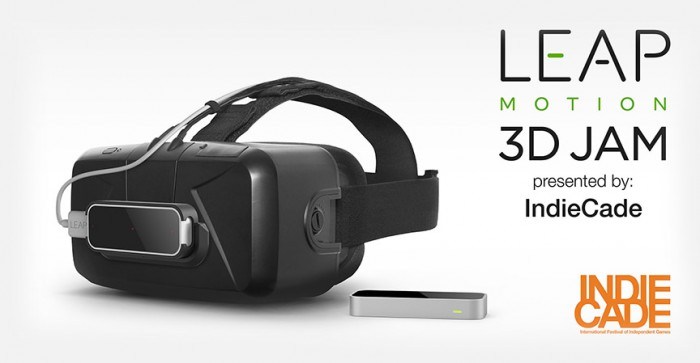 Leap Motion is teaming up with IndieCade for a ’3D Jam’ dev contest which utilizes the company’s motion controller. Leap recently released a ‘VR Mount’ for their motion controller which connects to the front of the Oculus Rift and the company is hoping to see VR-based and desktop submissions from developers pining for $75,000 in prizes.
Leap Motion has been working to breathe new life into their compact low-latency motion controller by aligning themselves with the burgeoning VR industry.
See the full story here: http://www.roadtovr.com/leap-motion-3d-jam-indiecade-prizes-rules-hardware-hubs/
Netflix Quietly Raises its 4K Ultra High Definition Subscription Rates
 The Netflix spokesperson contacted via email confirmed that new subscribers, or current subscribers with newly purchased 4K UHD TVs, now will have to pay $11.99 to receive 4K streaming content. This is a $4 increase for HD users that signed on prior to May 9th, 2014.
The 4K content is available on select models of Ultra HD TVs from LG, Samsung, Sony and Vizio, and Netflix subs with compatible sets will see an additional row displaying 4K TV shows and movies in their on-screen menus.
See the full story here: http://hdguru.com/netflix-quietly-raises-its-4k-ultra-high-definition-subscription-rates/#more-14397
Someone finally made a truly 3D movie
 But whether you're interested in his avant-garde musings or not, there's one big reason to see this film: it may be the first one that really uses 3D to do something new.
Godard, on the other hand, manages to film the world in 3D very much as we see it, using a long depth of field that makes the film’s world extend far into the distance. On top of that, many of the scenes are deeply layered, making the 3D effect more prominent than usual. In one scene, there's a good seven layers from front to back (not counting the actors): a potted plant, a chair, a bike, a barrier, a house, another house, and finally some trees. It’s one of the first times in a 3D film that the image truly looks like it has depth.
He mixes 2D and 3D
The more interesting use of 2D, though, is when archival footage (or, at least, what looks to be archival footage) is interspersed with the newly shot 3D footage in the film. In many ways, this is a modernized equivalent to cutting back to a black-and-white flashback. The fact that it's 2D lets us know that it's out of the modern narrative.
He totally messes with your vision
Sometimes the 3D in Goodbye to Language looks crisp, clean, and downright gorgeous. Other times, it'll drive you cross-eyed — and that's exactly what Godard wants to do.
See the full story here: http://www.theverge.com/2014/9/21/6563495/goodbye-to-language-godard-messes-with-3d-and-its-awesome
A Preview of Oculus’ Newly Licensed Audio Tech Reveals Stunning 3D Sound
 Audio is absolutely vital to the dramatic impact of almost all forms of entertainment.
Oculus made it clear last month at its inaugural developer event ,’Oculus Connect’, that audio is in their sights. Not only was the new Crescent Bay prototype revealed sporting top-quality integrated headphones, but also a high quality audio pipeline utilising RealSpace 3D Audio, a proprietary 3D audio mixing and processing technology developed by a company calledVisisonics.
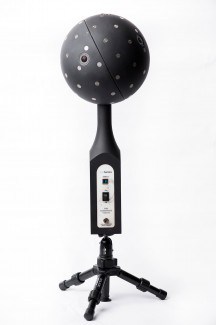
Visisonics offers a wide array of solutions for capturing, mixing and processing 3D sound stages, including a neat ‘Audio Panoramic Camera’, an 8-inch sphere with 64 mics and 5 cameras embedded for capturing panoramic video with expansive sound to match.
The company has close ties to theUniversity of Maryland, an institution attended (and subsequently dropped out) by Oculus CEO, Brendan Iribe.
Visisonics are a spinout company from the school, currently holding exclusive licensing rights to technology developed on campus. They’ve focussed on the capture, mixing and processing of spatial audio, specialising in systems based around HRTF (head-related transfer function)
See the full story here: http://www.roadtovr.com/oculus-rift-dk2-realsense-3d-audio-preview-download/
3D ‘Interstellar’ in Oculus Rift virtual reality exhibit
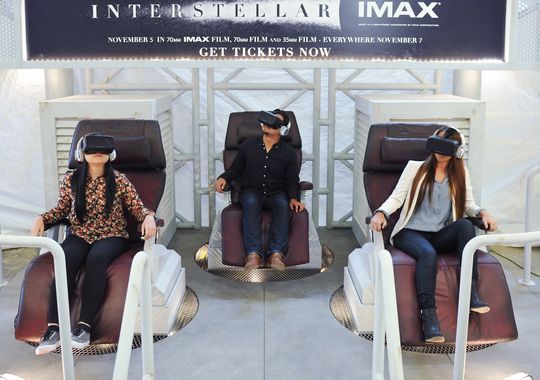 The most stunning view of Christopher Nolan'sInterstellar to date is now available — through the immersive Oculus Rift Interstellar Experience.
The virtual Oculus Rift world was revealed on Monday in New York City and will travel throughout the country ahead of the film's opening Nov. 7.
The Oculus Rift experience allows participants to don high-tech headsets (known as the Oculus Rift development kit) to feel as if they are traveling, even floating in zero gravity through the Endurance spacecraft from the film.
Mike Woods, executive creative director of the effects house Framestore, says theInterstellar Oculus Rift experience is even "a considerable step up" from the Game of Thrones experience his company created this year to wide acclaim.
The project required a team of 15-20 people over the span of two months to painstakingly re-create the world and "the exact ship" from the movie.
The tour will hit participating AMC IMAX theaters in New York, Houston, Los Angelesand the Washington, D.C. area. As part of the Oculus exhibit, the smaller Ranger ship from Interstellar will make its world-wide debut at the Smithsonian National Air and Space Museum's Udvar-Hazy Center in Chantilly, Va. The exhibit will be open to the public Nov. 6-20.
See the full story here: http://www.usatoday.com/story/life/movies/2014/10/06/interstellar-oculus-rift/16806167/
Augmented Reality Glasses Review: Epson Moverio BT-200
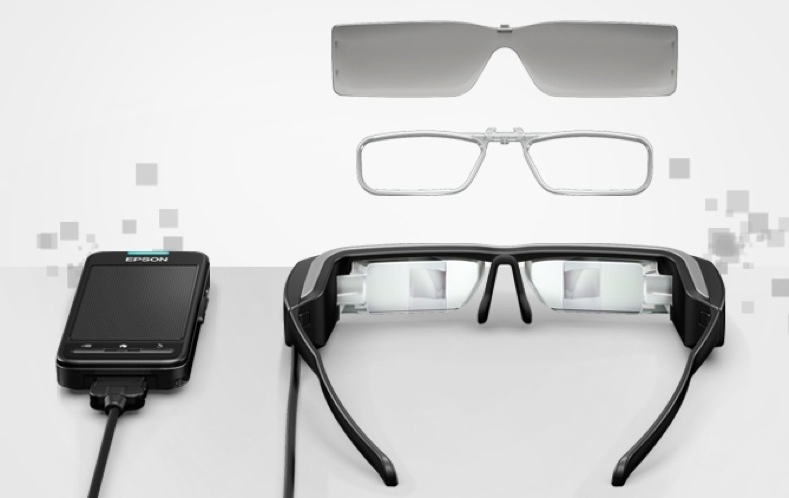 Images are projected in front of both eyes, using 2 projectors. The resolution is 960 x 540 and it’s transparent. 3D images are possible so great for the gamers, the entertainment lovers and also for industry.
Built-in motion sensors detect your head movements. With additional motion sensors on the controller. Yes, there’s a controller.
The controller has a textured touchpad and a micro-sd card slot. Connection to Wi-Fi and Bluetooth is via the controller. Battery life is 6 hours. The micro-USB charger connects to the controller.
With a front-facing camera and the dual-screen combination then yes, these smart glasses are made for AR.
Field of view is approximately 23 degrees. You get built-in GPS, Accelerometer, Microphone, Compass and Gyroscope. Audio is via Dolby Digital Plus Surround Sound. You’ll need the earbuds (supplied) to use it.
The Epson Moverio BT-200 runs on Android 4.0 (Ice Cream Sandwich), with an OMAP 4460 1.2ghz dual-core processor and 1GB RAM. Add to this 8GB of internal memory, expandable to 32GB, then you’ve got the makings of a decent pair of smart glasses.
Apps
Present count is 17 built-in apps and 13 available from the Moverio “ apps market”. Not a huge yield but it’s a start.
...
Thumbs Up?
- Considerably cheaper than its main competition, Google Glass.
- Dual-purpose smart glasses. Can be used in industry and by the consumer market.
- Dolby Digital Surround Sound
- Battery life is 6 hours.
- 8GB internal memory that you can extend to 32GB with a Micro SDHC
Thumbs Down?
- Uncomfortable to wear over your own glasses.
- The controller and cord. Not great.
- Reports of issues with clarity.
- The resolution, at 960 x 540 could be better.
Verdict
These transparent, binocular smart glasses are a step in the right direction by Epson. When you’ve got the likes of the Vuzix M-100 and Golden-i in your field, it’s good that they have had a rethink and moved away from the BT-100. There’s less emphasis on industry and more on the consumer, gamers in particular.
...
See the full review here: http://www.techglasses.com/smart-glasses-review-epson-moverio-bt-200/
The Last Medium
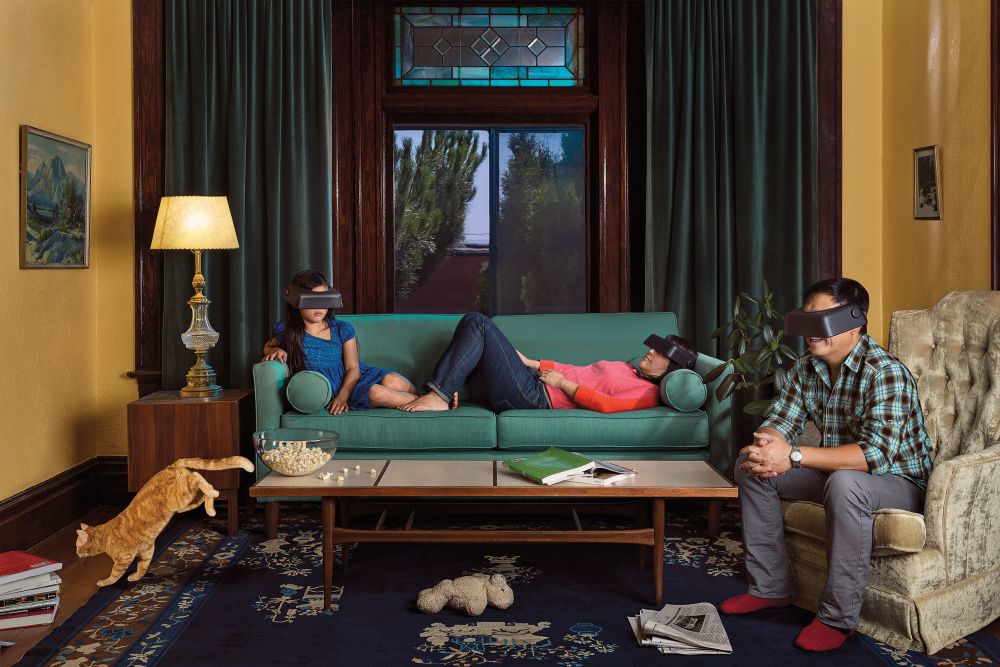 [Philip Lelyveld comment: This story is an excellent overview of recent events and current thinking on VR in entertainment. It is good prep material for the upcoming ETC DTS.]
Google Working on Large-Scale Video Displays
 See the full story here: http://online.wsj.com/articles/google-working-on-large-scale-display-technology-1412346897
Google X Is Developing Screens That Can Connect Like Legos to Form a Big Seamless Image
Google Inc. is building self-driving cars and balloons to beam Internet service from the sky. Now it also wants to make giant TVs.
Google’s secretive advanced-projects lab is developing a display composed of smaller screens that plug together like Legos to create a seamless image, according to three people familiar with the project.
With the modular pieces, the screen could be made into different sizes and shapes, the people said.
The previously undisclosed project is led by Mary Lou Jepsen, a former Massachusetts Institute of Technology professor best known for co-founding the One Laptop Per Child project, an ambitious but ultimately unsuccessful project to give cheap laptops to tens of millions of children in poor countries.
Ms. Jepsen co-founded three startups around display technology. The most recent, Pixel Qi, specializes in low-power displays that can be read in direct sunlight. She now heads the display division inside Google X, Google’s futuristic products lab. Her small team appears to include veteran engineers from Samsung Electronics Co. and Qualcomm Inc. among other companies, according to profiles posted on LinkedIn.
“I loved flashing colored lights as a kid, and I just kept going with that,” she said in a talk to developers at a Google conference in 2013. According to her website, she created a system in the early 1990s to project video on the Moon but abandoned it for health reasons.
Much about her current project isn’t known, including the size of the modules, the potential size of the giant display, or why Google is interested. A Google spokeswoman declined to comment.
In theory, such a large screen might be used to watch television or movies, browse the Internet and read email, perhaps simultaneously, said Riddhi Patel, research director at NPD DisplaySearch.
Ms. Patel said the largest TV screens today are about 110 inches diagonally, slightly more than nine feet. A Samsung model that measures 105 inches is listed for $120,000 on Amazon.
Even so, Ms. Patel said she doesn’t see a current need for ultra-large screens in homes. Before consumers would adopt such technology, she said, manufacturers will have to make the screens cheaper and easier to install and use.
Among the problems that the group is trying to solve, the people familiar with the project said, is how to make display modules that are “seamless” so that people looking at a giant screen wouldn’t see the borders between the modules.
The project remains at an early stage and has been kept secret, even within Google, partly because the technical challenges are as large as the planned screens, one of the people said.
“The big challenge is to electronically, and through software, do the stitching between the seams,” another person familiar said. Google X is trying to recruit more display experts to work on the problem, the person added.
Google X may be getting help from Gecko Design, a mechanical engineering and product design company that the research lab acquired in August.
Gecko worked on the One Laptop Per Child project. In August, Gecko Chief Executive Jacques Gagné said Gecko had been working with Google X since 2013 on a project that he wouldn’t disclose. He said Gecko was joining the research lab to work on a “variety of cutting-edge projects.”
On Wednesday, Mr. Gagné declined to comment on whether his team is working on the Google X display effort.
Microsoft Corp. also has been working on large display technology since at least 2012 when the software company acquired Perceptive Pixel. Founded by Jeff Han, the startup has made touch-screen systems larger than 80 inches for many years.
During a Microsoft developer conference in 2012, Mr. Han predicted that giant displays someday will be in every meeting room, conference room and classroom.
Google has had mixed results with its hardware. Google Glass, its Internet-connected eyewear, has recently seen employee defections ahead of an anticipated broad rollout in 2015. The device so far has suffered from its nerdy image and privacy concerns. However, Google’s cheap Chromebook laptops and its Chromecast wireless TV streaming device are both popular with consumers.
Google has previously disclosed a handful of projects inside its Google X operation. Besides Google Glass, the research lab also is home to Google’s self-driving car project; a futuristic contact lens for diabetics that could use tears to measure blood-glucose levels; a project to deliver Internet access from balloons in the stratosphere; as well as a new life sciences team collecting data to understand human health.
Experiment Shows Stylized Rendering Enhances Presence in Immersive Augmented Reality
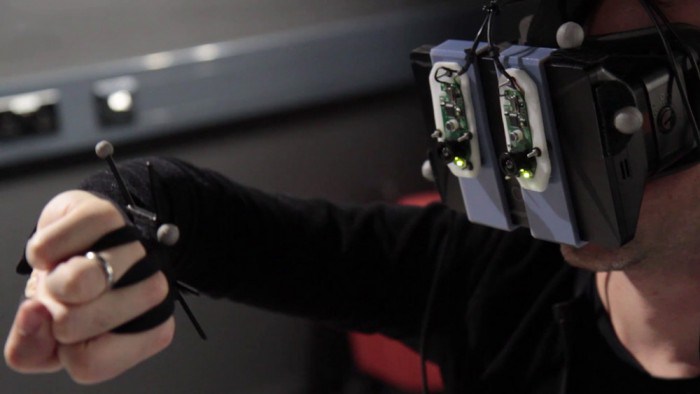 [Philip Lelyveld comment: the researcher found that if you use pass-through headsets and allow you to blend the real world image with virtual objects, and if you stylize the real world image so it starts to look like a virtual world, the viewer has an increased sense of 'presence,' she has a harder time telling what is real from what is virtual.]
In a paper published by the International Symposium on Mixed and Augmented Reality, it is demonstrated that stylized rendering can help blur the boundary between real and virtual when it comes to immersive augmented reality applications.
In order to genuinely feel present in a virtual space, sensory patterns must stimulate the brain in specific ways resulting in a psychological response. To achieve this, latency needs to be low across the entire pipeline. Field of view needs to be large as well. This gives the person the ability to perceive like they are somewhere else.
William Steptoe is senior researcher in the Virtual Environments and Computer Graphics group at University College London; he recently posed the question, “What is presence in immersive augmented reality” in a post on his research blog. Previously, William detailed the process of how to design and build a stereo camera rig for the Oculus Rift known as the “AR-Rift”. With this type of rig, which has cameras on the front to let users “see through” the headset, developers can begin to explore mixing real-life objects with virtual ones in an immersive way.
Several experiments were established using the the AR-Rift which tested users’ ability to distinguish between physical items and virtual models. Conventional rendering, where the real and virtual objects are displayed as-is, produced an error rate of 27%. For the most part, people were able to pick out the difference based on subtle graphical inconsistencies at first. However, the amount of uncertainty increased to 44% as a stylized rendering condition blended non-photorealistic effects together. This made it more difficult to point out the contrasting elements. Inaccuracy jumped even further to 72% during a virtualized simulation where sketch-like outline and cartoonish filters were applied.
See the full story here: http://www.roadtovr.com/experiment-shows-stylized-rendering-can-enhance-presence-in-immersive-augmented-reality/