Con-Tech: 4K Production, Color Gamut and High Dynamic Range
 Higher dynamic range in both the cinema and CE viewing experience was a recurring message yesterday at Con-Tech: The 2015 Preview Seminar. The NAB Show and the International 3D and Advanced Imaging Society held a seminar on content and technology trends including 4K production, color gamut, HDR and new workflows. The event, hosted by Paramount Pictures, featured panelists from companies such as Barco, CableLabs, Disney, DreamWorks Animation, Film Magic, Lionsgate, RealD and Technicolor.
See the full story here: http://www.etcentric.org/con-tech-4k-production-color-gamut-and-high-dynamic-range/
Explore Hawaii’s beaches without leaving the city! Hotel’s virtual reality ‘teleporter’ booth lets travellers see, feel and smell holiday locations without booking a flight
 The future of virtual reality took a very real - and large - step forward yesterday in an unlikely corner.
Marriott hotels has unveiled a new travel booth in New York where guests can explore the black sand beaches of Hawaii or the top of London's Tower 42, without buying so much as a bus ticket.
In one of the first premium virtual reality applications outside of the gaming and entertainment industry, Marriott is taking the immersive experience to new heights by allowing users to feel sensory elements such as heat, wind and mist as well as seemingly 'seeing' new locations in front of them.
Framestore did the work for Marriott - http://www.framestore.com
Data From a Century of Cinema Reveals How Movies Have Evolved
[Philip Lelyveld comment - file this under interesting but useless.]
Shorter shots
The average shot length of English language films has declined from about 12 seconds in 1930 to about 2.5 seconds today, Cutting said.
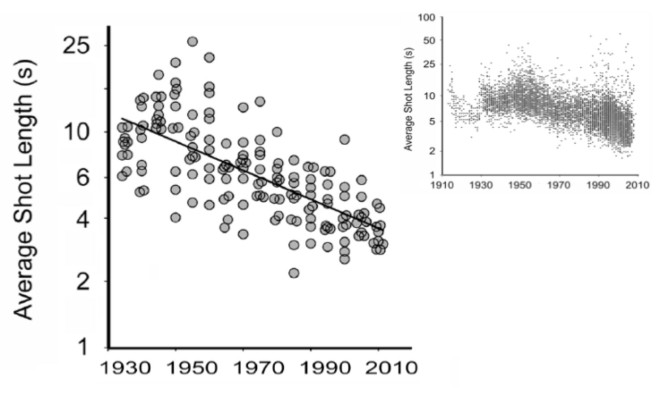
[Philip Lelyveld comment: this is both good data visualization and art.]
The color palette of Inception changes as the movie switches among dream worlds. Each vertical line represents the colors present averaged across several frames. Time moves from left to right.  James Cutting

See the full story here: http://www.wired.com/2014/09/cinema-is-evolving/
Sony’s Google Glass rival will go on sale by the end of March
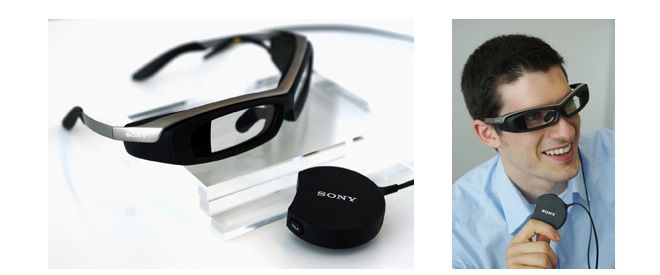 The rather awkward-looking SmartEyeglass is peppered with sensors — there's an accelerometer, gyroscope, electronic compass, ambient light sensor, and a 3-megapixel camera — and comes with a wire connecting it to an external battery pack equipped with an extra touch sensor and microphone.
Sony is releasing the software development kit for SmartEyeglass today and promises to have hardware kits available for developers to buy by the end of March. Other than the battery setup, the key difference between this heads-up display and Glass is that Sony uses a green monochrome display to overlay information atop the user's general view. SmartEyeglass will work in sync with compatible Android handsets to provide the wearer with notifications and other useful information like navigation directions. The Japanese company is now keen to recruit augmented reality devs who can start to provide SmartEyeglass with more and better functionality as it looks to progress beyond the concept stage.
See the full story here: http://www.theverge.com/2014/9/19/6483343/sony-smarteyeglass-sdk-and-dev-release-date
Failed Video Game Underlines the Perils of Using Kickstarter
 “The prototype was technically innovative, but it wasn’t very fun to play,” he said. “I probably focused too much on historical accuracy and not enough on making it sufficiently fun to attract additional investment.”
“Clang” received mixed reviews from its backers. Some demanded a refund, while others understood that they invested their money with knowledge of the risk. Crowdfunding sites rely on backers interested in putting money into project development, not necessarily investing in the traditional sense. And Kickstarter does not guarantee compensation.
See the full story here: http://qz.com/268852/neal-stephensons-failed-500000-video-game-and-the-perils-of-using-kickstarter/
Temp Post – Des Moines Register Adds a Bit of Virtual Reality to News Report
Newspaper Incorporates Technology of Oculus VR, Computerized Game Platforms to Tell Story

The Des Moines Register is using Oculus technology to enhance a story about a farming family adjusting to the globalization of agribusiness. Above, members of the Total Cinema 360 team shoot video for the Des Moines Register's virtual-reality news report. The Des Moines Register
If you've ever wanted to really get inside a news story, the Des Moines Register thinks it has the answer.
On Monday, the Gannett Co. GCI -1.70% -owned newspaper will publish its first virtual-reality news report, incorporating the technology of Oculus VR, computerized game platforms and 360-degree cameras. The report tells the story of how a sixth-generation Iowa farming family is struggling to maintain its traditions in an increasingly globalized world of agribusiness.
"We have tried to create a fully immersive news experience," said Anthony DeBarros, the director of interactive applications at Gannett's digital unit.
Last week, Gannett gave a preview of the virtual-reality news report. It includes familiar elements, such as a written article, photos and straightforward video. But it also takes a viewer into a computerized world of cows, soybeans and grain silos that gives the feeling you're roaming around a farm in Page County, Iowa.
After strapping on Oculus's virtual-reality headset, viewers can explore the farm grounds and interact with 3-D data graphics to learn more about the Dammann family and how demographic and economic changes have affected their lives. For example, viewers can walk up to the family's machine shop and click an icon that places them inside a 3-D video feature about maintaining high-tech farming equipment.

The virtual reality world you can explore through Oculus technology in one of the stories the Des Moines Register has produced. Gannett Digital
The report's nonlinear approach—users can view the information in any order—will feel familiar to videogame enthusiasts. For those who don't own an Oculus helmet, the feature will be available in a 2-D format that can be run on any computer. There are currently only 125,000 Oculus Rift headsets in circulation.
The effort comes amid a relentless push by traditional news organizations to add new multimedia dimensions to their storytelling as they try to woo online readers. The New York Times won a Pulitzer Prize last year for its 2012 "Snow Fall" feature about an avalanche in Washington's Cascades, which blended video, rich graphics, photos and text. Other organizations including the Guardian and The Wall Street Journal have created similarly ambitious works.
Previous Coverage
Mr. DeBarros says Oculus can be the next big innovation for newsrooms. "It is equal parts a journalistic endeavor and R&D effort," he says.
Beyond using the Oculus technology to advance storytelling, he says, Gannett also could sell ads to run within the virtual environment. The company may apply the various technologies used to produce the farm report in other articles at the 81 newspapers it owns, he said.
There are some reasons to be skeptical of the effort. For one thing, the technology is still in prototype phase. Facebook Inc. FB -1.42% recently paid $2 billion to buy the virtual-reality headset maker, but it isn't clear whether the technology will find an audience beyond the hard-core game community.
Roy Peter Clark, a senior scholar at the Poynter Institute, says new digital elements can enhance reporting, but they can't replace the value of strong narrative storytelling.
"Although we call it multimedia, most of these stories are hybrids that use the visual elements to amplify the underlying narrative," he says. "You can take a virtual tour of a building where an event occurred but that is a different thing than having characters who are fully explained."
Gannett includes a warning at the beginning of the report that virtual-reality technology can cause dizziness, as it did for this reporter. Oculus says it has been addressing the problem with better screens and software and promises that the next generation of the technology will have other improvements.
Mitch Gelman, Gannett's vice president for product development, says he sees plenty of applications for the new technologies the company is experimenting with. If a 360-degree camera were used at the protests in Ferguson, Mo., last month, for example, it could have given viewers the feeling they were in the middle of it all. Putting readers on the battlefield in Syria could have a much more visceral effect than a 2,500-word feature article, he says.
Messrs. DeBarros and Gelman said the costs of developing the reporting methods were fairly low, since the game technology at its core is inexpensive and is well established, so there is no shortage of programmers familiar with it.
"For journalists to make the leap to building in this environment is not such a big step anymore," Mr. Gelman said.
Write to Lukas I. Alpert at lukas.alpert@wsj.com