Virtual reality offers dramatic possibilities — and challenges — for the film industry
 “Your typical coverage in photography as well as just where somebody can stand and not be seen doesn’t necessarily exist,” Gratzner said. “Every perspective from top to bottom, 360 degrees, there has to be action and something going on at all times, otherwise the viewer can turn around and see there are people waiting for the take or turn around and see that basically nothing is happening.”
That requires creative equipment set ups too. Lighting and sound equipment need to be strategically placed outside the shot, just like people. One scene of “The Mission” took place in a dark bunker, where the crew rigged up giant mirrors and lights outside of cracks and small windows in the walls to direct a large amount of light inside.
A firm release date for “The Mission” has not been set, but presumably it will coincide with Oculus Rift’s launch to consumers sometime in the next year.
See the full story here: http://gigaom.com/2014/08/06/virtual-reality-offers-dramatic-possibilities-and-challenges-for-the-film-industry/
PARC’s technique of mincing chips into printer ink could revolutionize the way electronics are made.
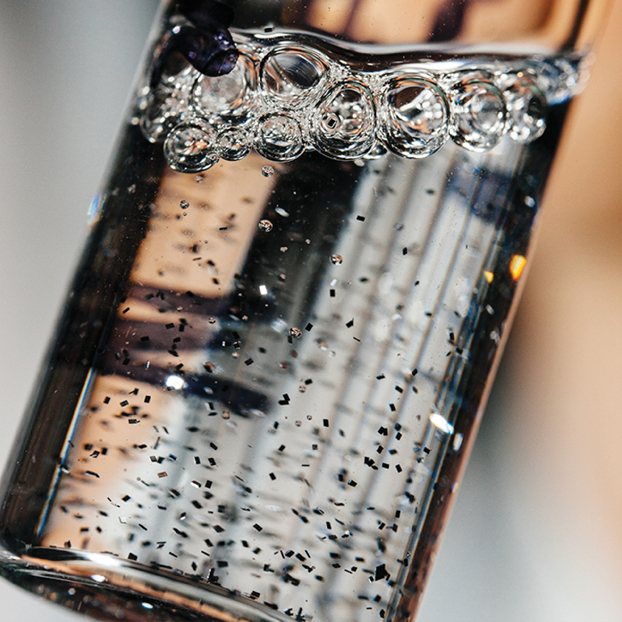 Typically, chips are made in bulk on semiconductor wafers and then cut into individual units and placed on motherboards inside computers and other devices. But researchers at PARC, in Palo Alto, California, envision doing something different with the wafers: chopping them up into hairs-width “chiplets,” mixing them into an ink, and guiding the tiny pieces electrostatically to just the right spot and orientation on a substrate, from which a roller could pick them up and print them.
Because printers can deposit materials on different substrates, this technology could be used to make high-performance flexible electronic devices, tiny sensors festooned with dense arrays of diverse sensors, or 3-D objects with computing functions woven in, says Janos Veres, who manages PARC’s printed-electronics team. And the approach could make it easier for more people and small companies to design and manufacture custom computing devices.
The technology marshals chiplets into place using software-controlled electrical fields generated by arrays of wires beneath an assembly substrate. Like balls rolling into divots, the chiplets go to locations defined by the electrical fields.
The first hurdle is figuring out how to precisely assemble chiplets; so far, PARC has managed to place four at a time and then wire them together in a second step. Still, that achievement is a start toward “accelerating the evolution of microelectronics,” Veres says. “We can iterate new circuits every minute, opening up thousands of uses.”
See the full story here: http://www.technologyreview.com/photoessay/529761/micro-chiplets/?utm_campaign=newsletters&utm_source=newsletter-daily-all&utm_medium=email&utm_content=20140808
The New Foursquare Is Here, and It’s Surprisingly Good
 Launching it for the first time, you'll be prompted to log in the same way you always have; but right afterward, the app begins creating a profile of you by asking what you're into. You like iced coffee? Thai food's your thing? How about cozy places? Choose as many or as few as you like, and Foursquare will know better which stuff to show you.
It uses these preferences — along with your check-in history, its own restaurant ratings and data from your Foursquare friends — to surface recommendations just for you. The more you use Foursquare, the smarter these recs will get, the company claims.
...
In other words, the app needs to give you options, and those options are often overwhelming. Thankfully, the new Foursquare encourages liberal use of its many filters when looking for the best venue.
Filters are the magic potion that make Foursquare recommendations useful and unique. Not only does it include the usual suspects of filtering by price, cuisine and distance, you can also get much more granular: The app lets you filter search results by specific features, such as being dog-friendly or having Wi-Fi.
...
See the full story here: http://mashable.com/2014/08/06/foursquare-8-review/?curator=MediaREDEF
Is There Any Way to Avoid Standards Wars in the Emerging Internet of Things?
 [Philip Lelyveld comment; Consortia developing and publishing standards around a rapidly evolving technology is a waste of time. What they CAN do is pool their efforts and drive markets towards standardization, which can be codified later. Each of these groups is trying to do there for their narrowly defined portion of the Internet of Things ecosystem. It will be a venn diagram-driven battle later on. (Does anybody want to get with me and develop a consulting pitch around these ideas?)]
He points to three industry-wide groups that are each attempting to establish their own IoT standards—one of which is the IEEE, publisher of IEEE Spectrum. The other groups, small consortia of companies with IoT interests are: the Open Interconnect Consortium, which includes Intel, Atmel, Broadcom, Dell, Samsung, and Wind River; and the Thread Group, comprising Nest Labs, Samsung, Yale Security, Silicon Labs, Freescale Semiconductor, ARM, and Big Ass Fans. (No, that was not a typo. Samsung has decided to hedge its bets by joining both of the corporate groups.)
See the full story here: http://spectrum.ieee.org/tech-talk/consumer-electronics/standards/is-there-any-way-to-avoid-standards-wars-in-the-emerging-internet-of-things?curator=MediaREDEF
A heads-up display could be safer than glancing at your smartphone while driving—but some features may be more distracting than others.
Market research company IHS estimates that 348,000 cars will be sold in the U.S. with heads-up displays this year, up from 247,000 million in 2013. But cars with built-in systems tend to be pricey; what’s more, most heads-up displays tend to do just a few simple tasks, such as showing directions or speed.
Navdy began taking orders on Tuesday for its $299 device. It is expected to ship to customers early next year.
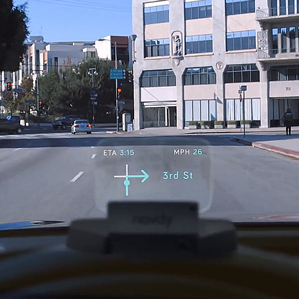
To make Navdy work, data is sent via Bluetooth from a companion smartphone app (both iPhone and Android will be supported initially). A tiny projector projects the image onto a small screen that the driver looks through to see part of the road.
An infrared camera—not built into the device I saw—will let the device recognize gestures such as swiping to accept an incoming call. You can also text and tweet by gesturing to bring up a microphone and dictating a message, Simpson says. Eventually the system will be opened to outside developers, but to start it will work only with a number of apps, such as navigation apps like Google Maps and music apps like Pandora and Spotify.
Paul Green, a research professor in the driver interface group at the University of Michigan Transportation Institute, says that whether a heads-up display is distracting depends on how it’s implemented—whether it interferes with you seeing things or is bright enough for use at night and during the day, for example.
NBA COURTSIDE AT HOME? LIVE ACTION VIRTUAL REALITY IS HERE AND BETTER THAN EXPECTED
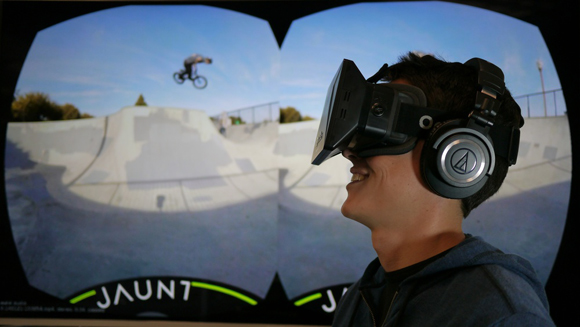 William Gibson famously said, “The future is already here – it’s just not evenly distributed.” I’m guessing Gibson was probably referring to the coming world of live action content for the Oculus Rift, and if that’s true he’s exactly right. The future is stuck in a Palo Alto office loft. JauntVR to be exact.
Forget the simulated world of virtual reality video games. The real VR disruption is coming from live action. Do you want courtside seats for the Lakers? Looking to get inside the White House press room? Have you been on stage with your favorite band lately? It’s not a matter of if, but of “HOLY CRAP it’s already here!!”
To get a sense of what JauntVR has built, their technology is described as “an end-to-end solution for creating cinematic VR experiences.” Their camera films real world footage from everything surrounding it, and their software stitches those clips together to create a seamless experience. The wrap-around film capture means that you’re able to swivel in any direction to maintain that feeling of “actually being there.”
Rarely is the window into the future as stunningly clear as was for me for the next few minutes inside that Oculus Rift.
But as exciting as this sounds, live event ticket sales won’t vanish overnight. Events are a social affair, and live crowds will never and should never be replaced. Even at home, VR will remain (at least for the short term) a companionless substitute for watching with friends.
Businesses in the “experience” industry ought to respect the vaporizing forces of digitization, otherwise risk ending up in the analog graveyard with Blockbuster.
See the full story here: http://singularityhub.com/2014/07/22/nba-courtside-at-home-live-action-virtual-reality-is-already-here-and-its-better-than-expected/
New Breed of Online Stars Rewrite the Rules of Fame
 WME digital agent Avi Gandhi said he’s seeing an increasing number of online stars making seven figures a year, with some approaching eight. As the ad business — which has had 70 years of buying on TV — starts figuring out that the Internet is a missed opportunity, even more dollars will pour into the ecosystem. “These digital stars, a lot of them, have online audiences bigger than TV shows,” Gandhi noted.
STAYING NATIVE
Jenna Marbles surely figures into this elite group. With 13.5 million subscribers, she is second only to comedy duo Smosh among U.S.-based YouTubers. Born and raised in Rochester, N.Y., Marbles — whose real name is Jenna Mourey — still has no desire to do anything other than regularly post odd, funny and personal episodes on her channel every Wednesday. The 27-year-old mostly produces the entire show alone from her Los Angeles apartment.
The rise of digital stars — who control their relationship with the audience more closely than any generation of talent that has preceded them — will inevitably change the dynamics of the industry, said Larry Shapiro, senior VP and head of talent at Fullscreen and a former CAA agent. “Hollywood believes in pixie dust. Silicon Valley believes in data,” he said. “Today’s entertainment has to be a combination of both.”
See the full story here: http://variety.com/2014/digital/news/shane-dawson-jenna-marbles-internet-fame-1201271428/
Startup Wants You to Capture the World in 3-D
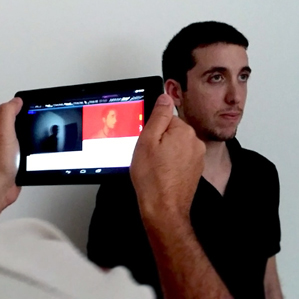 Gur Bittan envisions a future where you’re not just capturing a regular video of a child’s first steps with a smartphone; you’re doing it in 3-D, and sharing it with friends who can manipulate the video to watch it from different perspectives—even the kid’s point of view, providing you’ve scanned the scene from enough angles.
The company’s software and hardware designs are part of Google’s Project Tango tablet, which can map environments and objects. It is also working on apocket-sized 3-D scanner and already offers an enterprise 3-D scanner called the F5.
To capture 3-D information, a projector overlays an infrared light pattern onto whatever it is you’re trying to scan—a teddy bear, for instance. Then a digital camera and a depth sensor, synched to the projector, capture the scene with the light reflected by the bear. The technology works even in complete darkness, since it includes its own illumination; in bright environments the quality of the resulting image depends on the hardware used.