How Statisticians Found Air France Flight 447 Two Years After It Crashed Into Atlantic
 Their approach was to use a technique known as Bayesian inference which takes into account all the prior information known about the crash location as well as the evidence from the unsuccessful search efforts. The result is a probability distribution for the location of the wreckage.
Bayesian inference is a statistical technique that mathematicians use to determine some underlying probability distribution based on an observed distribution. In particular, statisticians use this technique to update the probability of a particular hypothesis as they gather additional evidence.
In the case of Air France Flight 447, the underlying distribution was the probability of finding the wreckage at a given location. That depended on a number of factors such as the last GPS location transmitted by the plane, how far the aircraft might have traveled after that and also the location of dead bodies found on the surface once their rate of drift in the water had been taken into account.
MIT’s CityHome makes 200 square feet feel like a mansion
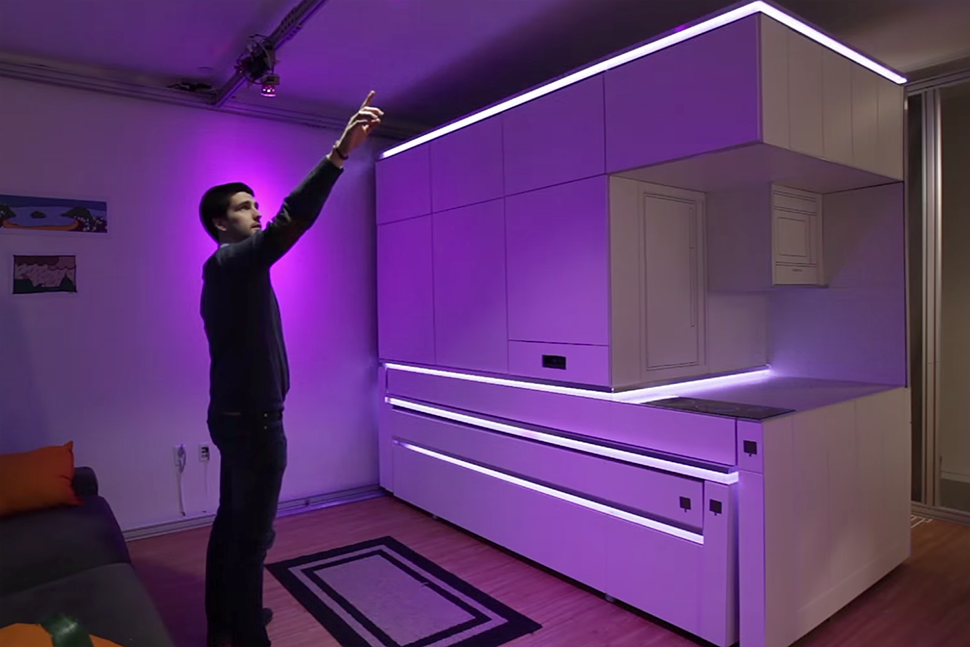 Contrary to what the name might suggest, CityHome isn’t actually a living space itself. It’s more like a large, consolidated chunk of home essentials that allows you to maximize usable space in a small studio. Think of it like a murphy bed on steroids — it’s basically a closet-sized mechanical box that fits into an apartment and functions as a bed, work space, dining room table (with seating for six), a cooking range, closet, and multipurpose storage space.
Read the full story here: http://www.digitaltrends.com/home/mits-cityhome-packs-everything-need-200-square-feet/#!RwmFa
Metaio’s ‘Thermal Touch’ technology turns everything into a touchscreen
 The German tech company Metaio recently demonstrated its new “Thermal Touch” interface, which turns just about anything into a touchscreen. It’s the latest jump forward in the field of augmented reality, which aims to incorporate computer-generated images into the natural world.
All you need for Thermal Touch is a thermal camera and a working finger. Simply hook up the camera to any device you’re wearing, such as Google Glass or other type of smart eyewear, and then get to touching. The infrared camera can track the lingering heat signature your finger leaves behind, using it to activate digital content in your glasses’ heads up display.
So if you’re reading a magazine while wearing Thermal Touch, you can touch one of the items you like and all of its pricing information will appear on your screen. Or you can even go to the website where you can buy it.
See the full story here: http://www.digitaltrends.com/cool-tech/metaios-thermal-touch-technology-turns-everything-touchscreen/
Is UltraViolet Finally Catching On with Consumers?
Results from the research group’s report based on a survey conducted in February found that 82% of individuals with an UltraViolet account — there are now over 16 million — plan to continue to use the service in the future. UltraViolet launched in 2011, and is a product backed by most studios, with the exception of Disney, retailers and tech companies.
And those that do tend to buy more digital movies and TV shows than traditional consumers of home entertainment.
In fact, NPD found that a UV user is 11 times more likely to have made an electronic sell-through film purchase in the last year than those without an account.
According to the Digital Entertainment Group, consumers spent nearly $1.2 billion buying movies and TV shows digitally in 2013, up from $808 million in 2012. The key driver behind the jump: the growing tendency of studios to release big titles digitally two or three weeks ahead of their release on disc, a practice pioneered by Sony Pictures in 2011 and now embraced by all the majors.
See the full story here: http://variety.com/2014/digital/news/is-ultraviolet-finally-catching-on-with-consumers-1201189265/
ESPN STUDIO INTEGRATES VIDEO DISPLAYS AND ONLINE FEATURES
 The sports network is also working on some sort of holographic imaging technology for the hosts, but the details of “Project Jarvis” — as the venture is called — are still unknown.
ESPN is also hoping to expand its digital presence. “The network has found that viewers that access ESPN on multiple devices spend three times as many hours with its content than those who watch TV alone,” reports Bloomberg.
“SportsCenter” now has 10 people working on social media. Last year, there was only one social media employee.
A Dunkin’ Donuts’ season-long sponsorship with ESPN’s “Monday Night Football,” in which plays are re-enacted with cartoon coffee cups in place of the athletes, has been viewed more than 70 million times since September on Vine, the video-sharing website, according to Costello.
The network is particularly concerned about its eroding young viewer base. ESPN primetime viewers fell 2 percent this past year in the 18-to-49-year-old age group.
See the full story here: http://www.bloomberg.com/news/2014-05-22/espn-lights-up-new-tv-studio-for-screen-obsessed-viewers.html
The Future of Money-Like Things
But unlike the wild west, today the rails, roads, and freight of payment flows have been flattened. A Bitcoin is inseparable from the database of its agents’ transactions since its creation. Indeed, this is the only material form a Bitcoin ever takes! It is one with its network. Similarly, American Express loyalty points are of a piece with the network that carries them. Because of this, Bitcoin and AmEx points have a kind of non-interoperability. They are systems unto themselves that require still other systems—exchanges—in order to work with other payment systems. This points toward a future of closed payment communities linked by new gateways, new toll-takers. In other words, new infrastructures, sitting alongside the old. Coin will depend on magnetic stripe readers and the existing card networks; what will new payments depend on? The same infrastructures, or new ones? Like the old postal service, will there be common carriers for the internet of money-things? Ultimately, this is not just a technical question, but a political one.
See the full story here: http://www.theatlantic.com/technology/archive/2014/05/future-payment-systems/370902/?curator=MediaREDEF
On the Future of MetaFilter
Peak ads, MetaFilter’s Google Problems, and the need to scale back..
 While MetaFilter is relatively small (only about 62,000 have paid the one-time $5 for an account to date and 12,000-15,000 of those members come back to interact with the site every day), we have a great group of members, and I think we consistently have some of the best discussion on the web, with the sites attracting over 80 million readers last year. Our commenters are literate and thoughtful, and our site is watched around the clock by a staff of moderators. Despite the site’s modest stature its influence makes waves in the larger world (like mentions on popular TV shows: Tremé andMythbusters).
Unfortunately in the last couple years we have seen our Google ranking fall precipitously for unexplained reasons, and the corresponding drop in ad revenue means that the future of the site has come into question.
See the full story here: https://medium.com/technology-musings/941d15ec96f0?curator=MediaREDEF