How I Killed A Startup In 4 Hours (And Why I Don’t Regret It)
 [Philip Lelyveld comment:A website killed because its business model is predicated on copyright infringement. Is this an outlier, or a recognition of the value of creative individuals' work - or at least current IP law? The writer claims the later.]
Personalpaper.me, which launched last Thursday, promised something that, on the face of it sounded pretty great: throw the site a few URLs and it would print out those long articles you’d never get to on Instapaper or Pocket, package them up as a beautifully designed physical newspaper, and drop that paper in the mail to you — all for the equivalent of about $2 per “issue.”
This product, created by developers at the agency responsible for viral hit game Monument Valley, even, audaciously, offered to strip out ads to create a clean, readable format you could stick in your handbag and read on the subway.
You’ve probably spotted the problem already: personalpaper.me represents copyright infringement, unauthorised republication and illicit distribution on an industrial scale. In other words, its entire business model is predicated on theft.
See the full story here: http://techcrunch.com/2014/04/28/how-i-killed-a-startup-in-4-hours-and-why-i-dont-regret-it/?ncid=tcdaily
MEDIA EXECS GATHER AT HITS 2014: HOLLYWOOD’S DIGITAL MAKEOVER
By Phil Lelyveld
April 25, 2014
The Hollywood IT Society (HITS) — a community of IT professionals representing the studios of the MPAA and supporting information tech partners — hosted its annual day-long Hollywood IT Summit at the Hyatt Regency in Century City this week. Adapting to rapidly changing expectations for IT-related content production and distribution was the running theme at the April 22 event, where execs and creatives gathered to discuss network connectivity, cloud resources, big data, analytics, content management and more.
 Steve Lapinski, CIO Film & West Coast Television for NBCUniversal, noted that the consumerization of IT has changed expectations of what an enterprise IT organization has become.
Alex Grimwade, SVP Television Production InfoTech for Twentieth Century Fox Television, added that the explosion of production volume can’t be managed without a systematic and rigorous approach to data. Standalone apps are easy, she said, but data integration is the missing link and the critical next step.
During ETC CEO Ken Williams’ CTO panel, Greg Gewickey, VP Digital Distribution Technologies at Warner Bros. Entertainment, said that three current focus areas for his team are: 1) creating better picture and audio, 2) advancing efforts in technical standards bodies, and 3) monitoring consumer trends worldwide. Creatives can drive tech adoption within the industry, he added.
Hanno Basse, CTO of Fox Filmed Entertainment, echoed Gewickey’s comments. It is important to create better picture and sound for both the home and theatrical experience, he said, as well as evolve the product for the younger audience. In five years, Fox’s product will need to be more than a 90 minute narrative.
Eddie Drake, VP Technology at Walt Disney Studios, spoke rhapsodically about the passion that people who created their own videos based on “Frozen,” and especially the song “Let It Go,” have shown. Disney worked with YouTube to monetize and support those consumer-generated efforts.
DreamWorks Animation CTO Lincoln Wallen added that activity on YouTube is an indication of how consumers want to interact. DreamWorks is more than a movie company, he said. It creates a world of characters. That enables the studio to engage the audience over many stories. He noted that consumers are looking for very different experiences than they did 20 years ago.
Gewickey mentioned that Media Camp, the Warner Bros. entrepreneurial media technology accelerator initiative, has produced results that “challenge our ideas” of where entertainment is heading and what consumers want.
Regarding the move toward even higher resolution content, Marvel Studios CTO Sean Flynn told the audience that the upcoming “Spider-Man” sequel, which is a 4K production, generated a “crushing” data load. They look to commodity boxes to economically manage the data.
“Every pixel costs us money,” Wallen added, “so we ask ‘how can we not do that and get the same quality level?’” He gave the example of varying the resolution of VFX elements. Basse also pointed out that the picture needs to look good at 5-inches and at 60-feet.
In a wide-ranging discussion of workflows and cloud resources, Flynn said that he is intrigued by the movement of data in live productions. He posited that the lessons learned in live productions will drive the simplification of technologies and processes used on-set for non-live productions as well.
Basse summed up many conversational threads by saying: “At the end of the day, you can’t BS your way out of it. The stuff either works or it doesn’t.”
See the original post here: http://www.etcentric.org/media-execs-gather-at-hits-2014-hollywoods-digital-makeover/
The Internet of Frames
[Philip Lelyveld comment: this could define the future of media monetization.]
 Every frame of video, every audio sample and their associated metadata are addressable as web URLs, making them easily accessible to operators and automated processes wherever they are. In simple language, this will allow content creators to locate and work with media wherever it is stored, create a finished product from any of the parts and send it anywhere.
See the full story here: http://www.quantel.com/page.php?u=2610f4f2812d8062e186b1f79fa3c71f
What MIT learned from a Mongolian teenager who aced a MOOC.
Agarwal remembers a meeting where Myanganbayar gave a presentation to his staff as part of a series of meetings with MOOC students. “More than half of edX was in the room listening to him, glued to his every word,” he said. Their biggest question: How did Myanganbayar master the material in the MOOC, based on a sophomore-level MIT course on circuits and electronics, without having taken the prerequisites that cover concepts such as differential equations? There was nothing dumbed-down about the circuits course, known in MIT’s cryptic course catalog as 6002x, but Myanganbayar was one of only 340 to ace it out of about 150,000 registered students.
 The edX staff learned that Myanganbayar spent about a quarter of the time he invested in the class scouring the Web for supplementary material, essentially using free websites to teach himself the high-level math he needed.
“We certainly took that lesson from him and others to heart,” said Agarwal. “We began to create tutorials for some key concepts that students might not know.”
It turns out the lesson fit a pattern. Though edX aimed to reach the world, its initial courses were designed for the people professors at MIT and Ivy-caliber partners know best—the ultraqualified students they’re accustomed to teaching in their hallowed halls. ...
Myanganbayar isn’t your typical online student, as I learned when I sat down with him in his dormitory common room earlier this year. He avoids activities that he considers wastes of time. “I don’t like to read literature books because they seem useless,” he says, explaining why he has avoided Harry Potter and other distractions. Wearing shorts and an “I [heart] MIT” T-shirt, he said that he took the MIT MOOC not because it was from a famous college, but because the intro video for it promised that it would teach him to understand how iPhones work. He was fascinated.
He also had some old-fashioned help. His principal had invited Tony Kim, a graduate of Stanford University, to lead daily help sessions at Myanganbayar’s high school to supplement the online course. So essentially, Myanganbayar’s MOOC had a really good teaching assistant—not a perk offered to the other 149,990-some people in the class
Diamond Teleporters Herald New Era of Quantum Routing
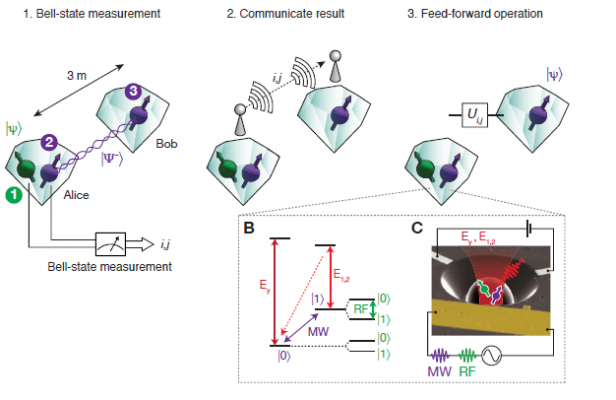 The prospect of a quantum Internet has excited physicists for two decades. A quantum Internet will allow the transmission of information around the world with perfect security and make cloud-based quantum computing a reality.
But first, physicists must perfect the technology of quantum routing—the ability to receive and transmit quantum information without destroying it.
That’s a significant challenge. The key is a technique called quantum teleportation, which transmits information from one point to another without it passing through the space in between. This is a routine operation in any decent quantum optics lab but quantum routing—which concatenates the process—is another challenge altogether.
Today, Wolfgang Pfaff at the Kavli Institute of Nanoscience Delft in the Netherlands and a few pals say they’ve take a significant step toward this goal with the first demonstration of diamond teleporters that can act as nodes in a quantum network. “These results establish diamond spin qubits as a prime candidate for the realization of quantum networks for quantum communication and network-based quantum computing,” they say.
In the meantime, these guys have taken a small but an important step towards robust, scalable quantum networking. “The ability to generate remote entanglement and to control and read out multiple qubits per node as shown in the present teleportation experiment makes NV centers a leading candidate for realizing a quantum network,” they say.
So having twiddle their thumbs for two decades waiting for quantum routers, perhaps physicists will not have too much longer to wait until they finally get them.
How America’s Leading Science Fiction Authors Are Shaping Your Future
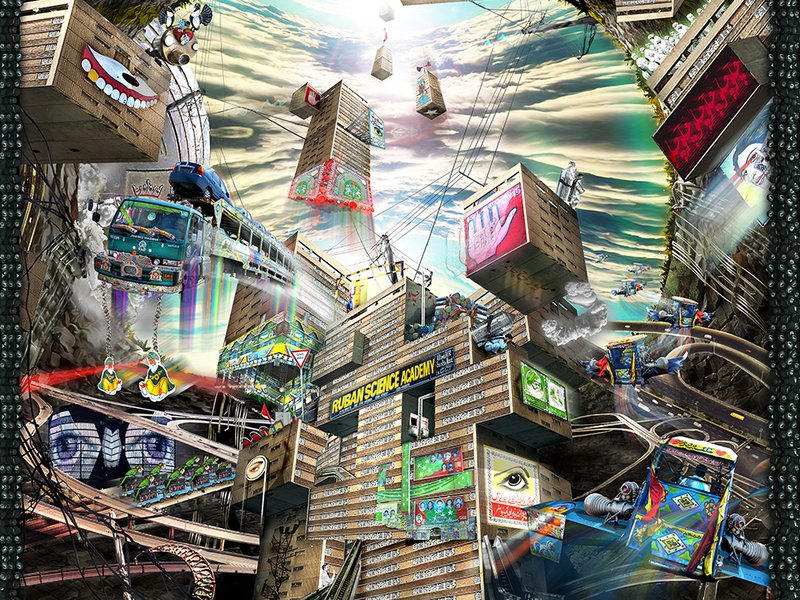 “Science fiction represents how people in the present feel about the future,” Robinson says. “That’s why ‘big ideas’ were prevalent in the 1930s, ’40s and partly in the ’50s. People felt the future would be better, one way or another. Now it doesn’t feel that way. Rich people take nine-tenths of everything and force the rest of us to fight over the remaining tenth, and if we object to that, we are told we are espousing class warfare and are crushed. They toy with us for their entertainment, and they live in ridiculous luxury while we starve and fight each other. This is what The Hunger Games embodies in a narrative, and so the response to it has been tremendous, as it should be.”
For his part, William Gibson believes that to divide science fiction into dystopian and utopian camps is to create a “pointless dichotomy.” Although his seminal 1984 cyberpunk novel, Neuromancer, depicts a gritty, scarcity-driven future, he does not consider his work pessimistic. “I’ve only ever wanted to be naturalistic,” he says. “I assumed I was being less than dystopian in the 1980s, because I was writing about a world that had gotten out of the cold war intact. That actually seemed unrealistic to many intelligent people at the time.”
The distinction between dystopian and utopian may often seem to hinge on whether the author personally has hope for a better future.
At the MIT Media Lab, instructors Sophia Brueckner and Dan Novy were surprised to discover that many incoming students had never read science fiction. “I could guess it’s because they’re top students from top schools who have been told science fiction is a form of children’s literature, or it isn’t worth their time,” Novy says. “They’ve had to compete so much to get where they are. They may simply not have had time to read, beyond required humanities assignments.”
Read the full story here: http://www.smithsonianmag.com/arts-culture/how-americas-leading-science-fiction-authors-are-shaping-your-future-180951169/?curator=MediaREDEF?no-ist