David Byrne speaks out again on artists’ survival in the streaming music era
 For much of its history, digital music is something that’s been done to musicians, not done by them. They haven’t played a role in creating the services, and usually haven’t had a choice about where or how their music is made available. The current transition from sales to streaming, ownership to access – whatever you call it – needs to be different.
That’s why it’s refreshing to see Byrne end his piece with four suggestions. First: that there should be no free on-demand streaming unless artists are directly controlling it through their own sites, or as publicity. Second: that they should get 50% of all streaming income paid to their labels. Third: that they should have approval of whether their work can be used. Fourth: transparent accounting and data sharing, to help artists reach their fans to market their music more effectively.
See the full story here: http://musically.com/2014/04/01/david-byrne-speaks-out-again-on-artists-survival-in-the-streaming-music-era/?curator=MediaREDEF
A Billion-Dollar Bracelet Is the Key to a Disney Park
[Philip Lelyveld comment: the debugging of this technology in such a high traffic environment could position Disney to play a major role in the next generation wireless financial transition economy out i the real world.]
 Among other perks, the system provides a service called FastPass+, which allows visitors to prebook front-of-the-line access to three rides, parades or character meet-and-greets. The system also strives to make it easier for guests to buy food and merchandise — just stand at the register and swipe your wristband, called a MagicBand, which also functions as room key, park ticket and V.I.P. access. Disney thinks people will spend more money and time at the 40-square-mile mega-resort if they find it easier to navigate.
“We are pretty transparently upping our promise to our guests, and that is why we’re being so deliberate about this test-and-adjust period,” said Thomas O. Staggs, Disney’s parks and resorts chairman. “Delight turns very quickly to expectation.”
Disney wants to keep people from visiting competing Central Florida parks, including Comcast’s Universal Orlando Resort, and it thinks preplanning is one answer. Disney guests will be urged to use a website called My Disney Experience to begin locking in the particulars of their visits long before leaving for Orlando. (Adjustments can be made during the visit using a related smartphone app.)
See the full story here: http://www.nytimes.com/2014/04/02/business/billion-dollar-bracelet-is-key-to-magical-kingdom.html?curator=MediaREDEF&_r=0
Piracy software heads to the 21st century
 Put another way: services like Popcorn Time, which allows users to stream torrented movies, and the OpenEmu gaming app are bringing piracy into the 21st century. And both of those tools are free to use, partly because that might allow them to avoid any legal troubles and partly because asking people to pay for something that allows them to access everything else they want at no charge would be breathlessly oblivious.
The point is that these tools are advancing piracy software enough to make watching a few movies or playing a few games seem less like an ordeal and more like a pleasure. For anyone used to finding their content on the Pirate Bay or — see if you get this reference, millennials — LimeWire, using these tools is like graduating from a Betamax player to Netflix.
In Popcorn Time’s case, it’s almost exactly like using Netflix.
What started out as an experiment for a group of friends soon developed into something much bigger. Popcorn Time now has 20 collaborators on Github and continues to expand at a rapid pace. Developers from all over the world have added new features and within 24 hours it was translated into six languages.
Read the full story here: http://pando.com/2014/03/11/piracy-software-heads-to-the-21st-century/
CinemaCon 2014: ‘4-D’ theater coming to Regal Cinemas L.A. Live

A South Korean company aiming to transform the way Americans experience movies at the multiplex is bringing its "4-D" theater technology to Los Angeles.
Seoul-based CJ Group, the conglomerate that operates Asia's largest theater chain, has signed a deal with AEG to open a "4-D" theater at Regal Cinemas L.A. Live Stadium 14 in downtown L.A. this summer.
The technology, called 4DX, combines moving and vibrating seats with wind, strobe, fog, rain and scent-based effects, all of which is synchronized to the action on screen.
The venue would be the first American "4-D" theater for the CJ Group, which has already expanded into Japan, Taiwan, Chile, Columbia, Croatia and United Arab Emirates, among other countries.
See the full story here: http://www.latimes.com/entertainment/envelope/cotown/la-et-ct-aeg-4d-theater-20140324,0,4666741.story#axzz2xXyV8q6d
Samsung’s 28-inch, 4K monitor to sell for $699.99
 The UD590, a 28-inch 4K monitor priced at US$699.99, displays images at a resolution of 3840 x 2160 pixels, which is four times higher than current 1080p high-definition monitors or TVs. Samsung has already released 4K TVs, both straight and curved, and the UD590 monitor is for computer users.
...The product will ship on April 18,...
Samsung has also brought some of its TV features to the monitor. It can convert lower-definition video content to the 4K resolution, and has a picture-in-picture feature to show content from two sources. The monitor has a “Game Mode” button that reduces screen lag, improves color and alters the “screen’s contrast to make dark spots darker and light spots lighter” when playing games, according to a UD590
Other technical specifications of the monitor include a 1-millisecond response time, 170-degree viewing angle, and the ability to tilt from 1 degree to 15-degrees.
Other 4K monitors are expected to become available this year, but many still remain priced well over $1,000. A 31.5-inch 4K monitor from Asus is selling for $2,899 on Amazon.com, while a 32-inch Sharp 4K monitor is priced at $3,595. Lenovo is due to ship two 4K monitors this year, including a 28-inch monitor that will be priced at $799.99, the company said in January.
See the full story here: http://www.pcworld.com/article/2137880/samsungs-28inch-4k-monitor-to-sell-for-69999.html
More pseudo-technical information is here: http://www.samsung.com/levant/consumer/computers-peripherals/monitors/led-monitor/LU28D590DS/ZN-features?CID=AFL-hq-mul-0813-11000279#
The Latest Chat App for iPhone Needs No Internet Connection
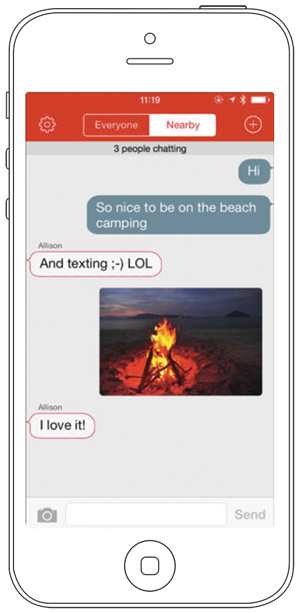 FireChat makes use of a feature Apple introduced in the latest version of its iOS mobile software, iOS7, called multipeer connectivity. This feature allows phones to connect to one another directly using Bluetooth or Wi-Fi as an alternative to the Internet. If you’re using FireChat, its “nearby” chat room lets you exchange messages with other users within 100 feet without sending data via your cellular provider.
The new feature of iOS7 currently only supports data moving directly from one device to another, and from one device to several others. However, Open Garden’s forthcoming software will extend the feature so that data can hop between two iPhones out of range of one another via intermediary devices. That approach, known as mesh networking, is at the heart of several existing projects to create disaster-proof or community-controlled communications networks
Apps built to exploit such device-to-device schemes can offer security and privacy benefits over those that rely on the Internet.
That means the content of a message and metadata could not be harvested from a central communications hub by an attacker or government agency. “This method of communication is immune to firewalls like the ones installed in China and North Korea,” says Mattt Thompson, a software engineer who writes the iOS and Mac development blog NSHipster.
However, peer-to-peer and mesh networking apps also come with their own risks, since an eavesdropper could gain access to local traffic just by using a device within range.
Syuzi Pakhchyan
 Philip Lelyveld comment: Syuzi Pakhchyan covers the difference between wearable technology and fashion technology on her blog. http://www.fashioningtech.com