4KTV at SMPTE: Broadcaster Update
 U.S. broadcasters have employed 4K on the production side. Bob Seidel of CBS said the network is now acquiring assets in 4K. He also described how the network used 4K for what it’s calling “Heyeper Zoom,” with emphasis on the “eye.” CBS employed six 4K cameras at the Super Bowl to acquire footage at 3840 x 2160 pixels and used the footage for slo-mo replays and highlights.
Beginning of this year, Fox did NASCAR in 4K… acquisition, FOR-A FT-100 and Canon C-500, which was also used for the MLB All-Star Game along with AJA’s KiPro Quad DeBayer. For NFL games, Fox used the Canon C-500 with AJA’s KiPro Quad DeBayer and Corvid Ultra, as well as EVS XT servers.
What Fox has learned with Super Zoom, Callahan said, is that:
- Not every play lends itself to 4K.
- Focus is critical.
- Filtering is needed for extraction.
- Uncompressed is better.
- Motion blur is still a problem with 4K.
- Moving 4x3 Gbps SDI can be difficult.
See the full story here: http://www.tvtechnology.com/article/ktv-at-smpte-broadcaster-update/221995
4KTV at SMPTE: Consumer Update
 The debate about whether or not 4K resolution will be detectable by the human eye in the average living room situation is immaterial. Here it comes, ready or not. So please, at least get the color right, Pete Putman said to a room full of applauding engineers at the SMPTE Technical Conference in Hollywood.
Putman, the walking encyclopedia of display technology, said 8-bit color should be “outlawed” for 4K.
“Eight-bit color isn’t sufficient for 4K, 10-bit and 12-bit must be used,” he said.
The lower color depth yields abrupt borders on color fields that look a little like a paint-by-numbers kit painting. It’s a waste of resolution.
As with all emerging technologies, there’s a chokepoint, and with 4KTVs, it’s the interface. The maximum data rate minus the overhead for HDMI 1.4 is sufficient for 8-bit, 3840 x 2160 4K at 30 Hz, but not 10- and 12-bit at 60 Hz. HDMI 2.0 can handle a higher payload, but it still can’t handle 10-bit color, Putman said. DisplayPort 1.2 supports 60p, 10-bit 4K, but is not as ubiquitous as HDMI.
Read the full story here: http://www.tvtechnology.com/article/ktv-at-smpte-consumer-update/221993
Million-Year Data Storage Disk Unveiled
 [Philip Lelyveld comment; this could be added to the list of potential film archiving solutions.]
Magnetic hard discs can store data for little more than a decade. But nanotechnologists have now designed and built a disk that can store data for a million years or more.
The data is stored in the pattern of lines etched into a thin metal disc and then covered with a protective layer.
The metal in question is tungsten, which they chose because of its high melting temperature (3,422 degrees C) and low thermal expansion coefficient. The protective layer is silicon nitride (Si3N4) chosen because of its high resistance to fracture and its low thermal expansion coefficient.
These guys made their disc using standard patterning techniques and stored data in the form of QR codes with lines 100nm wide.
Read the full story here: http://www.technologyreview.com/view/520541/million-year-data-storage-disk-unveiled/?utm_campaign=newsletters&utm_source=newsletter-daily-all&utm_medium=email&utm_content=20131022
America’s Greatest Inventor
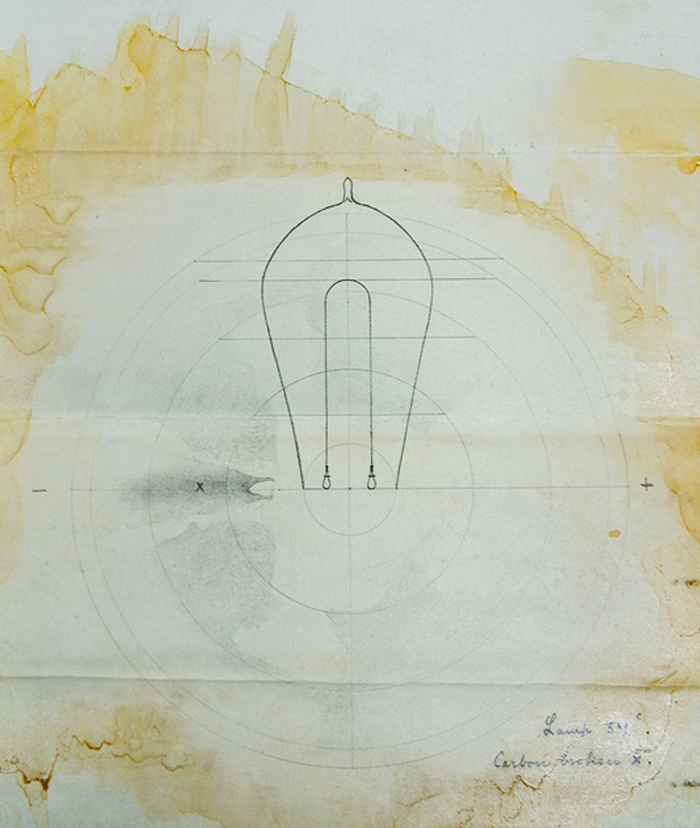 [Philip Lelyveld note; Bill Gates Blogs!]
Obviously, Edison’s inventions were revolutionary. But as this book makes clear, the way he worked was also crucial for his success. For example, Edison consciously built on ideas from predecessors as well as contemporaries. And just as important, he assembled a team of people—engineers, chemists, mathematicians, and machinists—that he trusted and empowered to carry out his ideas. Names like Batchelor and Kruesi may not be famous today, but without their contributions, Edison might not be either.
Second, Edison was a very practical person. He learned early on that it wasn’t enough to simply come up with great ideas in a vacuum; he had to invent things that people wanted. That meant understanding the market, designing products that met his customers’ needs, convincing his investors to support his ideas, and then promoting them. Edison didn’t invent the light bulb; he invented the light bulb that worked, and the one that sold.
Finally, Edison recognized that inventions rarely come in a single flash of inspiration. You set a goal, measure progress using data, see what’s working—and what isn’t working—adjust your plan, and try again. This process can be very frustrating because it means running into a lot of dead ends. But each dead end tells you something useful. As Edison famously said, “I have not failed 10,000 times. I’ve successfully found 10,000 ways that will not work.”
See the full story here: http://www.thegatesnotes.com/Personal/Americas-Greatest-Inventor?curator=MediaREDEF
So Far, Smart Watches Are Pretty Dumb
 In theory, smart watches offer a smoother, more natural way of checking information than pulling out a smartphone. The act of glancing at your watch is a commonly accepted social custom, and it’s intriguing that an old form factor could come back to prominence. It’s just that now we want to see more at a glance than simply the time.
Unfortunately, the first smart watches are too much like the Graves watch: complicated in a way that makes them more curiosities than helpful tools. Their manufacturers, trying to please as many people as possible, have turned them into Swiss Army knives—neat at first, but not really fantastic at anything, and ultimately destined to be ignored or replaced by a simpler, sharper blade.
The Big Business of Big Hits: How Blockbusters Conquered Movies, TV, and Music
 How come so many movies are sequels, adaptations and reboots? Why do music studios spend so much on just a handful of superstar artists? And since when did TV shows become so lush and sophisticated?
These sound like scattered questions for an entertainment guru, not an economist, but Anita Elberse, a professor at Harvard Business School, is both. And her great new book, Blockbusters, explains that the four questions share one answer. The blockbuster strategy—betting more and more money on fewer and fewer titles—has taken over the entertainment world.
Read the full story here: http://www.theatlantic.com/business/archive/2013/10/the-big-business-of-big-hits-how-blockbusters-conquered-movies-tv-and-music/280298/