Survey says 3D holographic FaceTime and air-powered batteries by 2015
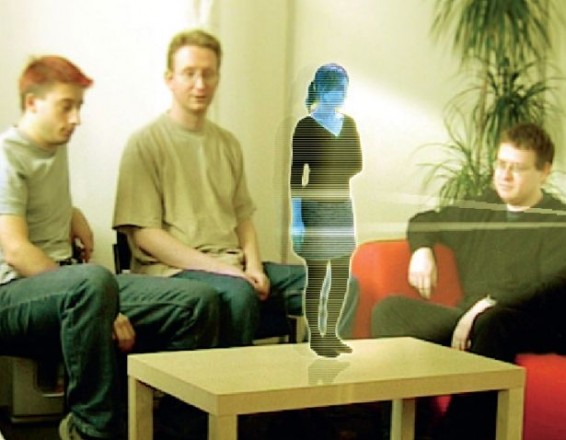
Around Christmastime every year, IBM rolls around computer labs around the country, surveying 3,000 researchers to ask them what big technological advance will be de rigeur in the future.
This year, the big fad was Apple’s Facetime, and so many of the researchers now think that video chat will go 3D by 2015 in the way of Star Wars style hologram video calls.
According to the survey, these holographic video calls will be projected from smartphones using pico-projector technology. That’s plausible, I guess, but it doesn’t really answer the question how the video caller will be captured as a 360 degree hologram.
Original full post here
Now 3D Classroom (India)
With the introduction of 3D Digital Light Processing (DLP) technology in a school in the Capital, learning process is likely to become more interactive and subjects like biology and chemistry easy to understand
“3D is known to help student in retention of content particularly for mathematics and subjects like physics, biology et al. Being a school for girls, I’m confident that more and more girls will take up maths and science for specialisation as this new system will instill confidence in them,” said Queen Mary’s School principal Neelam Kapoor.
Complete original post here
Texas megachurch to offer Christmas services in 3D
 The church, headed by Pastor Ed Young, will be offering 21 services that promise to be a Christmas experience folks have never seen.
Purchase Intent for 3DTV Varies Around the Globe
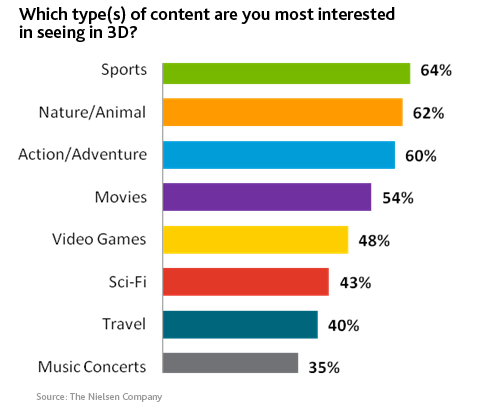 For the technology to gain widespread adoption in the U.S. and abroad, marketers need to emphasize 3DTV viewing as complementary to the 2D experience. David Poltrack, Chief Research Officer of CBS Corporation and President of CBS Vision, said he is confident 3DTV is “just going to be a part of television” like cable and high definition. “No one has taken the really powerful TV dramas and made them with the eye toward 3D,” said Poltrack. “I think once that happens, you’re going to see regular television programming capturing [and] being enhanced by 3D, and people are going to watch special episodes of their favorite programs in 3D.”
Read the full story here.
Toshiba’s glasses-free 3D TV does on sale (description)
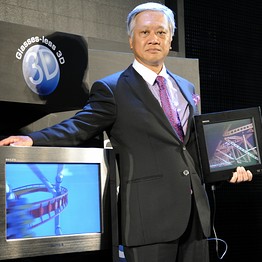 Masaaki Osumi, Toshiba's head of TV operations, unveils the world's first glasses-free 3-D television at a trade show in Tokyo in October. Twelve-inch versions of the TV will go on sale this week, to be followed later by 20-inch models.
As Toshiba Corp. prepares to start selling the world's first glasses-free 3-D televisions in Japan this week, the Japanese electronics and industrial conglomerate says it plans to go global with a larger model of over 40 inches in the coming fiscal year.
"The glasses-free 3-D TVs Toshiba showed reminded us why we need the special glasses," said Ichiro Michikoshi, an analyst at Tokyo-based market research firm BCN. "Those TVs certainly set the direction for 3-D's future, but it will take a while."
Read the full story here
Doctors Visually Enhance Prostate Surgery with 3D
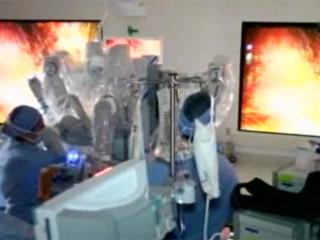 When men are diagnosed with prostate cancer, the concern is they won't recover full bladder and sexual function, but a combination of robotics and 3D technology are helping make this delicate surgery more precise.
See the full story here
Brave develops 3D Panasonic ‘Padvertising’
Brave has developed its first tablet ad - dubbed a "padvert" - for Panasonic's Viera 3D TV, in the first issue of Virgin's Project iPad newspaper.
The ad's interactive elements are triggered by the iPad's accelerometer, which senses how the iPad is being carried and how the user is watching.
Full story here 
3D Tile Format – how it works
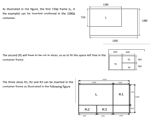 The 3D Tile Format is a frame compatible way to transmit two 720p images in a single 1080p frame. Quartarete TV (Italy), working in tandem with the Italy-based Sisvel Group, will use the 3D Tile Format to deliver HD and 3-D content as two 720 elements (right and left eye) within a single 1080p/50 HD signal, via the DVB-T broadcast standard.
The story is from Broadcast Engineering
CES: 2011 TVs preview
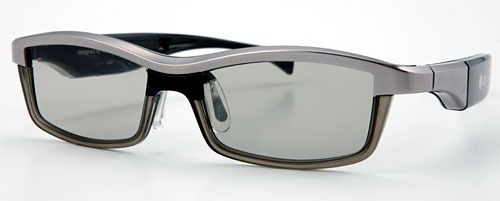 Welcome to CNET's predictions for the TV hardware category at the Consumer Electronics Show in Las Vegas. For previous shows--most recently CES 2005, CES 2006, CES 2007, CES 2008, CES 2009 and CES 2010--I've placed not-so-bold bets on buzzwords like "1080p," "LCoS," "iDCR," "xvYCC," "LED," "Green," "Internet TV" and, yes, "3D." My first bet for 2011: Don't expect to see any major new technology acronyms this year.
The most prominent trends of 2010 were the introduction of 3D--the biggest, and most controversial, new TV feature in the last few years--as well as the addition of expanded Internet capabilities such as Samsung Apps, Vizio's VIA platform, and yes, Google TV. Those two trends will gain strength in 2011 and undergo some interesting differentiation as makers seek to distinguish themselves from the pack.
Full story here.
Sony has a lot to play for as it seeks 3D success
(Phil Lelyveld comment: excellent article on Sony's unified 3D strategy.)
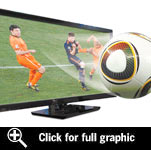 Of all the things that could have spoiled the debut of Sony’s 3D television business this year, an Icelandic volcano was perhaps the furthest from Akira Shimazu’s mind.
Mr Shimazu, the lead project manager for 3D ventures at the Japanese company, was busy with other matters when ash from the erupted Eyjafjallajökull peak began grounding European air traffic in April. He was co-ordinating what he describes as Sony’s most complex and wide-ranging roll-out ever.
Read the full story here