As More Colleges Adopt Online Anatomy Tools, Primal Pictures Provides Digital, Virtual Cadavers
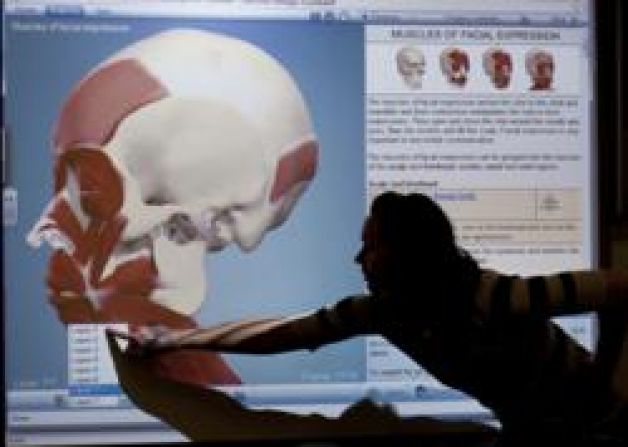 As advances in technology change how human anatomy can be viewed and learned, more colleges and universities are closing the cadaver lab and adopting virtual anatomy tools. Boise State University recently replaced its traditional human cadaver lab -- in use for anatomy students since the early 1980s -- with Primal Pictures’ Anatomy.TV, an interactive, web-based anatomy & physiology learning tool.
The web-based system allows students to log in anytime from anywhere, and tracks the number of hours students spend with the program. Instructors can review data on student usage and study time and can adjust or modify the class time lectures and discussions accordingly.
Read the original post here:
Displays of the future: the screen technology of tomorrow
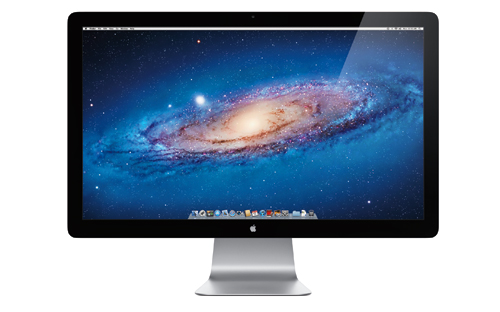 One of the major shifts taking place in monitors now is the rapid uptake of White LED technology. According to Gaba Cheng, Digital Display Product Manager at Acer, around 65% of the monitors sold in 2011 used White LED, but this will soar to over 95% over the remainder of 2012. This energy saving technology uses up to 68% less energy than other backlight technologies, and is also more Earth friendly thanks to the lack of any Mercury used in their construction. ...
It’s unlikely we’ll see much progress in the 3D world, as NVIDIA has only just released version two of its 3D Vision technology. There was little progress on auto-stereoscopic (glass-less) displays in 2011. Gamers lusting after an IPS display will approve of recent rumours about the impending launch of 120Hz IPS displays, though we’ve been unable to ascertain who’s making the panels, so we’ll believe it when we see it. ...
Read the full story here:
New technique lights up the creation of holograms
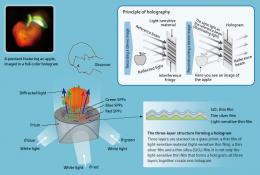 Figure 1: The mechanism of full-color holography The major difference between the researchers’ technique and ordinary holography is the use of a prism to adjust the light beam’s angle of incidence in combination with a thin silver film to produce the surface plasmons. When the angle of incidence is controlled appropriately, the silver film is excited to produce surface plasmons, which in turn cause the white light to reach the hologram in the three primary colors of red, green and blue, producing a floating full-color stereoscopic image. Although only still images can be obtained at present, Kawata is planning to improve the current system to enable movie imaging based on the same principle in the future. Credit: RIKEN
...
See the full story here:
World’s Biggest 4K 3D TV Debuts in China
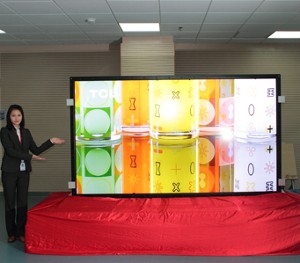 ...TCL—one of China’s biggest television makers—has upped the ante to 110 inches. The model features a 4K x 2K (4,096×2,160 pixels) resolution and supports 3D with active shutter glasses.
In addition, it’s a touch-screen TV with multi-touch technology and “an intelligent and dynamic backlight” which I assume is an LED backlight, but the press release didn’t specify. ...
So far the company has built at least two of the big TVs and donated them to The Great Hall of the People, a ceremonial government building at Tiananmen Square. ...
Read the full storyhere:
Pew Study: Most U.S. College Students Now Prefer Digital Reading
“Survey on Students and Tablets 2012” (PDF) polled 1,206 U.S. college students and 204 college-bound high school seniors. Some findings:
—College students prefer digital over print for “fun” reading (57 percent) and textbook reading (58 percent), “a reversal from last year, when more students preferred print over digital.” Pearson says the trend is also apparent among high-school seniors (though it doesn’t break out which format the majority prefer), “and is mostly driven by an increase in the preference to use tablets for reading.” The study doesn’t ask whether students are using tablets or e-ink e-readers for reading.
—A quarter of college students now own a tablet, compared to just 7 percent last year. Seventeen percent of college-bound high school seniors own a tablet, compared to four percent last year.
—Thirty-five percent of college students who own a tablet also own “an e-book reader or small tablet device.” (Not sure what a “small tablet device” is! Asking Pearson.)
—Among college students who own tablets, the iPad is the most popular (63 percent), followed by the Kindle Fire (26 percent) and Samsung Galaxy Tab (15 percent).
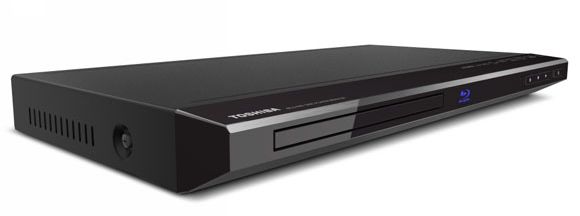
Get a Toshiba 3D Blu-ray player for $62.99
[CNET]
The BDX4150 is new, not refurbished, and that price includes shipping. In addition to 3D, it supports streaming from services like Netflix.
See the full story here:
Google’s latest search may cause it to stray
[Philip Lelyveld comment: My CES 2012 meeting with the head of Vuzix, which makes heads-up and head mounted displays for 3D viewing and augmented reality, was delayed for an hour because Sergy Brin and his R&D team were in deep technical discussions in the Vuzix booth.]
...According to Rob Enderle, the principal analyst at Enderle Group, "The project appears to be connected to virtual-reality glasses, which initially will add [images] - like virtual signs including ads, names, street, address, company, resident - to physical things dynamically and eventually change what we see. Think of shifting clothing or people to an older age or another planet." ...
This would leave the way open for Google to fast-track the development of entirely new 21st-century technologies and products. The optical technology being developed at Project X could underpin a wide range of consumer devices allowing 3D representation. "Android@home" could, for instance, be used eventually to stream not only audio but also 3D images around the home. ...
See the full story here:
Bourne’s Swan Lake prepares to go 3D in over 200 US theaters
... When Bourne's distinctive, testosterone-heavy flock swoops in Tuesday to some 220 theaters across the U.S., it will be only the second time a full ballet is presented in 3D, after “Giselle” last year. ...
For NCM Fathom, which is presenting the screenings along with More2Screen, Bourne's “Swan Lake” was a particularly apt choice to introduce more people to 3D ballet — a concept it obviously hopes will take off. Future screenings are planned for other countries.
“This particular version has some very special qualities about it,” says Dan Diamond, senior vice president of NCM Fathom Events. He adds that of all the art forms, ballet fans have responded the most enthusiastically to the concept of 3-D, according to the company's research and its pilot screenings last summer of “Giselle,” another classic.
“First of all, ballet on a big screen is beautiful,” Diamond says. “What 3D does is accentuate the nuances — the depth of field, the height of jumps. It just brings the audience closer. Our goal isn't to use 3D as a gimmick, but to enhance the experience.”
Bourne says he initially feared it could feel gimmicky, but was delighted with how it all came out. And, he adds, imagine the possibilities.
“The potential for the performance of dance is thrilling,” he says.
See the full story here
“Think in 3D” – A 3D Production Book For More Quality 3D Movies
“Think in 3D” is a book by Clyde De Souza. For those not familiar with this name and person, he is an expert in the 3D stereoscopic technology. He is also a partner of the Real vision company based in UAE. He has been the judge for the Digital studio Awards that recently had its eight innings.
The book is primarily meant for the directors and cinematographers as also film school graduates. The book draws their attention on the present cult of 3D which has moved from just movies to the TV scenario. These makers of 3D have therefore to think in that format and their picturing needs to be mended accordingly.
... There is the digital format of the book for Kindle, iPad and iPhone also available while the hardcover can be ordered from Amazon.
See the full story here: