LG attempts to rebuild ‘credibility’ beginning with £5m ad campaign
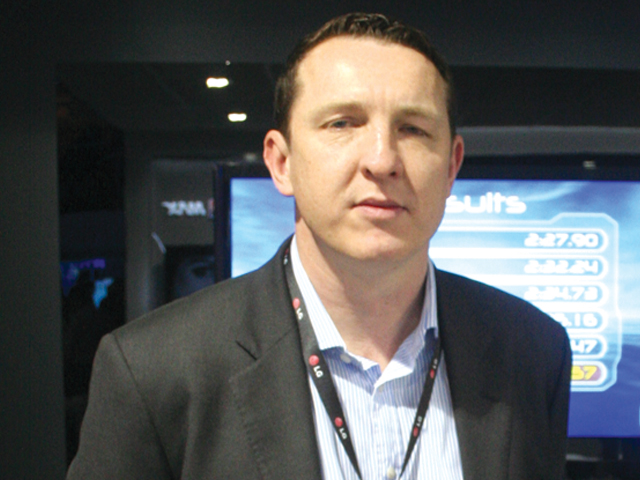
Manufacturer to focus on the low- to mid-end of the market to combat sharp decline in market share over the past two years
LG says it needs to rebuild its commercial credibility in the UK after its market share declined “significantly” over the past two years. The company has seen its market share drop from around 10 per cent two years ago to around five per cent today.
LG Electronics UK consumer marketing director Stephen Gater (pictured) told Mobile News the manufacturer had focused on the high-end handset market despite a lack of consumer confidence in its products.
He also admitted sales of its Optimus 3D handset did not match expectations.
To combat this, Gater said LG is looking to focus more on the low- to mid-end of the market to rebuild its credibility among customers and resellers alike. ...
Read the full story here:
John Carter 3D behind the scenes exclusive
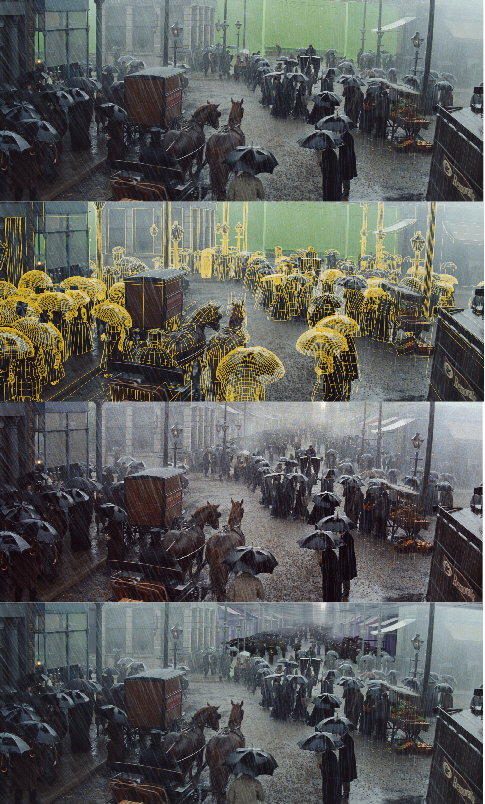 [Philip Lelyveld comment: this is a lengthy article on the 3D work in John Carter]
3D Focus: Can you elaborate on your new 2D to 3D conversion technique?
Scott Willman: Anytime you want to convert or separate anything you have to identify certain objects in the frame and give them individual depth. How you give them individual depth various from company to company. Ours takes a more visual effects approach and says – if I’m in a 3D environment like your animated character would be or your virtual set would be, there is no reason we can’t use that same 3D environment and render it through a second eye camera instead of selecting a character or selecting someone’s face or nose and saying 'this should be this deep' or 'this should be this big' or 'this person’s running towards the horizon so they need to shrink this much'. We are able to project that plate image onto a piece of geometry that physically does run towards the horizon and vanishes properly and works with the rest of the visual effects elements seamlessly. It becomes a lot less arbitrary and a lot more realistic.
3D Focus: Do you think conversion is now better than native?
Scott Williams: Conversion and native both have their benefits. If given the right amount of time, the right budget and the right people, conversion can give you a level of control that native can’t give you. You can say this is our hero character or this is where the audience should be looking so let’s give a little bit more depth in that area or maybe not so much in the background and you worry about specularity and reflections that maybe don’t match between the eyes which you often get. Some of that is not even there working from a single image. Which one is better is a debate that will go one forever I am sure but I think conversion does have a place and can give creatives a lot of control.
Courtney Vanderslice-Law: I think from a producer’s point Scott’s being incredibly modest. He and Bob Whitehill working together have made John Carter look the way it looks. From a layman’s point of view you would expect that native 3D would look better because it's shot in native 3D but the process we went through shows it can work. Unfortunately not all the results of conversions have been up to the standard of what the John Carter conversion is. ...
Read the full story here:
3D displays made from flexible fiber?
 Could new light-carrying fiber technology be the future of 3D display panels? A team of researchers associated with MIT’s Research Laboratory of Electronics (RLE) believe so.
A paper published recently on the Nature Photonics website suggests that a new material, woven from specialist flexible fibers, could be used within future generations of 3D displays. ...
“The coolest thing about this work, really, is the way it’s made,” says Marko Loncar, an associate professor at Harvard University. “The technology that they used to do it, basically, they can make kilometers of these things. It’s remarkable.” ...
See the full story here:
3D-printer with nanoscale precision (w/video)
 Printing three dimensional objects with incredibly fine details is now possible using "two-photon lithography". With this technology, tiny structures on a nanometer scale can be fabricated. Researchers at the Vienna University of Technology (TU Vienna) have now made a major breakthrough in speeding up this printing technique: The high-precision-3D-printer at TU Vienna is orders of magnitude faster than similar devices (see video below). This opens up completely new areas of application, such as in medicine.
Setting a New World Record
The 3D printer uses a liquid resin, which is hardened at precisely the correct spots by a focused laser beam. The focal point of the laser beam is guided through the resin by movable mirrors and leaves behind a hardened line of solid polymer, just a few hundred nanometers wide. This fine resolution enables the creation of intricately structured sculptures...
See the full story here
Soapbox Saturday – Image 3D


Do remember playing with one of these when you were a kid? I remember loving them. We were recently given this viewer from Image 3D along with a reel that we got to create. … I filled it with pictures of them because I thought they’d get a kick out of seeing themselves in the viewer. You can even add 3D text to your pictures. It was easy to build the reel. I think it would make a really fun, unique gift idea too. My nephew was excited to see himself in one of the pictures too. …
What is 4D and 5D cinema?
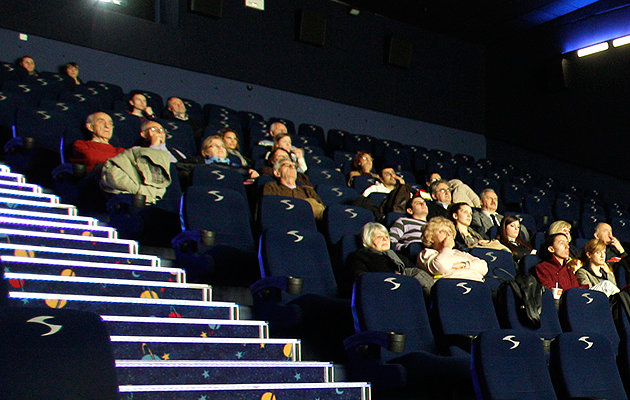
A 4D film combines physical, tactile experiences with 3D presentation. Water cannons, leg ticklers and back pokers are just a few of the devices to have soaked, tickled and prodded audiences in the name of entertainment.
The term ‘4D film’ is relatively new but adding physical effects to films is almost as old as the first ‘talkie’.
In 1929, a New York cinema sprayed perfume into the auditorium during the musical ‘The Broadway Melody’. Audiences watching the 1959 horror film ‘The Tingler’ were zapped by simulated electric shocks during key moments of the film. …
Korean chain CJ 4DPlex is adding physical effects to regular films. Wind, fog, strobe lights and smells have already enhanced films like ‘Avatar’ and ‘Kung Fu Panda 2’ leading to some complaints of nausea induced by the water and scent effects.
So what is 5D? The ‘London Eye 4D Experience’ producers Centre Screen define a 5D film as one that the audience can interact with.
‘Vengeance’, at the London Dungeon, is described as the ‘UK’s first 5D laser ride which combines 3D film with 4D special effects and the fifth dimension of rider interactivity in a rapid fire laser shoot out’. …
See the full story here:
France bids adieu to silver screens
Taking a position that threatens to turn the theatrical 3D business upside down, France’s national film board the CNC has announced plans to phase out all silver screens from Gaul’s theaters within five years.
The bold move, announced March 7 by CNC prexy Eric Garandeau, essentially rules out one leader in the 3D exhibition market, RealD, as well as MasterImage and most Imax screens, as all use polarized-light systems that require silver screens. It favors competitors Dolby and Xpand, since both already meet the Association Francaise de Normalisation (AFNOR) standard for screens. …
At issue is the “hot spot” that appears on silver screens when they’re used for 2D.
The AFNOR standard says the dropoff in brightness from the center of the screen to the edge can’t be more than 20%. With a silver screen, the dropoff in brightness is typically much greater than that. All French exhibitors will have to meet the AFNOR standard by 2017. …
Gaul currently counts 2,519 3D screens, of which around 1,200 use silver screens.About 850 of those are RealD. The RealD technology dominates the 3D projection market in the U.S. and Canada. …
Among today’s 3D projection systems, however, RealD systems can deliver the brightest image, and low light is the biggest issue plaguing 3D in theaters. The CNC decision would force a tradeoff between today’s brightest 3D presentation and best 2D presentation. …
Read the full story here:
Turn Your Baby’s Cry Into an IPhone Case

To create custom iPhone cases, Shapeways has teamed with SoundCloud, a software maker that specializes in letting people create and share sound recordings. In this case, you can use a SoundCloud app to record some audio and then create a waveform—basically a picture—of that audio clip. Then you hop onto the Vibemarketplace on Shapeways’s website and select your audio recording. The company will print out an iPhone case that captures the unique hills and valleys of the waveform and mail it to you for $25. (Or $19.95 until March 18.) …
If iPhone cases aren’t your thing, Shapeways has all kinds of other oddities on offer, including a bird’s nestegg cup, bespoke cufflinks, and even a bikini.
See the full story here: