WHY THE KARDASHIANS 3D CHRISTMAS CARD MATTERS
... So as I see it, while the Kardashian Christmas card uses basic red/blue anaglyph as opposed to more sophisticated techniques to create the 3D, the fact that they did it means one thing: 3D is something that the public/consumer finds interesting. Why else would the Kardashians bother? It’s not like they live for art (to put it mildly). But they do live to attract attention and to find ways to keep injecting themselves into society. ...
Read the full story here
DARPA releases solicitation for MIST-IR long-range 3D imaging technology project
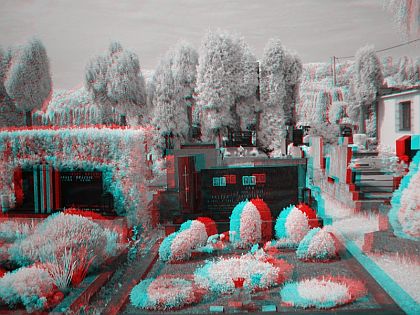
Electro-optics scientists at the U.S. Defense Advanced Research Projects Agency (DARPA) in Arlington, Va., released a formal solicitation Monday for the Military Imaging and Surveillance Technology - Long Range (MIST-LR) program (DARPA-BAA-12-22), which seeks to develop fundamentally new avionics and vetronicselectro-optic sensors for target identification and tracking.
Technical areas of emphasis in the program are image resolution-2D and 3D; system link-budget and image signal-to-noise ratio; image quality, contrast, and the ability for automated identification; maximum relative target motion; image acquisition and processing time; image field of regard and range depth; image size and coverage rate; image frame rate; transceiver targeting and steering; target recognition; differential scene motion for detection; system size, weight, and power requirements; compensation of turbulence effects; and manufacturability and affordability.
See the original post here:
Indian scentist creates 3D printer of the future
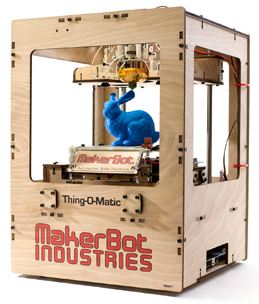
...what if you could just take a picture of something and watch as that thing was suddenly replicated as a 3D model before your very eyes? ....
That’s exactly what Tammabattula has created. The only catch is that the picture needs to come from a 3D camera. “All 3D printers require the item to be made from an intricate and complicated digital wireframe file. Naturally, you need a great deal of technical knowledge in order to produce these. My invention does away with this, instead printing directly from a photograph, by means of a 3D camera,” he said in a press release.
...
Read the full story here:
Intelligent Cheese Counter
It is a common problem. That soft golden-yellow stuff at the back of the cheese counter looks so delicious and inviting, but you are too scared to order some because you do not know the name. And, even if you do, you may not know how to pronounce it correctly. All you can do is point and hope for the best. That is where the intelligent counter can help.
The intelligent cheese counter recognises the product the customer is pointing at and displays it on a screen for the customer and sales staff to see. It even provides additional information, such as the origin of the cheese or the wine that goes well with it.
The system uses a 3D camera mounted above the cheese counter which can pinpoint the target of the pointing gesture to within 2 cm. The details of the cheese are then displayed on a standard dual-display set of scales.
The intelligent cheese counter was conceived and developed at the innovative Retail Laboratory, an applied research lab operated by the DFKI and based at the headquarters of hypermarket operator GLOBUS-SB-Warenhaus, in St Wendel, Germany. The lab’s close partnership with the retail experts at GLOBUS enables its various projects to focus on the specific requirements and potential of planned SB hypermarkets and accelerates the technology transfer process.
See the original post here:
The 2012 London Olympics is 3D TVs’ big opportunity
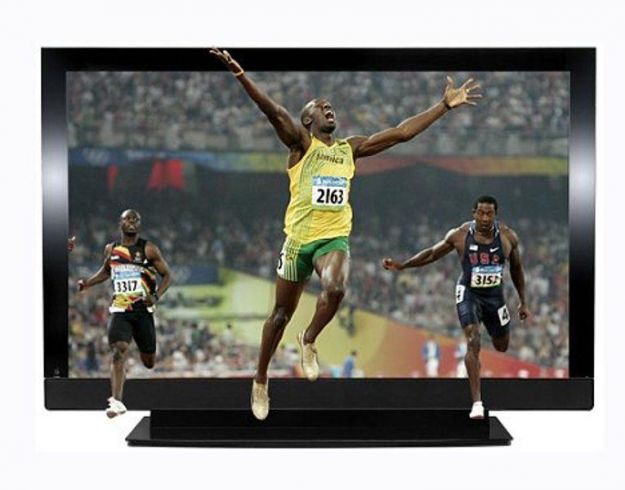 Regardless of sports in 3D, the Olympics have always been an event that drives TV sales. During the Beijing Olympics, the demand for large screen TVs increased more than 84-percent year-over-year in China. The hosting country wasn’t the only one to experience this: New Zealandexperienced increased TV set sales two weeks out from the Olympics, and the North American TV set market saw big numbers in the third and fourth quarters of 2008. ...
Read the full article here:
3D printed glasses are Fashion Week’s hottest accessory
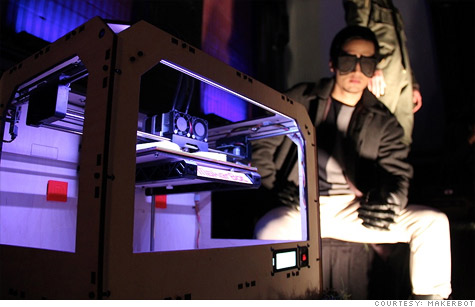 "Your product is a reflection of the tools you have. This is a new tool for people to make objects. You don't have to have eight years of schooling ... people are going to start to make their own things."
Read the full story here.
Will The Future Of 3D Sports TV Ever Come Into Focus?
...
Is it worth the trouble, given that 3D TV hasn't exactly set the world on fire? Remember that more than half a decade after HD made its debut, it still wasn't clear it would get over its growing pains. Alessi said that last year, the second full year that 3D units were on the market, they accounted for 9 percent of total TVs sold. Digital TVs, of which HD is a subset, needed three years to capture 9 percent of the market: "The first few years that DTV came into the market, 3D adoption has actually been a bit faster," Alessi said. ...
Read the full article here:
What Lies Ahead for 3DTVs?
The concept of 3D televisions is a rather new occurrence in the field of entertainment, but the technology behind them has been around for decades. By projecting a television program into a three-dimensional form by using a variety of different displays (stereoscopic, 2D+depth, multiview), the user is then able to see a 3D image with glasses and more recently, without the glasses. In order to understand where these contraptions originated and where they are taking us, it is vital that we look at the past, present and projected future of the 3D TV.
In The Past
The first 3D image was created of Queen Victoria at The Great Exhibition in 1851. Changes in technology did not permit large advances and it was 1915 before the first “3D movie” was debuted in public. The first color 3D movie followed in 1935 and by the 1950s, many movies were being made in 3D and shown across the United States in theaters. Over the past decade, a renaissance of 3D entertainment has occurred and the first “3D-ready” TVs (those that work through a pair of 3D glasses) began to appear on the market, despite being astronomically expensive.
The Present Day
...
The Future
Active 3D screens and bulky glasses will give way to passive 3D systems that are embedded directly into the television. We may even see some initiatives in 3D Web TV. While this technology will increase the price of the television in the short-run, it will lead to a more pleasurable and realistic experience when viewing it. The future of 3D televisions will resemble that of a holographic system more than anything, as viewers will ultimately not need any expensive (or cheap, for that matter) glasses to view the 3D programming in its intended form. This technology in its entirety, however, is still at least a decade away but those who wish to enjoy full-3D systems today can do so; the downside is that most full-3D TV sets cost upwards of $4,000 for a quality 42”-47” name brand unit.
Read the full story here:
A lens so big that you can see a whole animal and its cells at the same time – in crystal clear 3D
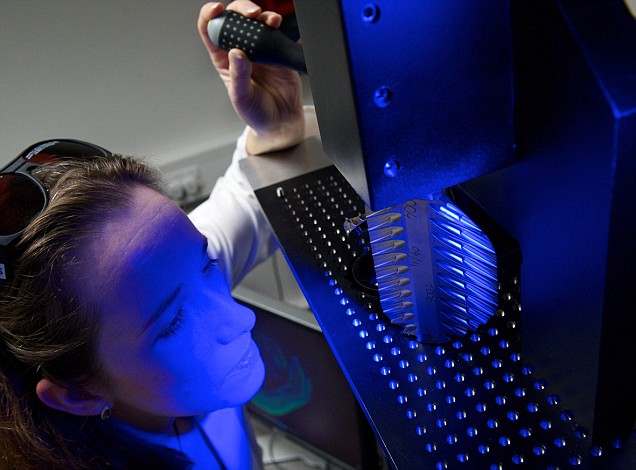 The 70cm mesolens, with its 8cm diameter, is a breakthrough in the world of microscopy that can cut the speed of scientific work and improve the development of new drugs, say researchers.
Two large electrically controlled mirrors focus a laser beam to examine tissues such as the cortex of the brain or tumours. It could play a vital role in identifying new treatments for diseases such as cancer, they claim.
The lens was developed at the University of Strathclyde, in Glasgow, to meet the growing need to examine much larger tissue samples than could be handled by existing technology.
Its resolution is 1,000 times finer than nuclear magnetic resonance microscopes currently used, allowing it to see detail in images just 500 nanometres across when examining specimens measuring 6mm. ...
See the full story here: