Occipital wants to interrupt virtual-reality scenes with what’s coming at you in real life to prevent surprises and spills
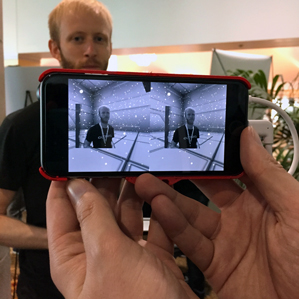
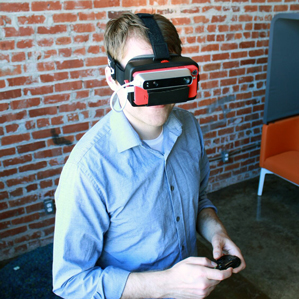 Occipital’s sensor works by projecting a laser pattern onto your immediate environment. Its infrared camera picks up that pattern and uses it to measure the distance to objects in the scene so that software can rebuild those objects in three dimensions. To add bits of the real world to a virtual one, Occipital takes video captured by the regular camera on the iPad (or, in a demonstration I saw using a different kind of sensor mount, an iPhone) and measures its depth; when an object in the real world—say a trash can—comes within a preset distance, the software will basically cut out the image of the can and insert it atop the 3-D virtual scene.
I got a look at what Occipital is trying to do during the Augmented World Expo in Santa Clara, California, this week. Powers placed a Homidoheadset onto my head—basically a generic version of Samsung’s Gear VR headset, which requires a smartphone to show virtual reality apps—into which he had slid an iPhone 6 that was connected to an Occipital 3-D sensor and had a wide-angle lens atop its normal rear camera. The view within Occipital’s virtual world was odd: I was standing within a vast, mostly empty gray room with yellowy dust particles slowly falling all around me, but after walking forward a few feet, the gray expanse was interrupted by a pixelated-looking black railing that appeared in front of me. Unlike the room, the railing was the real thing, marking the edge of the floor we were standing on in the Santa Clara Convention Center.
A moment later, Powers walked in front of me, and when he got within three or four feet, I could see him from head to torso, roughly, through the goggles: pixelated and rendered in black and white, but looking more like an actual human than an animated one. It was strange, but compelling.