Algorithms exploiting light’s polarization boost resolution of commercial depth sensors 1,000-fold.
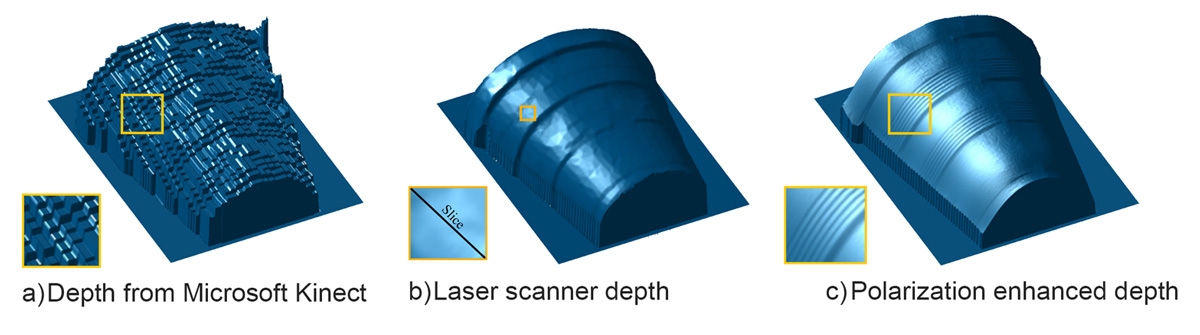 MIT researchers have shown that by exploiting the polarization of light — the physical phenomenon behind polarized sunglasses and most 3-D movie systems — they can increase the resolution of conventional 3-D imaging devices as much as 1,000 times.
“Today, they can miniaturize 3-D cameras to fit on cellphones,” says Achuta Kadambi, a PhD student in the MIT Media Lab and one of the system’s developers. “But they make compromises to the 3-D sensing, leading to very coarse recovery of geometry. That’s a natural application for polarization, because you can still use a low-quality sensor, and adding a polarizing filter gives you something that’s better than many machine-shop laser scanners.”
To resolve this ambiguity, the Media Lab researchers use coarse depth estimates provided by some other method, such as the time a light signal takes to reflect off of an object and return to its source. Even with this added information, calculating surface orientation from measurements of polarized light is complicated, but it can be done in real-time by a graphics processing unit, the type of special-purpose graphics chip found in most video game consoles.
The researchers’ experimental setup consisted of a Microsoft Kinect — which gauges depth using reflection time — with an ordinary polarizing photographic lens placed in front of its camera. In each experiment, the researchers took three photos of an object, rotating the polarizing filter each time, and their algorithms compared the light intensities of the resulting images.
See the full story here: http://news.mit.edu/2015/algorithms-boost-3-d-imaging-resolution-1000-times-1201