Here’s how Sundance’s first VR residency film got made
 Like so many artists eager to get their hands on the medium, Wallworth had never worked in VR film, but she knew exactly what she wanted to do with it. Years prior, while working with indigenous Martu artists in Australia's Pilbara desert, she'd mentioned visiting the Maralinga region near the country’s southern border — site of UK nuclear weapons tests in 1950s and 1960s. The wife of one of the Martu elders, a man named Nyarri Nyarri Morgan, turned to her. "You have to talk to Nyarri," she said. Seeing one of those tests — an explosion of ash and a lingering, otherworldly cloud — had been his first encounter with the non-indigenous world.
For years after, Wallworth had pondered a way to work with Nyarri to tell the story. "Then, when I saw VR, I thought: 'This is really perfect,'" she says. Seeing in all directions would help bring audiences into the vast Australian desert, where they would meet Nyarri and his family (virtually) firsthand. Collisions could follow him through his daily life as he told the story, building toward a single, unreal moment: the bombing itself, now decades in the past.
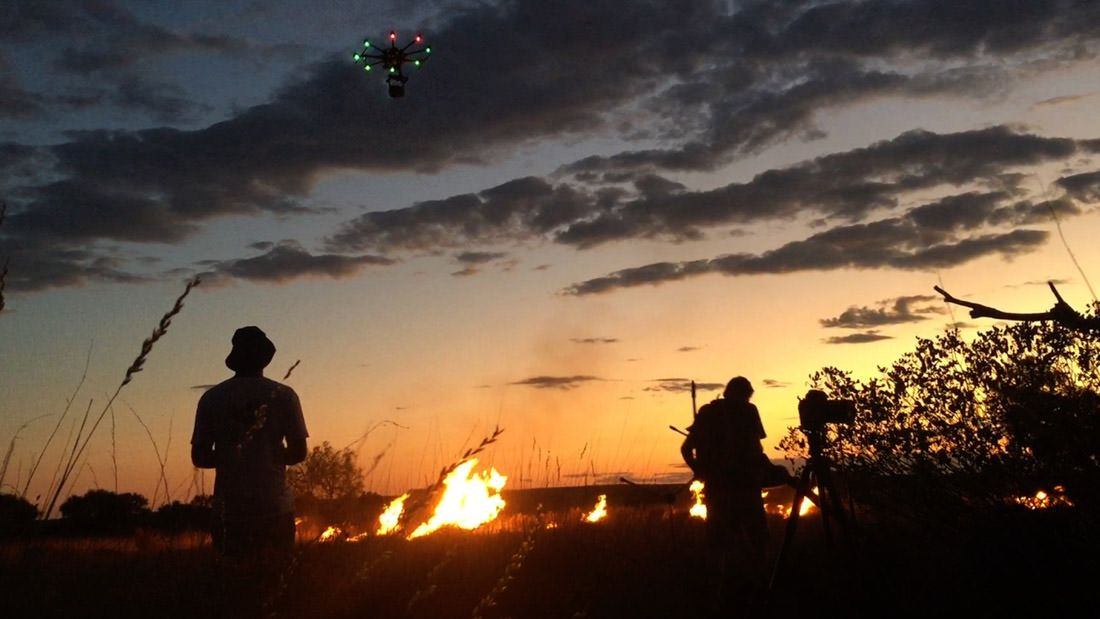
"I took this camera out on this shoot having not shot one scene," says Wallworth. Armed with a week of training from Jaunt, she soon started figuring out the quirks of VR film. Instead of closely controlling scenes, a 360-degree filmmaker has to plan each one and let it play out from a distance. "It’s closer to directing theater than directing film," she says. "We’re kind of hiding behind a door talking to someone through an earpiece — or for us, hiding behind trees and trying to avoid spiders and fire." Afterwards, she and an editor would work with a low-resolution version of the video and send it off, not seeing exactly what they'd made until a perfectly stitched copy came back.
She wanted Collisions to have the same theatrical premiere as a traditional film, even if it was on dozens of tiny screens instead of one large one. With help from the artistic engineering collective Two-Bit Circus, every audience member would don a Gear VR and Wallworth would trigger them simultaneously, making sure each one started and finished at the same time. People might not be able to see each other in the headsets, but they'd take them off knowing they'd had a shared experience.
See the full story here: http://www.theverge.com/2016/2/9/10940236/sundance-virtual-reality-residency-lynette-wallworth-collisions