VR & AR Certification Program
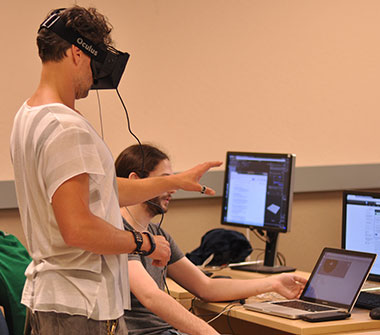 See the full story here: http://www.cogswell.edu/virtual-reality-certification.php
Cogswell Polytechnical College is pleased to announce the launch of a new VR/AR certificate program, which addresses the development of content for virtual reality (VR) and augmented reality (AR). VR is a new human-user interaction paradigm utilizing computer-generated immersive environments. Users participate in VR using headsets which project images within a closed visual space, special immersive sound technologies, and optionally, articles of clothing that provide tactile sensations that increase the sense of “presence.” AR overlays interaction with the physical world with computer-generated three-dimensional visual and auditory sensory information to provide an enriched experience without excluding the surrounding environment. This program is a 15-credit (CEUs) set of specialzed classes that will be offered weekday evenings and weekends to accommodate the schedules of industry professionals. The purpose of this certificate program is to provide professionals in the computer graphics industry the opportunity to join development teams that create VR or AR content.
VR and AR Courses Include:
VAR400 Perception, Cognition and Presence in VR/AR - starting Summer 2016
This is about how the eyes and ears respond to rich, interactive virtual and augmented stimuli, how they pass that information to the brain, how the brain processes that data and builds representations from those stimuli, and how this is then relayed on to the motor regions of the brain to become action. VR and AR provide very strong stimuli and an understanding of how those stimuli are processed and what responses they evoke, provide useful suggestions for creating powerful and vivid subjective experiences. The experience of virtual and augmented worlds depends upon the mediation of perceptual faculties that can be cognized as 'being in' a virtual or augmented space. This course will first present the perceptual and cognitive fundamentals of sight, sound and touch and then present ways in which these faculties are mediated by technology to create a sense of 'presence,' i.e, of being in that world. The course will include theories of presence as well consider health-related impacts of sensory mediation in VR & AR.
Prerequisite: None
VAR450 Human Computer Interface & Interaction Design - starting Summer 2016
Human Computer Interface design addresses problems of usability in VR and AR systems. This course will begin with fundamental techniques of interaction and address progressively more challenging problems. The course will engage both theory and practice of HCI with hands-on projects. It will include an introduction to spatial audio relevant to VR and AR for non-audio specialists. Essentials of multichannel matrixed audio for designers. HCI design theories focus on techniques and rationales for effective interaction between humans and computing machines. This is a multi-disciplinary subject that includes elements of computer science, behavioral sciences, design and media studies among others. In the end, good HCI design results in flexible and responsive computers interfaces that allow humans the power and freedom for productivity and expression. This particular offering of HCI Design will focus on what VR and AR technologies bring to HCI that increase the immersive impact of a user's experience.
Prerequisite: VAR400 or concurrent enrollment in VAR400
VAR500 VR/AR Design Principles 1
Moving beyond design principles for 2D and 3D art, VR Design Principles 1 addresses semantic vs. responsive gestures, the reactivity of objects in virtual space, interactive element targeting, ergonomics, economy of gestures and other factors specific to VR and AR. This course integrates theory and practice with many hands-on projects.
Principles of motion and design applied to VR/AR environments. The success of VR/AR with the public ultimately might come down to the stories that can be told with these technologies. At the time, these new technologies hold promise of adding something valuable to storytelling. Our program will offer two courses in design principles that will address such issues as addresses semantic vs. responsive gestures, the reactivity of objects in virtual space, interactive element targeting, ergonomics, locomotion, optimization for VR tracking, hand and body design, space and perspective, and progress toward the development and implementation of stories as immersive content.
Prerequisite: VAR400
VAR525 VR/AR Design Principles 2
Following on the foundations established in VR Design Principles 1, VR Design Principles 2 addresses locomotion, optimization for VR tracking, hand and body design, space and perspective. The course will integrate introduce elements of storytelling in an immersive virtual space.
Principles of motion and design applied to VR/AR environments. The success of VR/AR with the public ultimately might come down to the stories that can be told with these technologies. At the time, these new technologies hold promise of adding something valuable to storytelling. Our program will offer two courses in design principles that will address such issues as addresses semantic vs. responsive gestures, the reactivity of objects in virtual space, interactive element targeting, ergonomics, locomotion, optimization for VR tracking, hand and body design, space and perspective, and progress toward the development and implementation of stories as immersive content.
Prerequisite: VAR500
VAR550 VR/AR Studio
The capstone of the VR/AR certificate program is the VR/AR studio project, a multidisciplinary collaborative project that will engage the efforts of engineers, VR/AR content designers and audio specialists. All of the theory and practice of previous courses will come together in the implementation of projects inspired by 'real world' applications and in some cases commissioned by actual clients. Industry professionals will be brought in at intervals to provide expert feedback and to inspire best practices. This feedback will enable students to understand what mixes of elements result in in powerful and informative immersive user experiences. The projects will become a part of students' professional portfolios and will demonstrate their preparation for professional activity within the industry.
Prerequisite: VAR525