Former Oculus VP of Engineering Jack McCauley Demonstrates Long Range VR Tracking System
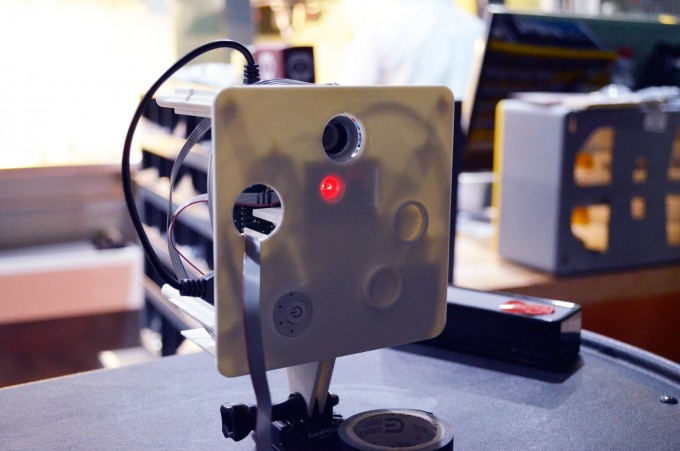 The face of the enclosure is about the surface area of a square box of tissues, but only about a quarter as deep. The back is seemingly missing a rear plate, which gives a clear view of an array of circuit boards and wires. Like Valve’s Lighthouse system, this is a laser-based tracking system. But unlike Lighthouse—which sweeps the room with lasers regardless of what’s in the area—this one actively seeks its intended target.
The MEMS Tracking System (or MTS, which I’m going to call it for ease of use) shoots its laser in a unique way compared to Lighthouse. Lighthouse uses lenses to stretch the laser’s landing area from a point into a line, then it sweeps those lines around a space by mounting the lenses on precisely spinning motors. MTS on the other hand, uses a tiny mirror (which tilts but doesn’t spin) to point the laser in any singular direction.
When initialized, MTS begins scanning a cone area in front of it in a grid-like pattern to search for its target. The target it’s looking for is a point of high reflectivity, measured by the amount of laser light that’s returning to the origin point. Of course, the laser could stop on any slightly reflective surface, so you need to make sure that the target is much more reflective than anything else in the environment, then set a minimum floor for detection, such that the laser continues to scan until a sufficiently bright reflection is found. A retroreflective marker, placed on a headset or motion controllers, serves as that sufficiently bright object, ensuring that much of the laser’s energy is reflected back to the receiver.
McCauley is clear to point out that much of what comprises MTS are off the shelf parts and algorithms pioneered for other purposes.
“Why nobody [applied this tech] for VR/MOCAP, I do not know. Perhaps nobody thought of it recently but it’s 16 years old and very established. They use these mirrors for optical switches in fiber optic bundles,” McCauley told me.
McCauley explained why he thinks this cameraless approach is important. Primarily it’s about range and cost.
See the full story here: http://www.roadtovr.com/mts-virtual-reality-vr-tracking-system-jack-mccauley-oculus-vp-engineering/