Stanford Alumni Mag – VR Overview
 Virtual reality—VR, to the initiated—is so realistic, so immersive, that it feels something like an actual experience.
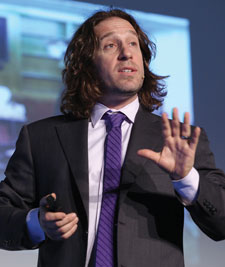
“We like to say the brain isn’t evolved yet to know that a virtual experience is not real,” says Bailenson, a professor in the communication department whose doctorate is in cognitive psychology and who has been studying VR’s effects for two decades.
And that, to hear Bailenson say it, means a whole lot more than you probably think. “We are going from essentially no VR to potentially pervasive use of the most powerful medium ever,” he says. “What are the consequences of a world where anything can happen at the touch of a button and feel like it’s actually happening?”
Jay Borenstein, ’94, MS ’94, a Silicon Valley veteran who teaches VR coding at Stanford.
As creators master VR’s potential, Borenstein expects the results to be just as far-reaching. “I am a real believer that the medium will be as transformative as television was, as the Internet was,” he says. “It is a profound leap ahead from the two-dimensional ways we experience things today.”
He also echoes a common refrain of VR creators—one borne out in Bailenson’s research—that VR allows the viewer to step into another’s shoes with unprecedented power. Indeed, VR has been embraced by documentary filmmakers who have used the medium to bring viewers inside uncomfortable environments, helping them relate to urban hunger, domestic violence and forced migration.
Belch, a former Cardinal kicker who developed STRIVR while working as a graduate assistant coach for the football team and earning his master’s in Bailenson’s lab, tells me to look for a receiver running an out pattern.
I take the mask off, clearer about the reasons for STRIVR’s growing reputation. Why, for example, Stanford head coach David Shaw, ’94, put his own money into starting the company. Why seven NFL and 13 college teams in addition to Stanford have signed on since STRIVR started. It’s like a flight simulator for athletes.
AltSpaceVR, for example, is a Redwood City company led by former rocket scientist Eric Romo, MS ’03, MBA ’06, who grew interested in the social potential of virtual reality after reading Infinite Reality, the 2011 book Bailenson co-wrote with Jim Blascovich, a professor at UC-Santa Barbara.
AltSpace enables a networked VR world where you can hang out, chat at a Super Bowl party, play Dungeons & Dragons, or stream Netflix onto a shared screen, all with people from around the world in the same room.
“Spatialized” sound conveys the changing distance between avatars, our virtual bodies. Voices are louder as you get closer, softer as you move away, in one ear or the other based on positions.
The AltSpace world is so complete you can check a web browser to read your real-life emails while in VR—something Romo does if he’s spending hours in a headset giving demonstrations. Once, early on, he spent six hours in a headset as others came and went. “I watched an awful lot of YouTube that day.”
In real life, for example, people often feel more favorable toward those who subtly—and often unconsciously—mimic their body language in conversation, the so-called “chameleon effect.” The same holds true in VR, according to research by Bailenson and Nick Yee, MA ’07, PhD ’07.
Likewise, Yee and Bailenson found that making your avatar taller can lead to assuming a strikingly more aggressive posture in negotiations, an effect that can continue even if the parties reconvene outside of VR. In one study, in which student volunteers negotiated on splitting $100, participants with short avatars were nearly twice as likely to accept a poor offer than were ones with tall avatars.
Bailenson’s lab is also early in studies on the effects of VR on young children, an area with scant research. In a previous study, they subjected elementary school children to a virtual experience where the children saw their own likenesses swimming with whales. A week later, a follow-up found half of them had false memories of themselves actually swimming with whales.
But if Bailenson is alert to concerns about VR, he’s also keyed into its potential for good. The lab has found that putting people in virtual reality can get them to change their behavior in positive ways. They save more for retirement if they see older versions of themselves, exercise more if they see their avatars lose weight as they work out, and show more empathy if they see the world through another’s eyes, quite literally in the case of a color-blindness simulation.
See the full story here: https://alumni.stanford.edu/get/page/magazine/article/?article_id=84558