Oculus Rift review – VIRTUAL REALITY IS ALWAYS ALMOST HERE
 But after nearly four years, the finished Oculus Rift has shipped to its very first group of customers, and it’s time to see whether the headset that started it all is still pushing the cutting edge of virtual reality.
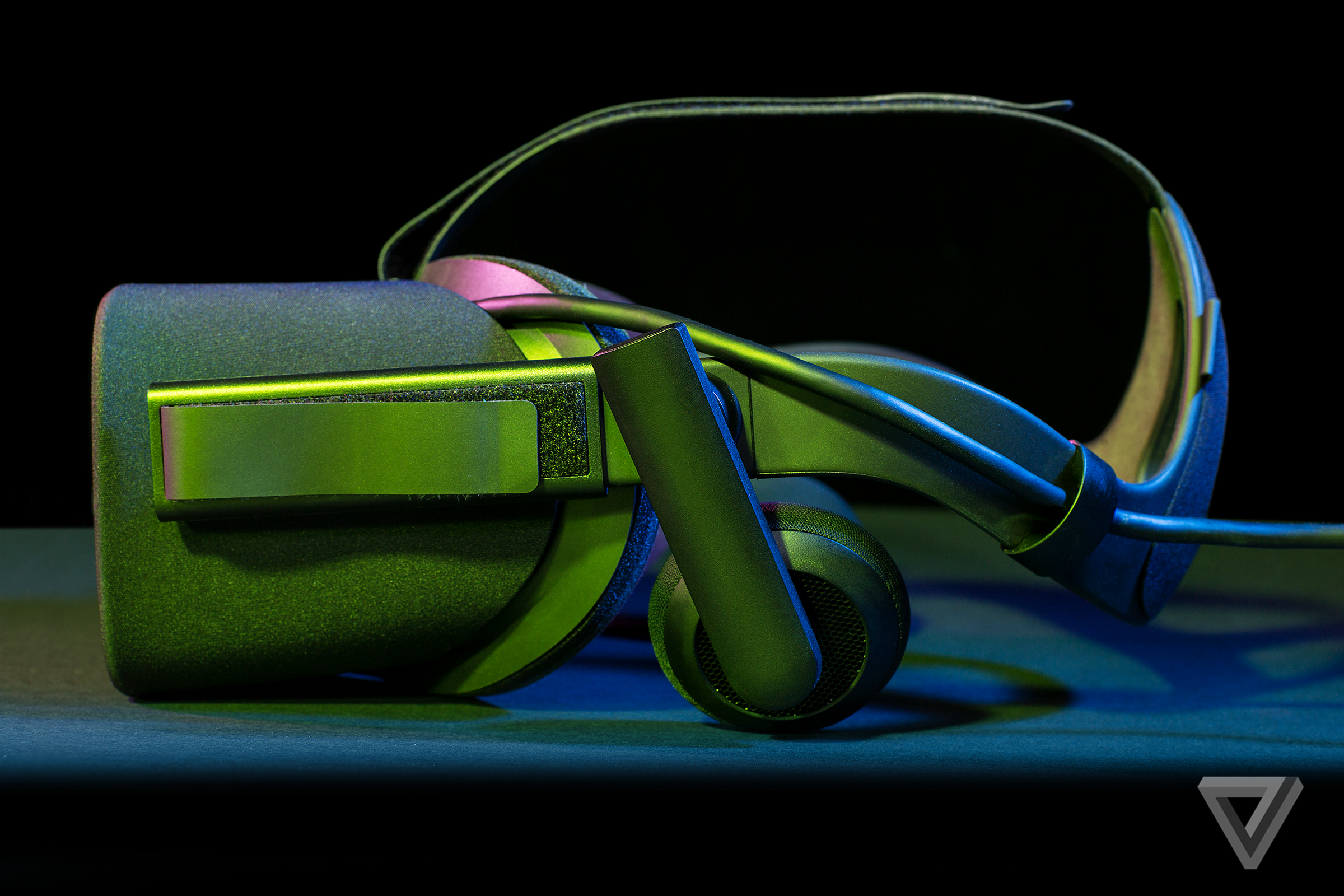
The all-black headset is downright understated by gaming hardware standards, with a front of smooth rubber, sides coated in coarse cloth, and lenses surrounded by a web of lycra. It’s tethered to a PC by a single wire, which runs out your left temple and along one of the adjustable side straps.
But once you get used to wearing it, the headset feels lighter and more comfortable than most of its competition, sealing against your face with a firm but pliable ring of foam.
Along with a cylindrical black tracking camera on a slender 8-inch stand, the Rift comes with two accessories: an Xbox One gamepad and a small, simple device called the Oculus Remote.
The 4-meter headset tether ends with one USB and one HDMI port, and the tracking camera is plugged in with its own USB cable — there’s no external power cable or controller box for either piece. You’ll just download Oculus’ Windows app and run through a short, though descriptive, setup checklist before getting into VR.
None of this matters if the view from inside the Rift is no good — and fortunately, it holds up. The headset contains a pair of lenses, a gyroscope and accelerometer, a pair of decent-quality removable earphones, and two 1200 x 1080 screens. The image they produce is bright and relatively clear (although it still has a bit of the graininess that almost all VR headsets struggle with), and the overall resolution is about the same as the single-screened Gear VR.
The biggest problem is that it’s impossible to tell where that space ends until you step outside it, causing a sickening jerk as the world stops responding to your motion.
The result is a lot of games where VR feels like an addition, not a transformation. Most of the first-person experiences could translate to flat screens without much trouble, and some — like space exploration game Adrift — are already coming to both VR and flatscreen platforms like PC and PlayStation 4.
VR-friendly design occasionally hampers a game. Chronos, a beautiful fantasy game that’s become one of my favorite Rift launch titles, uses the same combat mechanics as Dark Souls. Unlike Dark Souls, the camera moves between fixed angles for each area instead of directly following the player. This gives you a perfect view of its beautiful environments, and it cuts the risk of motion sickness to almost zero. But it also means that large enemies can block your view of the protagonist, and the camera will disorientingly pop to a completely different location if you move too far during a battle.
The high cost of buying and running high-end VR headsets makes them inaccessible to many people, and the Rift in particular is relentlessly focused on gaming. Within these limitations, though, the Rift makes a good case for seated VR, and it lays a solid foundation for what’s to come. The headset you can buy today is not Oculus’ most ambitious vision for virtual reality — but it’s a vision that Oculus has successfully delivered on.
See the full story here: http://www.theverge.com/2016/3/28/11284590/oculus-rift-vr-review