vMocion looks to end motion sickness in virtual reality by tricking your brain
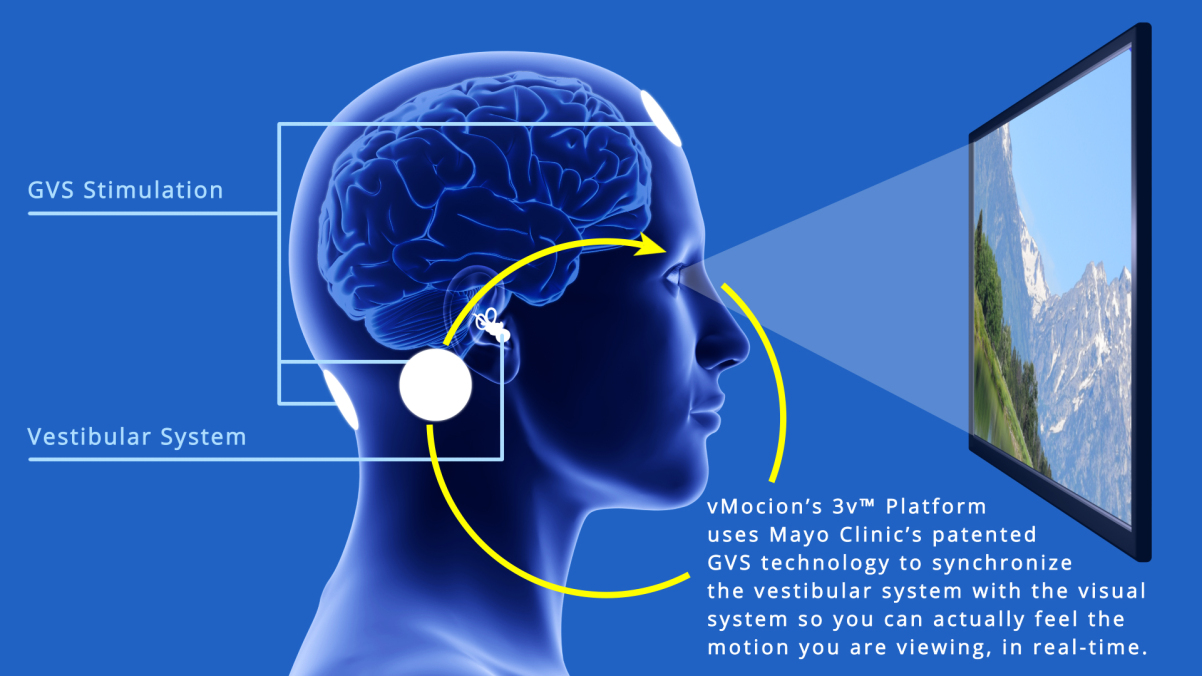 One of the major problems is the mismatch between the visual perception of motion given by the VR headset and the inner ear telling you that you’re standing still. Enough miscommunication and you start to grow a bit queasy.
vMocion is attempting to correct this problem by utilizing technology developed over 10 years of research by the Mayo Clinic’s Aerospace Medicine & Vestibular Research Laboratory. The technology is called Galvanic Vestibular Stimulation (GVS), and it uses strategically-placed electrodes to trick a user’s inner-ear into perceiving motion. In virtual reality, if this is timed perfectly, it can allow a user to feel totally immersed in their current setting and actually feel when the spaceship they’re piloting dives or turns.
If you’re following VR closely, this may not be the first time you’ve heard of GVS technology. At SXSW earlier this month, Samsung showed off a special project they’d been working on, the Entrim 4D headphones. The headphones were demoed in coordination with the Gear VR to show off GVS technology.
Dr. Michael Cevette, chair of the audiology department at the Mayo Clinic, tells me that the differences between Entrim 4D and the technology being licensed by vMocion are much like the differences between Gear VR and Oculus Rift. While Entrim 4D uses a pair of electrodes to measure movement around a fixed point, vMocion allows three-dimensions of motion stimulation.
It’s more than just adding more electrodes however, vMocion’s 3v platform uses its tech to convert simulated motion in existing 2D and 3D content into GVS stimulation. This means that content developers won’t have to specifically implement this technology into VR games and movies and users will be able to gain a more pleasant experience on a wide swath of VR content.
See the full story here: http://techcrunch.com/2016/03/30/vmocion-looks-to-end-motion-sickness-in-virtual-reality-by-tricking-your-brain/