Review: HTC Vive
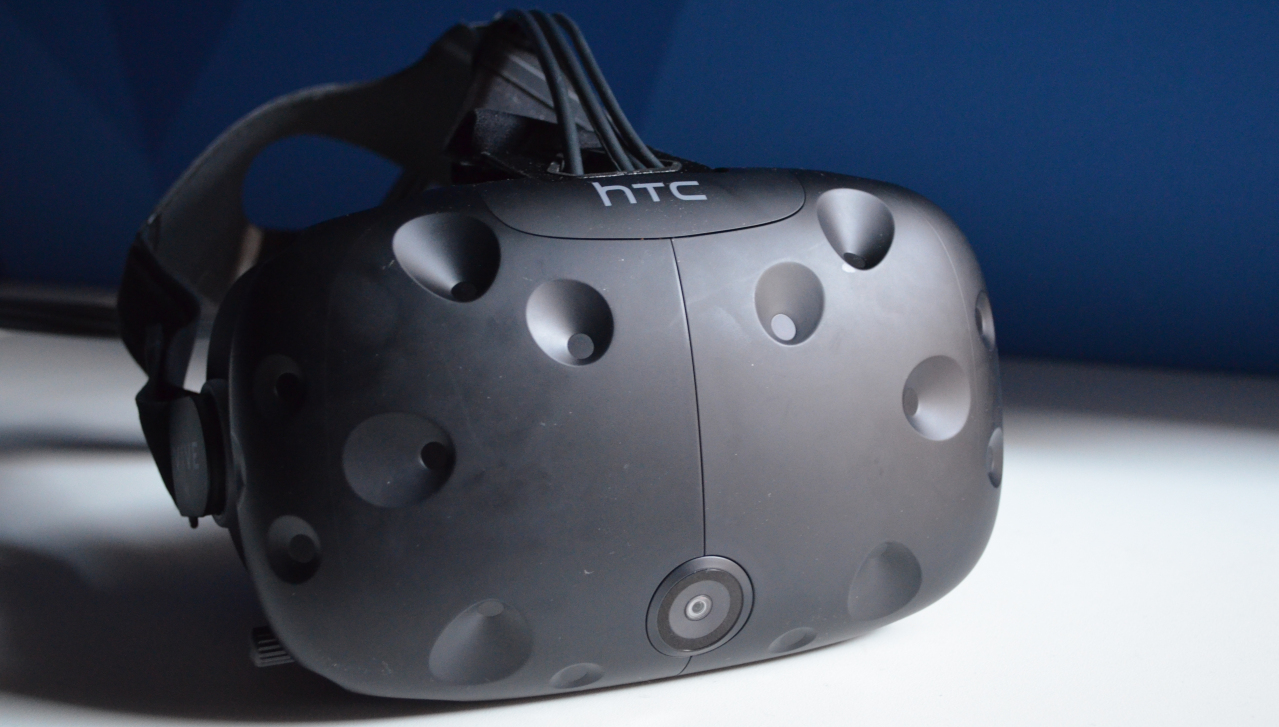 I’ve had a chance to show the Vive consumer version to my VR virgin friends and responses have rarely deviated from them saying the Vive is the coolest piece of technology they’ve ever seen.
The consumer Vive may hold that crown for me as well. It certainly bests the Rift in terms of immersion and is already developing an ecosystem that looks as though it is going to attract non-gamers particularly well in the coming months. It’s a bit less-refined and intuitive in terms of its feature set, but it nails so many of the futuristic pursuits it reaches beyond reality to find.
The setup of this system is a bit of a doozy.
With the Vive, physical space is a pretty precious commodity. The system’s room-scale tracking, which sees you as you move through space, requires a decent amount of room that you may have to get creative to find.
Mounting the two Lighthouse sensors (which track your headset and controllers) in opposite corners of the room was mostly painless. The lighthouse infrared cameras don’t need to connect to each other or the PC so that made things much easier.
...chaperone system to remind you of the physical borders of your measured space if you’re ever about to put your controller through a wall while in VR. It does so through a couple ways. First, a physical grid that pops up clearly showing your boundaries, and second, if you have the Vive’s head-mounted camera enabled, a 360-degree 2D image of the objects in your immediate vicinity pops up.
e interesting thing I noticed from trying out the various launch titles is how effectively game developers are aligning their designs of in-game tools to the real-world form factors of the controllers. What results is a level of immersion that makes you believe you might actually be picking up a gun when you grab the controllers off your desk while inside the environment.
I found myself missing the Rift’s integrated headphones. The Vive allows you to easily use whatever headphones you have at your disposal but I generally found that having another cord in the way was annoying and most of my headphones are quite heavy so I ended up just using the included earbuds, which weren’t all that awesome but performed fine.
Speaking of cords, the Vive is still a tethered experience.
The quality of the launch titles is another point. I got a chance to play about half of the roughly 70 launch titles that will be live on Steam today. The launch titles are certainly diverse but I struggled to find a standout experience. Indeed, the titles that ship with the Vive: Fantastic Contraption, Job Simulator and Tilt Brush are fairly representative of the type of content that succeeds on the platform.
Like
Magical room-scale tracking. Surprisingly useful camera. Quality optics. Top-notch motion-tracked controllers.
No Like
Bulky headset design. Large amount of floor space needed. General UI bugginess. Thick cord that easily tangles. No blockbuster launch titles.
Bottom Line
If there were a word I’d use to describe this piece of hardware, it would be ambitious. It tries so many damn things, and it gets most of the things so right, though not every feature is a home run. $799 is a lot of cash, but it really feels worth it here. The experience is in a lot of ways so much richer than any other headsets out there, including the Rift. Because of this, it may be a bit easier to point out flaws when they come up, if only because there’s just so much going on with this crazy piece of tech.
See the full story here: http://techcrunch.com/2016/04/05/review-htc-vive/?ncid=tcdaily