Restoring the Allure of the Movie Theater
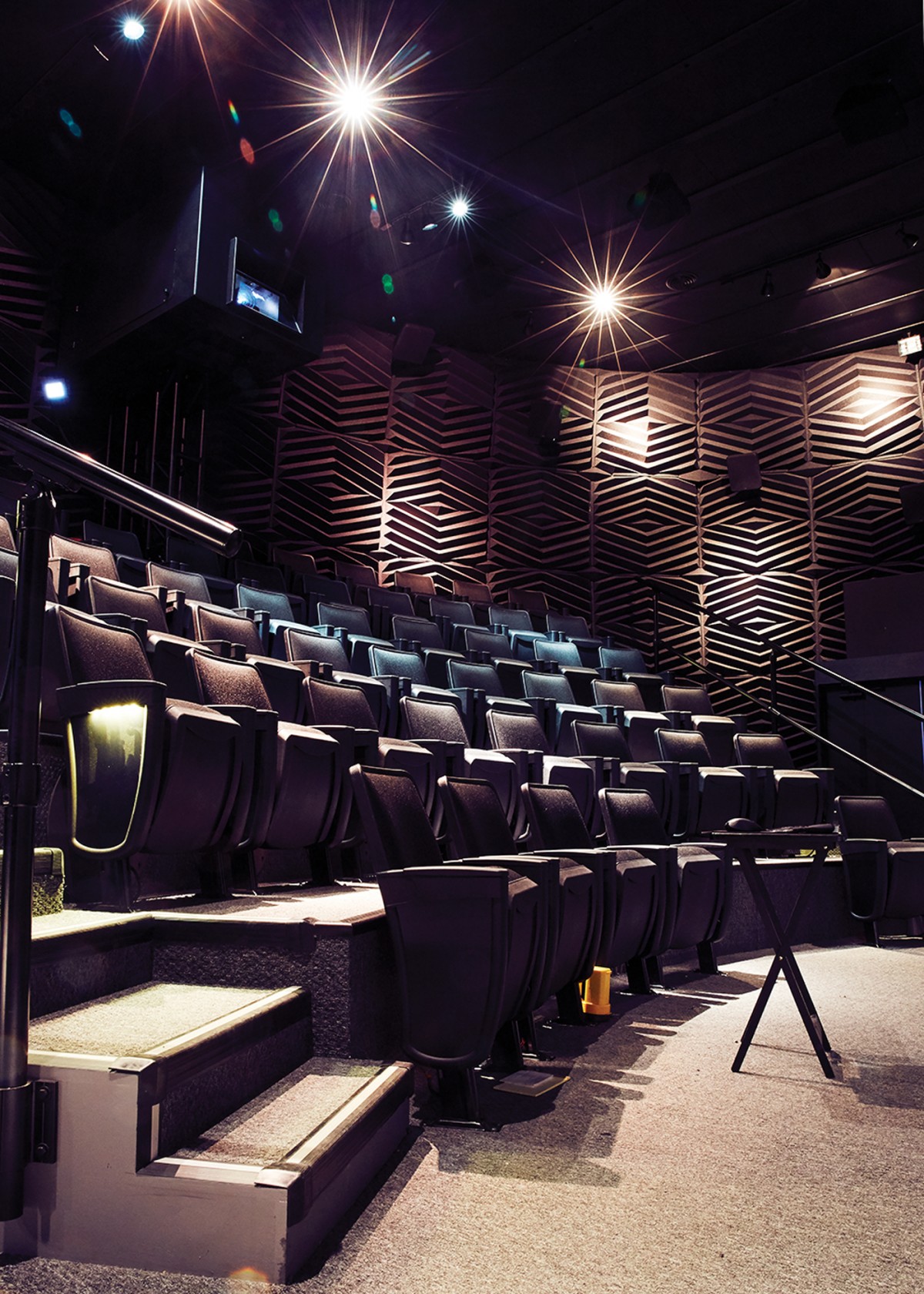 ...combining 3-D, 4K resolution, and ultrahigh frame rates.
After years of analysis, Trumbull thinks 120 fps is the optimal projection speed for digital 3-D movies. To make Magi movies, he uses two cameras or two sensors in one camera, and he photographs the left- and right-eye images at a slight offset instead of simultaneously, which is how conventional 3-D movies are made. Because one of the two camera shutters is open at any given moment, the Magi process captures all the action instead of just half of it. Trumbull then projects the movies in the same way they were shot—alternating left and right frames at 60 fps per eye—for a result that looks incredibly realistic.
Every aspect of the Magi Pod is meant to amplify the immersive nature of the Magi experience. The theater is deliberately small (1,300 square feet), to reduce audience eyestrain. Rows are laid out to ensure that each seat faces the center of the 36-foot-wide, 17-foot-tall screen, which offers a field of view twice that afforded by a regular movie screen. Because the screen is curved, to act as a lens focusing the light emitted by the projector, images appear three times brighter than the industry standard. Trumbull also included a 32-channel surround-sound system for more realistic audio effects and put special insulation inside the walls to eliminate reverberation.
The pod might solve several problems for the movie industry by helping to ensure that the theater experience far exceeds what’s possible at home.
He recently joined the advisory board of Magic Leap and has been mulling how to create content that would begin in Magi Pods and then live on in the startup’s “mixed reality” device.