Columbia Engineers Win $4.7M DARPA Grant to Revolutionize Augmented Reality Glasses
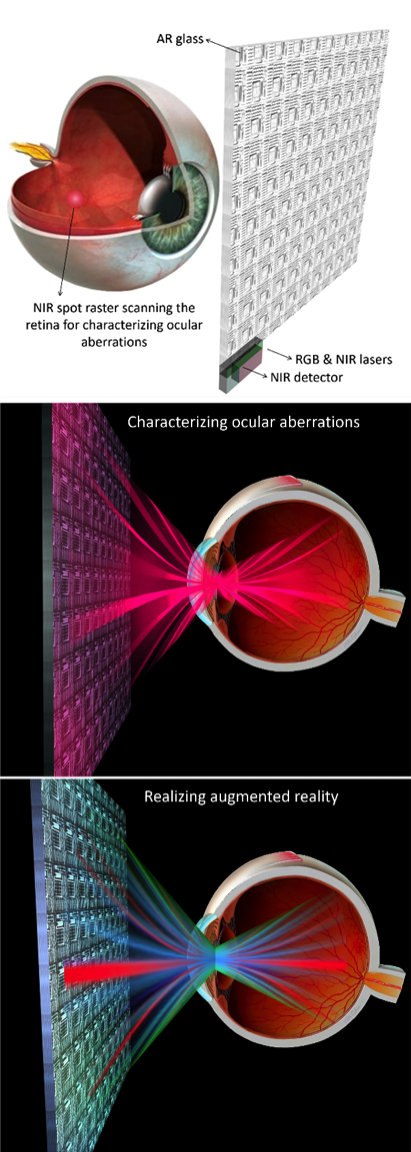 An interdisciplinary Columbia Engineering team is working with colleagues at Stanford, UMass Amherst, and Trex Enterprises Corporation to come up with an alternative solution. Thanks to a $4.7 million, four-year grant from DARPA, they are developing a revolutionary lightweight glass that is able to dynamically monitor the wearer’s vision and display contextual images that are vision-corrected.
“We are creating a game-changer, a completely novel glass design that enables high resolution projection and detection of light with no moving parts,” says Michal Lipson, Eugene Higgins Professor of Electrical Engineering at Columbia, a pioneer in nanophotonics who is leading the team. “Our design will be a key technology enabler for the Department of Defense, industry, and the general public. Our ultimate deliverable will be an ultrahigh-resolution, see-through, head-mounted display with a large field of view and vastly reduced SWaP (size, weight, and power consumption), coupled with the ability to correct users’ ocular aberrations in real time and project aberration-corrected visible contextual information onto the retina.”
The proposed AR glass relies on the ultrafast generation of arbitrary wavefronts, both in VIS and NIR. Fast arbitrary wavefront generation in these spectral ranges has been one of the major challenges in optics due mainly to a lack of actively tunable optical materials.
“We are proposing an ultra-compact platform for arbitrary wavefront generation with high speed that is based on tunable metasurfaces in the VIS and NIR,” says Yu, assistant professor of applied physics. “The metasurfaces are based on two critical innovations we’ve made at Columbia Engineering: our EnMats with highly tunable complex optical refractive indices and optical resonators that further enhance the electro-optic effect of the EnMats.”
“We will couple laser light into a bus waveguide, distribute it over a network of branch waveguides covering the entire surface of the AR glass, evanescently couple it into the SiN resonators, and then scatter it into the eye,” Lipson notes.
The team plans to develop a scalable fabrication process that is based on standard CMOS techniques, such as Deep UV lithography, and well-established procedures, such as dry transfer methods, to integrate the EnMats into the SiN integrated photonics platform.
See the full story here: http://engineering.columbia.edu/news/darpa-grant-augmented-reality-glasses