Creating Virtual Virtual Reality
Launched initially on Daydream in early 2017, and now available on Gear VR, Oculus Go, and Oculus Rift, Virtual Virtual Reality’s smart interaction design gives players freedom and control which—combined with a narrative tying it all together—makes Virtual Virtual Reality one of the most immersive mobile VR games to date. This guest article by Mitch Mastroni, Interaction Designer at Tender Claws, the studio behind the game, explores how the game achieved significant immersion even on more restrictive mobile VR headsets.
Our game Virtual Virtual Reality is a comedic adventure that is both love letter to VR and playful commentary on the tech industry. Players are welcomed by their manager Chaz to Activitude, a virtual service where humans are tasked with assisting AI clients. These AI, which appear in various forms ranging from a tempermental artichoke to a demanding stick of butter, have increasingly bizarre requests for the player to perform. The story unfolds as the player travels between virtual realities, diving deeper and deeper into the machinations of Activitude.
When players pick up objects in Virtual Virtual Reality, they see a curved line connecting their VR controller to the object in question. This ‘leash’ is the only tool that players have at their disposal for the full duration of the game. All other object interactions in the game (plugging a plug into a socket, watering flowers with a watering can, etc.) are performed with the leash. Even simple interactions—like tossing a ball in the air or dragging your manager by his robotic legs—are very satisfying to perform with the leash.
The leash helps the player understand the relationship between the controller’s movement and the object’s movement. It also enhances game feel by giving virtual objects weight.

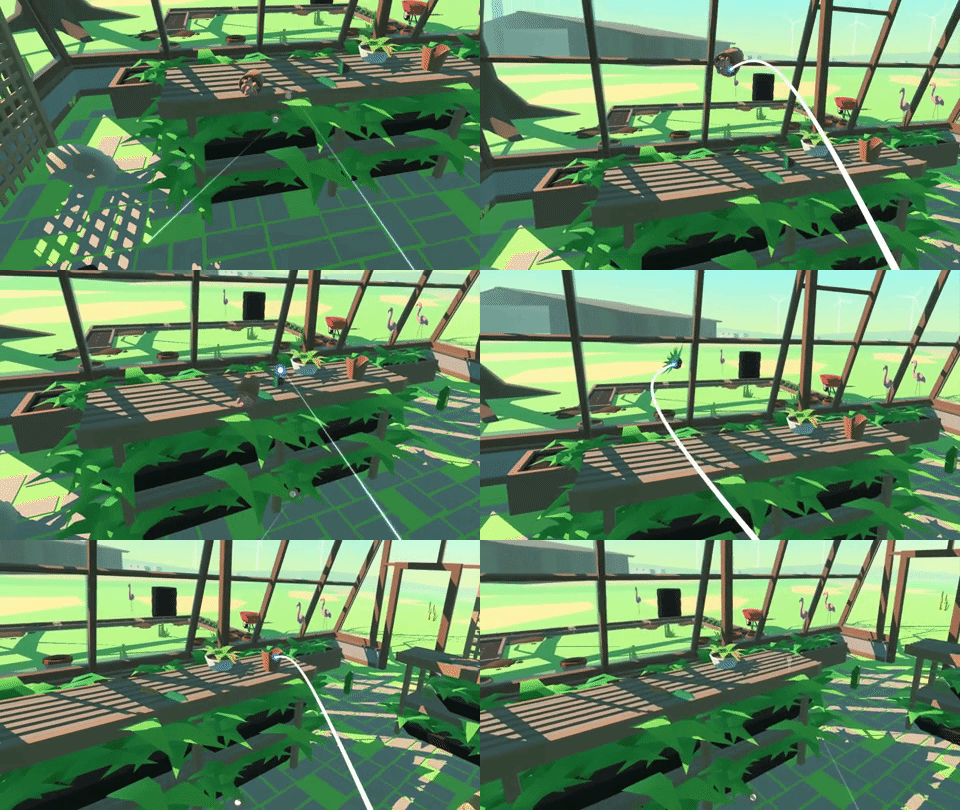 The choice of the leash was also informed by the distance between players and the objects that they interact with. Early VR experiments at Tender Claws resulted in us constraining object interactions to the “mid-range.”
We began the process of localizing Virtual Virtual Reality into eight languages after the game launched on Daydream.
The decision to use subtitles instead of recording dialogue in new languages was a matter of resources and quality control.
Early into our development of the headset transition mechanic at a 2015 hackathon, we realized that the experience of taking off and putting on headsets had potential beyond a narrative framing device. We wanted players to interact with headsets as often as possible.
See the full story here: https://www.roadtovr.com/designing-virtual-virtual-reality-mitch-mastroni-tender-claws/