AR Is Transforming Tech. What Can It Do for Cities?
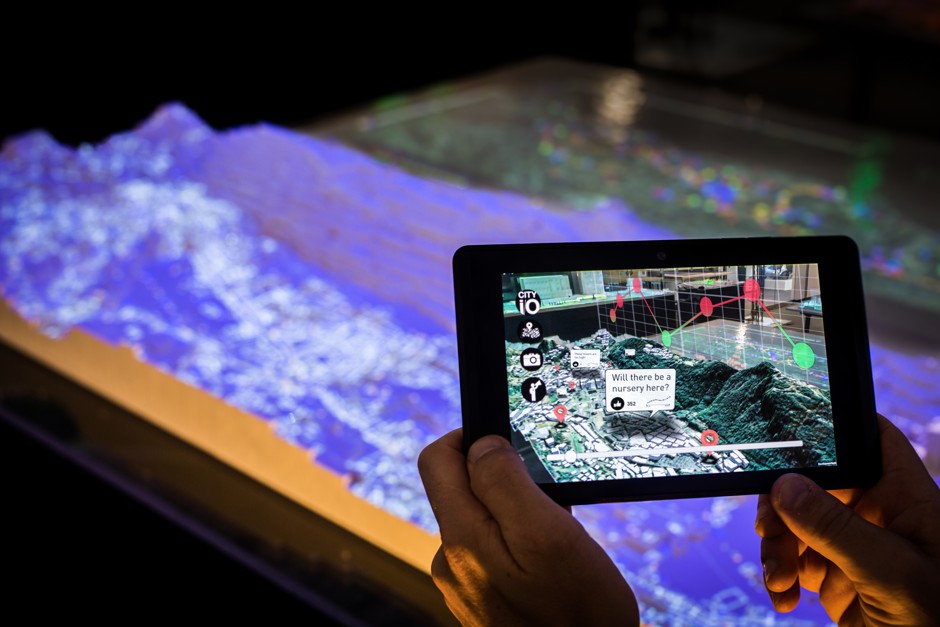 In 2016, as a part of its City Science initiative, the Massachusetts Institute of Technology (MIT) Media Lab collaborated with the City of Hamburg on a project called Finding Places, using optically-tagged LEGO bricks, simulation algorithms, and augmented reality to model potential locations for refugee accommodations. MIT researchers held dozens of community engagement meetings with local leaders and community members, where participants gathered around displays of the city that adjusted in real-time to user interactions, showing key statistics and transformations of urban areas.
Ariel Noyman, a researcher with the City Science project at the MIT Media Lab, has argued that “physical, tangible tools are better for understanding what happens in a city.” AR can vivify once-static data: “If we add an office building, that might be another 700 people leaving in cars and more congestion,” he said. However, there’s a huge difference between hearing this statistic and seeing it played out. “We want people to be able to physically visualize congestion,” he continued.
This year, both Apple and Google enabled AR as default in their devices, a sign that AR is “going to be something that we use seamlessly more and more,” Noyman said. If the trend continues, these kinds of large-scale civic engagement projects will become more and more feasible, as will other applications in local government.
A number of startups have already created AR tech with these capabilities, if not yet these city applications. Blippar’s AR City mobile app embeds directions as well as info on local restaurants, hotels and more into users’ view of the city landscape. A motorcycle helmet from BMW visualizes route guidance and flashes warnings about roadwork into riders’ vision. White Raven’s AR for connected vehicles displays info on nearby entertainment and retail offers as the driver passes by. It’s only a matter of integrating more existing data into these systems.
A number of other institutions including the University of Washington, American University, and Shanghai University have begun exploring government applications
Earlier this year, the City of New Rochelle won $100,000 via the Bloomberg Mayors Challenge to use augmented reality for participatory development, and is now competing for the $5 million grand prize.
See the full story here: https://www.citylab.com/life/2018/08/ar-is-transforming-tech-what-can-it-do-for-cities/566618/