A Hologram Hits the Runway
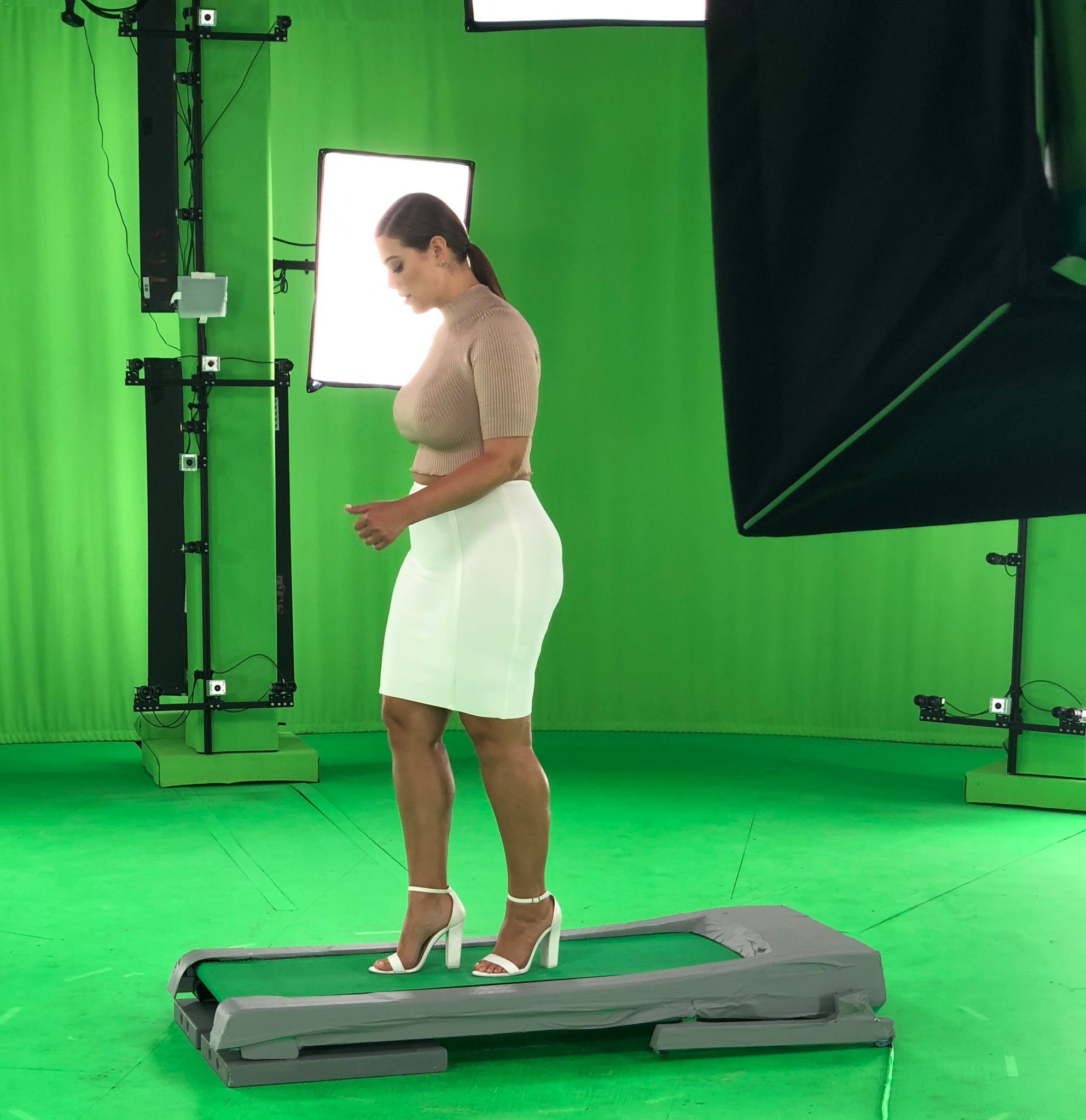 Our subject was the model and activist Ashley Graham. She had a strict cutoff at noon, and we were leaving extra time for things to go wrong.
As part of “Ashley Graham, Unfiltered” — an interview conducted by Joanna Nikas, a New York Times Styles editor, that explores issues around body image — readers who have downloaded the New York Times app (iOS) onto their iPhones or iPads can project a hologram of Ashley into their space as she demonstrates poses and her runway walk.
This is a new video format, with a new production process. Rather than record Ashley from just a few perspectives, she is captured from all angles using more than 100 cameras positioned around her on a stage that is essentially a giant green-screen in-the-round. The images from the cameras are then composited and processed together to create a single “hologram” that, when viewed through the screen on your phone or tablet, can be placed into your own physical environment.
We recorded Ashley Graham at Metastage, a brand new volumetric video studio in the Culver City Studios complex. “Having Ashley as one of our first captures was a testament to how far we’ve come with female empowerment in business,” said the studio’s chief executive, Christina Heller. “We had a strong, vivacious supermodel performing on a state-of-the-art volumetric capture stage run by women. The energy was fun and inclusive, just like it should be.”
The capture zone is confined to an 8-foot-diameter circular area, for instance, which required some creative problem solving — such as designing walk patterns that would fit and look natural in a small space. “It was like a math problem,” Joanna noted. Before she even stepped onto the stage, we worked with Ashley on a piece of circular carpet outside the dressing room area, drawing patterns and arrows on paper as if planning a football play.
We also needed to work within specific styling guidelines from the studio. No super-skinny stiletto heels, for example, and hair needed to be contained to a unified shape, as small flyaway strands are confusing to the capture system.
...personal space. We’ve solved this for now by having the hologram go transparent once a certain threshold of closeness is crossed.
To find other augmented reality projects, readers can choose the “Immersive AR/VR” tab in the NYTimes app.
See the full story here: https://www.nytimes.com/2018/09/05/insider/ashley-graham-hologram-augmented-reality-video.html