How Augmented Reality and Virtual Reality Can Revolutionize Science
At Springer Nature (the parent company of Scientific American), we are looking to our own scientific data and imagining where all that information can take us when given a new life inside AR/VR applications.
To that end, we will be hosting our first-ever mixed-reality Hackathon, November 7–9 in San Francisco, hosted at the Microsoft Reactor.
Participants will bring their favorite AR/VR headsets, their laptops and lots of creative energy; Springer Nature will provide access to millions of scientific data points through various APIs. Teams will solve real world problems, visualizing data across the sciences, in categories like Health, Humanitarian Aid, the Environment, an Inclusive World and more. ...
Despite all advances, you still had to understand a three-dimensional object (the synapse) from a two-dimensional viewer (your screen).
ENTER VIRTUAL REALITY
With the arrival of the fifth wave of computing, amazing techniques like artificial intelligence, blockchain and virtual reality have become more mainstream, and, subsequently, products have been built that embrace these new kids on the block. ConfocalVR is one of them. These and similar VR applications give science a new dimension and allow researchers to view and share data as never before, as was also noted in a recent Nature "Toolbox" article.
Springer Nature continues to keep an eye on new technologies that can help our readers interact with scholarly publishing in impactful, engaging ways. One of our favorite ways that we do this is through a recently launched series of Hack Days and Hackathons; at these events, we have seen rapid prototyping of some incredibly imaginative applications that take research data and scholarly publishing to the next level. Previous #SN_HackDays explored challenges in discovery, research data and analytics.
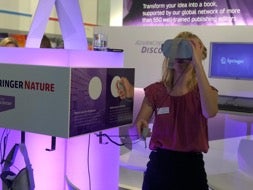
During our next Hackathon, we will build from our VR experiments and take a more visual approach to scientific data, inspired by advances in mixed-reality technologies.
See the full story here: https://blogs.scientificamerican.com/observations/how-augmented-reality-and-virtual-reality-can-revolutionize-science/