Serving virtual reality Raspberry Pi to flies
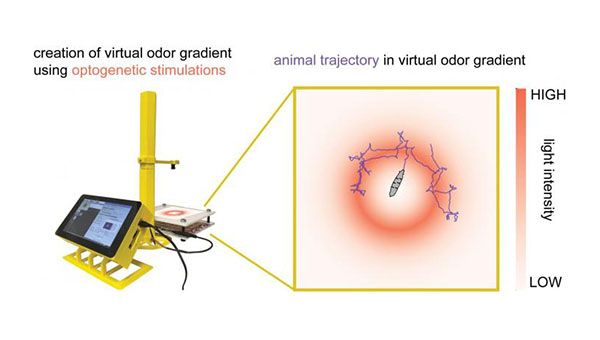 The Raspberry Pi Virtual Reality system (PiVR) is a versatile tool for presenting virtual reality environments to small, freely moving animals (such as flies and fish larvae), according to a study published in the open-access journal PLOS Biology by David Tadres and Matthieu Louis of the University of California, Santa Barbara. The use of PiVR, together with techniques like optogenetics, will facilitate the mapping and characterization of neural circuits involved in behaviour.
In the new study, Tadres and Louis used their PiVR system to present virtual realities to small, freely moving animals during optogenetic experiments. Optogenetics is a technique that enables researchers to use light to control the activity of neurons in living animals, allowing them to examine causal relationships between the activity of genetically-labelled neurons and specific behaviours.
As a proof-of-concept, Tadres and Louis used PiVR to study sensory navigation in response to gradients of chemicals and light in a range of animals. They showed how fruit fly larvae change their movements in response to real and virtual odour gradients. They then demonstrated how adult flies adapt their speed of movement to avoid locations associated with bitter tastes evoked by optogenetic activation of their bitter-sensing neurons. In addition, they showed that zebrafish larvae modify their turning manoeuvres in response to changes in the intensity of light mimicking spatial gradients. According to the authors, PiVR represents a low-barrier technology that should empower many labs to characterize animal behaviour and study the functions of neural circuits.
See the full story here: https://www.labnews.co.uk/article/2030709/serving-virtual-reality-raspberry-pi-to-flies