OpenAI’s fiction-spewing AI is learning to generate images
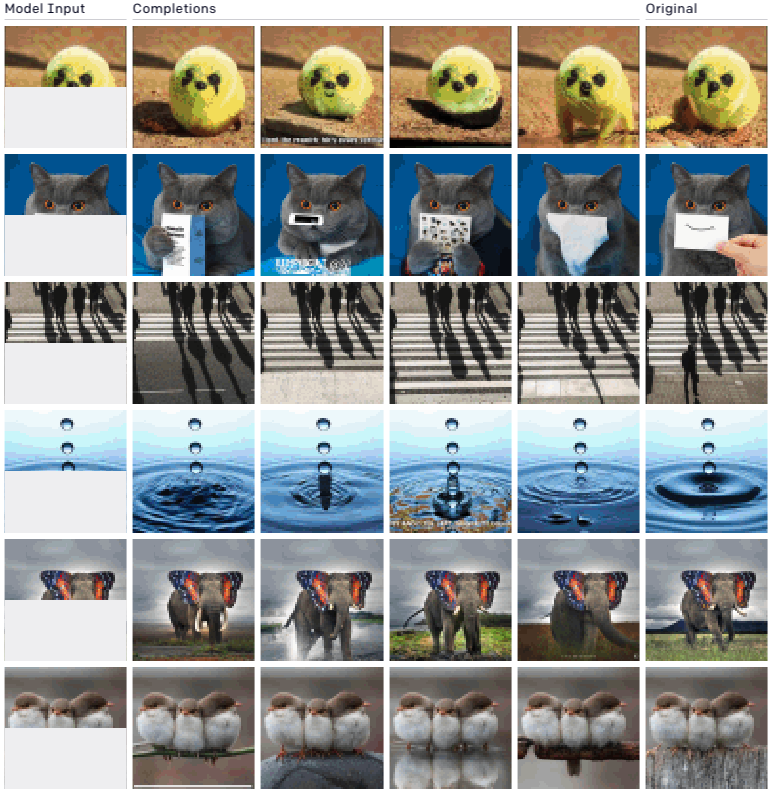 At its core, GPT-2 is a powerful prediction engine. It learned to grasp the structure of the English language by looking at billions of examples of words, sentences, and paragraphs, scraped from the corners of the internet. With that structure, it could then manipulate words into new sentences by statistically predicting the order in which they should appear.
So researchers at OpenAI decided to swap the words for pixels and train the same algorithm on images in ImageNet, the most popular image bank for deep learning. Because the algorithm was designed to work with one-dimensional data (i.e., strings of text), they unfurled the images into a single sequence of pixels. They found that the new model, named iGPT, was still able to grasp the two-dimensional structures of the visual world. Given the sequence of pixels for the first half of an image, it could predict the second half in ways that a human would deem sensible.
The results are startlingly impressive and demonstrate a new path for using unsupervised learning, which trains on unlabeled data, in the development of computer vision systems.
At the same time, the method presents a concerning new way to create deepfake images.