Come for the Network, Pay for the Tool
As high quality content and effective brand strategy move down the long tail, “community” has become an important concept for every post-Web 2.0 player. Crypto token holders, influencer fanbases, DTC brand customers, creator audiences, and new social networks are all often referred to as communities, and each has a stake in developing community for itself.
A new business type here is the paid community: a direct subscription to join in. Today, most paid communities live on the outskirts of existing social platforms. But as they become normalized, paid communities are becoming a viable business model for smaller-scale social networks aiming to be both profitable and socially sustainable.
This emerging new media thing, the paid community social network, has new rules and new risks, and just as it will require new skillsets to operate, requires a new way of understanding what both business and community mean.
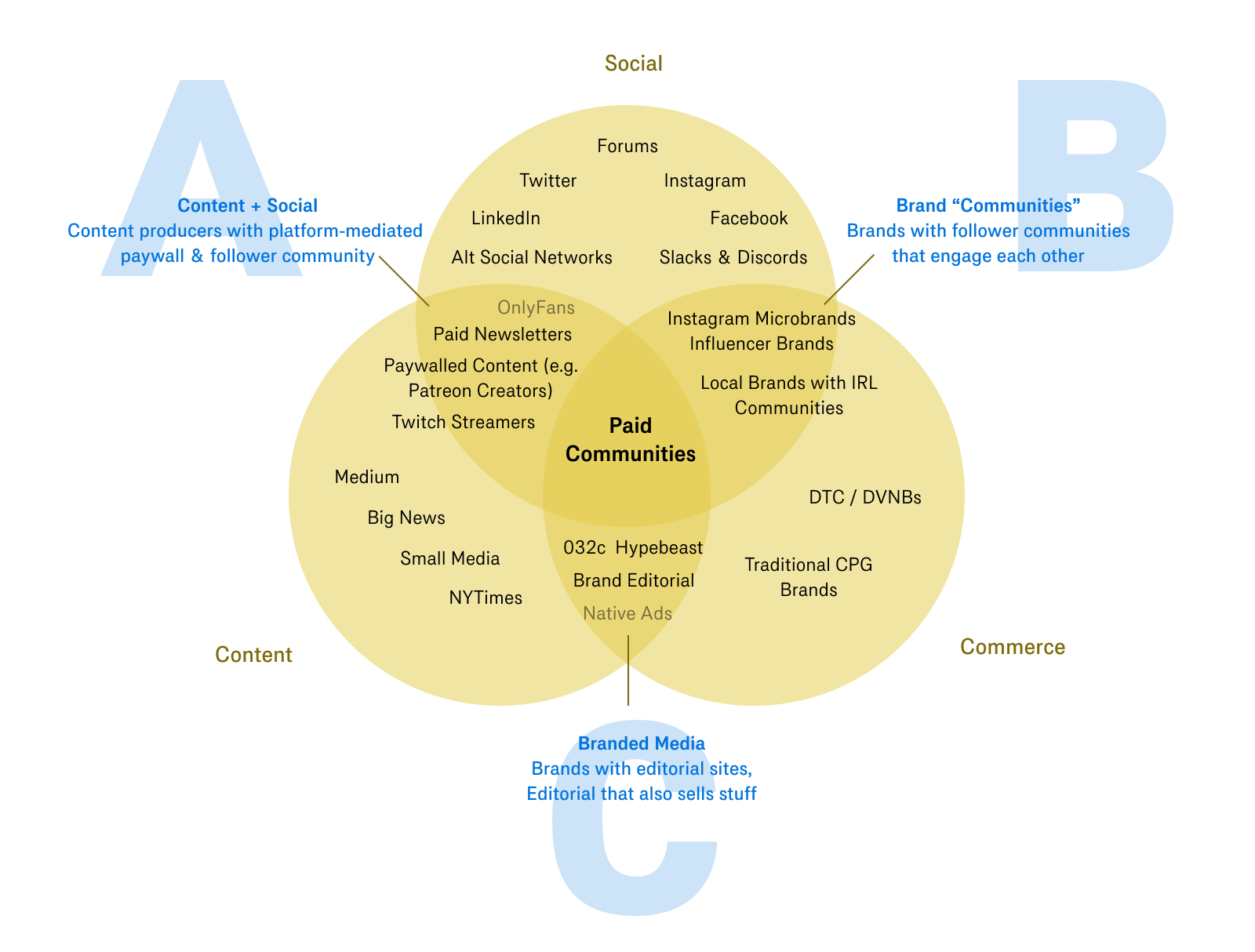
Paid Communities Are a New Business Model for Bespoke Social Media
Meanwhile, dozens of alternative social networks have sprouted up in the last couple years. With the maturation of Javascript-based web development and plenty of front-end talent, it’s become easy to build complex web applications with tiny teams. futureland.tv, Dialup, Special Fish, and alternative dating app Bighead are among these new experiments. These alternative social networks are interesting in part because they prove that dissatisfaction with mainstream web has motivated significant movement to alternatives. But they are also interesting because of their unique user communities.
Businesses want to be active participants in their customers’ social landscape, because brand values are the last battleground for differentiation.
Bloomberg
The key point to understand about Bloomberg is that it’s both a software product and a social network. The software product determined who would join the network, but the network is what keeps users there. It’s like a multiplayer video game, or Harvard: Sure, the quests and campus are useful, but people keep showing up because of the friends they’ve made or the connections they intend to make.
“come for the network, pay for the tool.”
See the full article here: https://subpixel.space/entries/come-for-the-network-pay-for-the-tool/?fbclid=IwAR2qlZbBMzJY9bHrSPmXMdE0kKOhmoSB6uAauetBpks_3FbV5nUQE4cJefQ