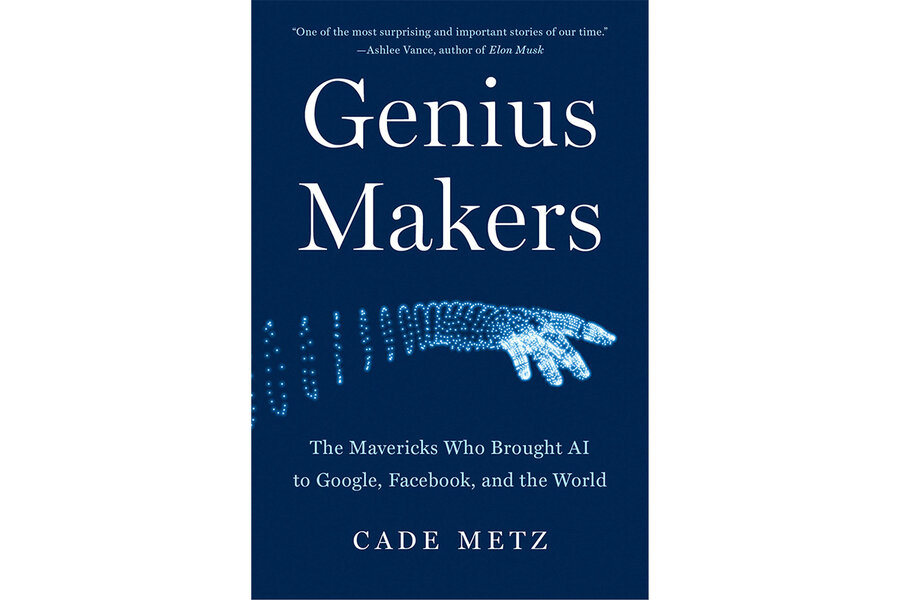
Machines that learn: The origin story of artificial intelligence
Metz shares the origins of AI in 1958, when a Cornell professor successfully taught a computer to learn. The machine was as wide as a kitchen refrigerator, and was fed cards marked with small squares on either the left or right sides. After reading about 50 of them, it began to correctly identify which cards were which – thanks to programming based on the human brain.
Overhyped expectations exceeded the technology of the era, and the study of so-called neural networks capable of replicating human intelligence remained largely fallow in subsequent decades. Even so, by 1991 the technology had advanced to a point that a machine could learn to identify connections on a family tree or drive a Chevy from Pittsburgh to Erie, Pennsylvania.
As interest in AI waxed and waned, early progress in the field came from just a handful of scientists. Metz focuses on Geoffrey Hinton, a British-born Canadian scientist who sold his startup to Google and subsequently won the Turing Award – the Nobel Prize of computing.
The potential is immense. So are the risks, and Metz touches on some of the pitfalls that have already emerged.
For the most part, though, Metz focuses less on the ethics of AI – and its potentially troubling future applications – than he does on how researchers got to the present moment.
See the full story here: https://www.csmonitor.com/Books/Book-Reviews/2021/0323/Machines-that-learn-The-origin-story-of-artificial-intelligence