Virtual reality study sheds light on what happens when your brain can’t tell which way is up or down
Visual reorientation illusion (VRI) is a phenomenon in which one’s perception of body positioning (e.g. standing vs. lying down) or motion (e.g., moving vs. static) disagrees with reality. It can be induced by tricking the brain with false sensory data: rotating a room 360º about a horizontal axis, for example, or tilting a room 90º with familiar objects (e.g. a lamp) whose orientation disagrees with gravity.
Beyond the purely scientific interest in understanding how differing and contrary signals are interpreted by the brain, being able to reliably produce (or combat) sensory illusions has practical applications in transportation and the future of immersive gaming and virtual experiences. In the present study, published in PLoS ONE, scientists from York University in Canada took a closer look at how the brain weighs contradictory sensory signals.
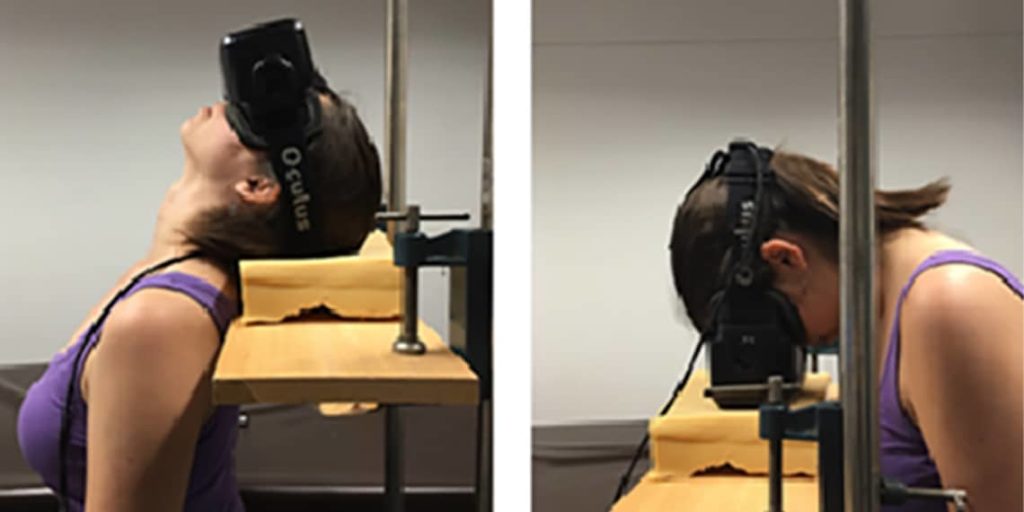
The series of three studies, involving a total of 72 participants, used supine (lying on one’s back) and supine-like (head tilted back), prone (lying face-down) and prone-like (head tilted forward), and standing positions to manipulate sensations of gravity, while a VR helmet provided corollary or contradictory visual stimuli, in the form of either a hallway (strong up-down signals) or starfield (ambiguous up-down signals).
See the full story here: https://www.psypost.org/2021/05/virtual-reality-study-sheds-light-on-what-happens-when-your-brain-cant-tell-which-way-is-up-or-down-60874