A Perspective of Americans’ Attitudes Toward Artificial Intelligence (Market Research by the Stevens Institute of Technology
PhilNote: this research covers a good spectrum of issues and beliefs, with lots of graphs.
KEY FINDINGS
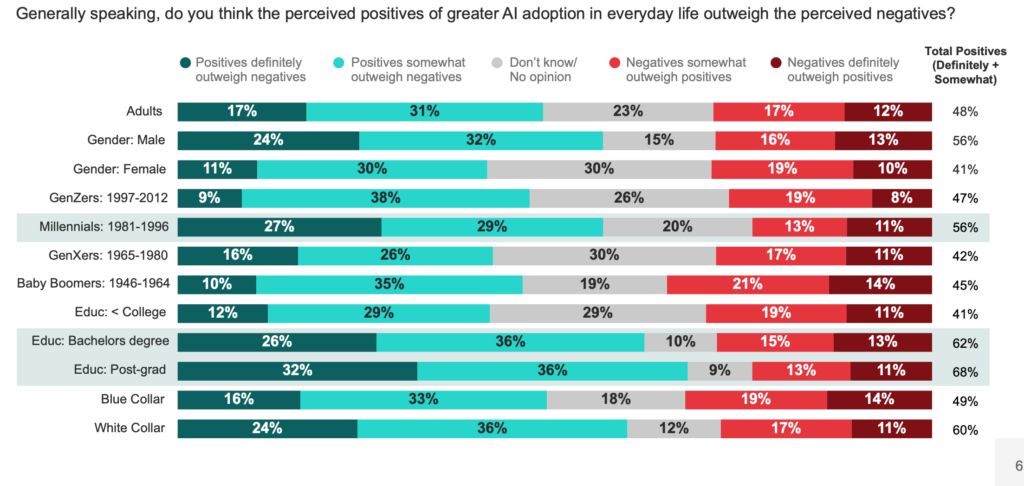
- Although adults have concerns about the potential negative consequences of greater AI adoption, nearly half (48%) believe the perceived positives of greater AI adoption in everyday life outweigh the perceived negatives.
- Adults believe AI should play a greater role in a number of tested industries in the future, including technology (66%), manufacturing (61%), logistics (58%), and retail (52%).
- Despite a general openness to AI playing a larger role in different industries, adults believe that among the specific tasks tested, most are still best accomplished by humans alone or with some degree of assistance from AI.
- Concern about AI’s potential negative consequences is high, with adults most concerned about a loss of personal privacy (74%), AI being used irresponsibly (72%), reduced employment opportunities (71%) and reduced human connectedness (71%), among the tested options.
• Half of adults (52%) believe it is likely that AI will become smarter than humans, and nearly two thirds (63%) believe AI will control too much of everyday life.
3. Majorities of adults believe AI has played a role in loss of trust in elections (57%) and institutions (56%), as well as the spread of misinformation (58%), political polarization (53%), and threats to democracy (52%).
• Democrats are more likely than Republicans to believe that AI has played a role in the spread of misinformation (64% vs. 56%) and in loss of trust in institutions (62% vs. 54%).
4. Adults view facial recognition as a responsible use of AI technology, and are comfortable with using it for tasks such as finding missing persons (70%) and pets (68%), for law enforcement use such as identifying and monitoring criminals (65%), and for identifying fraudulent behavior when making purchases (64%).
• Deepfakes, which are highly convincing digitally altered sound and images that are made to appear real, prove to be more divisive. Adults are nearly evenly split on whether using AI to create deepfakes is a responsible (38%) or irresponsible (36%) use of the technology.
See the full report here: https://www.stevens.edu/sites/stevens_edu/files/files/AI-survey/AI-Summery-Deck.pdf