What Culver City Election Data Tells Us About City Council Decisions
During the 2024 Culver City council elections there was a lot of talk about outside money and outside influence. But no one was asking where the candidates themselves were getting their money.
So last January, after all of the candidates completed their campaign finance filings, I downloaded all of their FPPC (Fair Political Practices Commission) filings from the public portal, converted the pdf files to spreadsheets, aggregated the data on individual candidates into master spreadsheets, and analyzed the data by geographic area. All of this, from FPPC pdf through resulting graphs, is posted on www.CulverCityElectionDonationData.com for anyone to verify and use.
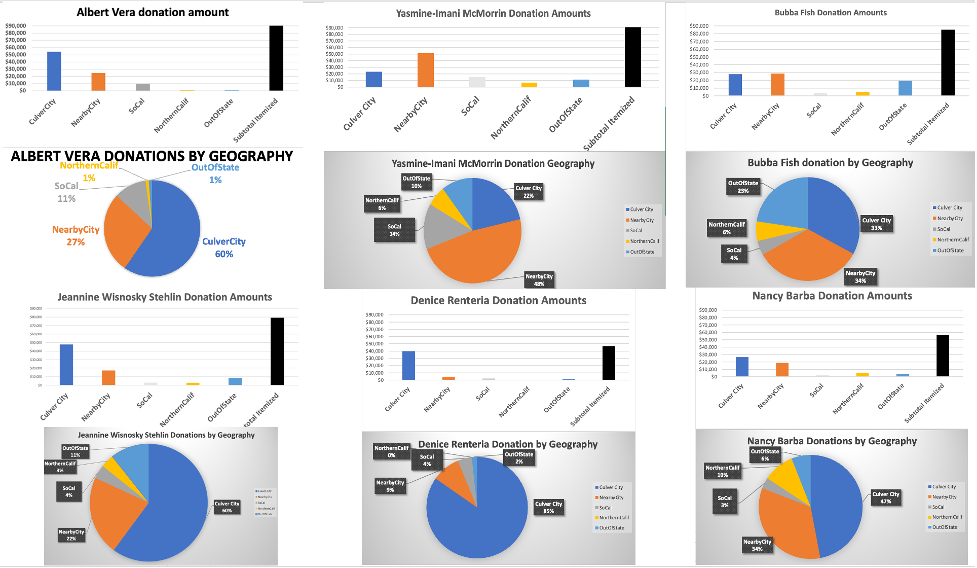
(See these plots, and their source data, at www.CulverCityElectionDonationData.com )
The bar charts show total dollar donations by geographic area, and the pie charts show percentage of donations by geographic area. All of the 2024 candidate bar charts use the same vertical scale, topping out at $90,000.
The most important color is dark blue. Dark blue represents donations from people who enter Culver City as their address. It is safe to assume that most of the people who did so are actual residents of Culver City.
The maximum donation any citizen could make to a 2024 Culver City council candidate was $1,120. Because of this limit, the dark blue total dollar donation bar and percentage of donations pie chart wedge are an excellent proxy for how much effort each candidate put in to convincing the citizens of Culver City that their ideas and candidacy were worth supporting.
The full geographic area breakdown is;
- Culver City (dark blue)
- Nearby Cities (orange); the surrounding cities are Santa Monica, Beverly Hills, Los Angeles, Venice, Inglewood, West Hollywood, Pacific Palisades, Marina del Rey, Playa del Rey, Brentwood, View Park – Windsor Hills (near Inglewood)
- Southern California (grey); the rest of southern California up to Santa Barbara
- Northern California (yellow); the rest of the state beyond southern California
- Out Of State (light blue); the other 49 states
The three winning candidates were Albert Vera, Yasmine-Imani McMorrin, and Bubba Fish.
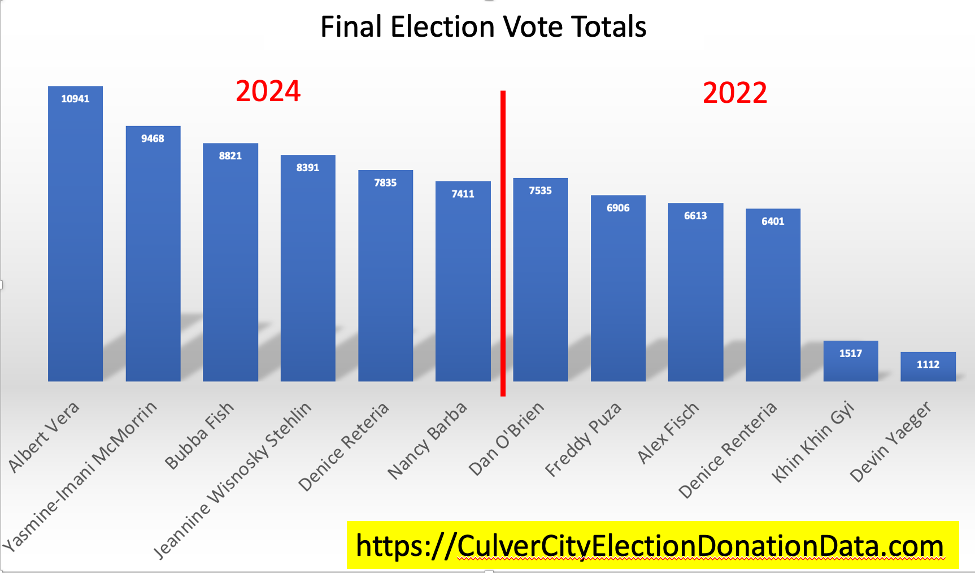
The next logical question was; how do the fundraising patterns of these three candidates compare to those of the other two Council members. So I repeated the process for the 2022 election campaign filings of Dan O’Brien and Freddy Puza. (Note that Dan O’Brien’s bar chart has a different vertical scale.)
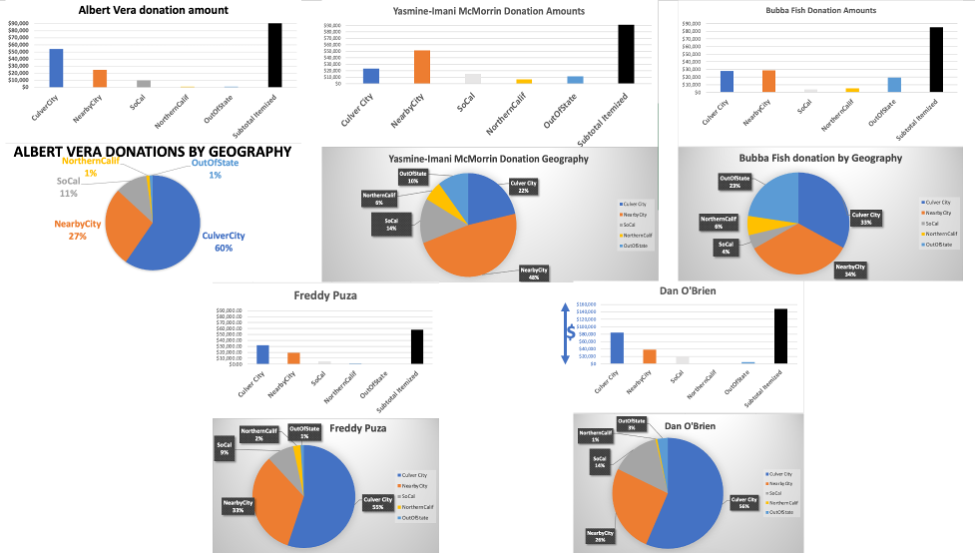
(See these plots, and their source data, at www.CulverCityElectionDonationData.com )
Editorial
I presented the above data as a non-agenda item at the January 12, 2026 City Council meeting because I wanted to make a general point. I began by saying; at the last governance sub-committee meeting I asked the co-chairs Yasmine-Imani McMorrin and Bubba Fish what they were doing to socialize their ideas among the citizens of Culver City – especially among people who might not agree with them.
The governance committee is working to update Culver City government processes and to find ways to increase citizen engagement and participation in our local government activities.
Some of the co-chairs’ ideas will require funding by the city at a time when the city is deeply in debt.
All new ideas can have unintended consequences. The value of engaging with people who have diverse opinions and backgrounds is that they may identify and mitigate the impact of unintended consequences that you may personally be blind to in the proposed solution.
Since the co-chairs’ goal is to increase citizen engagement in government activities, it stands to reason that the co-chairs should have a strategy for engaging Culver City residents in this process; especially those who may not agree with the co-chairs or whom the co-chairs may not agree with.
When I asked the co-chairs about this, Bubba Fish politely suggested that we talk about it later. When I looked to Yasmine-Imani McMorrin for a response, she remained silent.
One of the take-aways from the campaign donation data above is that Councilpersons McMorrin and Fish put the least effort into connecting with and understanding the Culver City community as a whole of any of the candidates during their campaigns. Their fundraising statistics for donations from Culver City residents (McMorrin: $23,056 / 22% of total raised, Fish: $28,081 / 33% of total raise) pale in comparison to not only the highest vote-getter Albert Vera ($54,059 / 60% of total raised), but also to two of the three losing candidates. Put the other way, Bubba Fish received $57,149 / 67% of his campaign funding and Yasmine-Imani McMorrin received $84,130 / 78% of her campaign funding from people outside of Culver City.
Councilpersons McMorrin and Fish fare just as poorly in comparison to their fellow Councilmembers Dan O’Brien ($83,895 / 56% of total raised from Culver residents) and Freddy Puza ($31,883 / 55% of total raise from Culver residents).
If the co-chairs had a quick answer to my question, this data could be considered an historic behavior pattern that they were working to overcome. Because they did not have a ready answer, I can only assume that nothing in their Culver City community outreach strategy has changed. That they are focused on serving their political base and the outside groups who support them and whom they support. That they are not concerned with engaging with and winning over the community as a whole.
Culver City has gone through multiple cycles of 3:2 voting blocks on the City Council where the majority has downplayed – and in some cases demonized - the concerns of the minority.
Proactive outreach to communicate with, understand, and incorporate the concerns of “the other side” will lead to better solutions. It will reduce the chance of community outrage when citizens who normally pay no attention of local politics are suddenly impacted by a Council decision. And it could positively impact the effort and cost in the City Council campaigns of people working to flip the 3:2 majority to 2:3 majority every two years.
An easy shortcut to achieving this would simply be to work on compromises that both sides of the 3:2 divide on the council can support. Given that in their respective elections Dan O’Brien and Albert Vera received the most money from Culver City residents of any candidate, received the highest percentage of their campaign funding from Culver City residents than any winning candidate, and got the greatest number of votes in the election of any candidate, the electorate has signaled that Councilmembers O’Brien and Vera represent ideas and positions support by a significant portion of Culver City’s citizens. Crossing the 3:2 divide and finding compromise would result in more popular and sustainable solutions from the council.
Working towards more 5:0 council votes may be asking too much. But asking elected officials to make a proactive effort to incorporate the concerns of the entire electorate in their activities so that their decisions are more supported and more sustainable seems reasonable to me.