The Future of Personal Entertainment, In Your Face
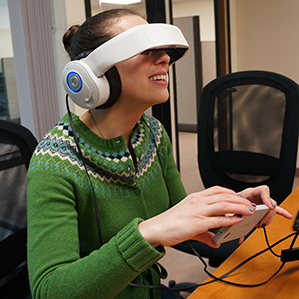 [Philip Lelyveld comment: This is a new augmented reality solution that may be an improvement over the Oculus Rift.]
So what makes the Glyph special? Avegant says it’s the headset’s image projection method, which reflects light onto each retina through a series of lenses and tiny mirrors and makes for sharper, easier-to-watch images than using a screen, as many competing products like Oculus Rift do. Its ability to mimic depth certainly makes it particularly good at showing natural-looking 3-D content.
I first watch an action scene ripped from a 3-D Blu-ray of the movie Avatar, which plays from a connected laptop (the Glyph can connect to any media player with an HDMI input, so you can use it with many smartphones, laptops, and tablets). With the Glyph on, I see what appears to be a large, bright screen in front of my face, with a black frame around it, and I can gaze above and below at slivers of the outside world. The Na’vi appear to fly around in front of my face, yet I don’t sense the delays, screwy coloring, or image doubling that I’ve noticed when viewing 3-D content in the past. There are some pixelated shots, but I’m told those are glitches in the Avatar file, not the device.
The Glyph enables this by emitting light from a low-power LED, which is reflected by an array of two million tiny mirrors onto a lens system and then projected to the back of your retinas. This seems to make for a much more comfortable viewing experience. I would happily watch a whole movie like this if time permitted.
I’m also surprised to learn that I can wear the Glyph without my glasses, since I can adjust the distance between each pupil and focus each eye individually.
See the full story here: http://www.technologyreview.com/news/523966/the-future-of-personal-entertainment-in-your-face/