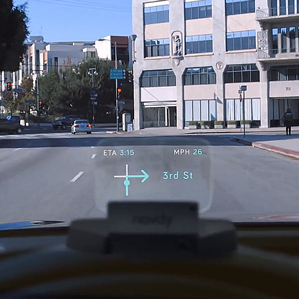
A heads-up display could be safer than glancing at your smartphone while driving—but some features may be more distracting than others.
Market research company IHS estimates that 348,000 cars will be sold in the U.S. with heads-up displays this year, up from 247,000 million in 2013. But cars with built-in systems tend to be pricey; what’s more, most heads-up displays tend to do just a few simple tasks, such as showing directions or speed.
Navdy began taking orders on Tuesday for its $299 device. It is expected to ship to customers early next year.
To make Navdy work, data is sent via Bluetooth from a companion smartphone app (both iPhone and Android will be supported initially). A tiny projector projects the image onto a small screen that the driver looks through to see part of the road.
An infrared camera—not built into the device I saw—will let the device recognize gestures such as swiping to accept an incoming call. You can also text and tweet by gesturing to bring up a microphone and dictating a message, Simpson says. Eventually the system will be opened to outside developers, but to start it will work only with a number of apps, such as navigation apps like Google Maps and music apps like Pandora and Spotify.
Paul Green, a research professor in the driver interface group at the University of Michigan Transportation Institute, says that whether a heads-up display is distracting depends on how it’s implemented—whether it interferes with you seeing things or is bright enough for use at night and during the day, for example.