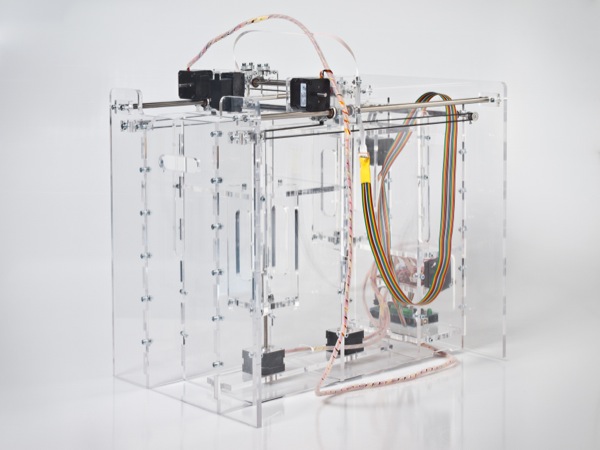
 “Unlike the MakerBot and RepRap printers that build objects by melting plastic, or the Form 1 that uses a laser to cure resin, Pwdr works just like a desktop printer,” explains Wired. “An HP inkjet deposits a liquid binder, mixed with ink, onto a layer of white gypsum powder. After the printhead passes, a roller bar drags a thin layer of powder across the surface and the process repeats a couple hundred, or thousand, times.”
“When completed,” the article continues, “the printer looks like a fish tank full of baby powder and the model needs to be carefully removed, dusted off, and dipped in clear glue that infiltrates the part and solidifies it. This process is essentially the same as what ZCorp 3D printers offer and opens the potential for hobbyists to create models featuring thousands of colors using a CMYK process, not the two or three offered by newer home user systems.”
See the full story here: http://www.wired.com/design/2013/01/pwdr-3d-printer-open-source/
 [Philip Lelyveld comment: I'm having trouble understanding how the recording element is a "pixel" as opposed to a volume.]
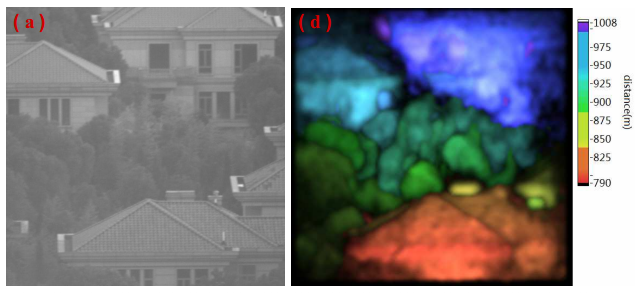
Ghost imaging is the extraordinary technique of bouncing a laser beam off an object and making high quality images from the reflected light using a single pixel. This single pixel records many data points which must be stitched together to create the image.
But there is no scanning involved (which would be equivalent to taking an ordinary picture very slowly).
Instead, the data from the single pixel is compared against the intensity of the original laser beam, which must be randomised by passing it through frosted glass. Then any correlations between the original and reflected beam reveal information about the object in the image.
It is these correlations that physicists use to assemble the picture, known as a ghost image.
That may sound rather fiddly and time consuming but it is actually hugely efficient.
See the full story here: http://www.technologyreview.com/view/510411/first-3d-images-created-with-single-pixel-sensor/
In an attempt to circumvent what prying eyes see (and perhaps get themselves out of potential future issues), Kent State University students Daniel Gur, Camden Fullmer, and David Steinberg spent a weekend together at a Hackathon at the University of Pennsylvania, and came up with a way to make the very public face of your Facebook stream at least look more professional.
Called FaceWash, the website will search your Facebook posts, tags, photos and more to find things that might prove controversial or downright embarrassing, should a prospective employer decide to take the time to scan your publicly shared posts. And these days, more and more bosses do...
See the full story here: http://technorati.com/social-media/article/got-a-job-interview-new-site/
Although the idea of networking machinery isn’t new, GE thinks that cheaper computing power and sensors are now poised to usher in a new era of big data for industry. Jeff Immelt, GE’s CEO, has called the idea arevolution, and the company’s top economist has suggested it could help increase worker productivity by as much as 1.5 percent a year.
With its push for the industrial Internet, GE may find it’s selling an idea that some manufacturers aren’t convinced is really new. Down the road from GE’s Schenectady plant, in Cohoes, New York, manufacturer Mohawk Fine Papers already monitors how much energy its machines use, pulling together the data in an analytics program it bought from a company called OSISoft. “A lot of the basics of what we’re talking about have been available to companies for years,” says Kim E. Osgood, Mohawk’s director of engineering and energy services.
See the full story here: http://www.technologyreview.com/news/509331/an-internet-for-manufacturing/?utm_campaign=newsletters&utm_source=newsletter-daily-all&utm_medium=email&utm_content=20130128
Google is seeking an experimental license to operate radio frequency gear in the airwaves of its Bay Area headquarters. The search giant filed an application with the Federal Communications Commission for a two-year license to run experimental equipment on 2 GHz frequencies in Mountain View at a 3.2 mile radius.
[Philip Lelyveld comment: is this, coupled with their St Louis experiment, part of a larger plan to create a walled garden fully integrated service?]
Google is seeking an experimental license to operate radio frequency gear in the airwaves of its Bay Area headquarters. The search giant filed an application with the Federal Communications Commission for a two-year license to run experimental equipment on 2 GHz frequencies in Mountain View at a 3.2 mile radius.
Google’s game plan isn’t specified in the filing, but bloggers for both The Atlantic and The Wall Street Journal surmise that the company is creating its own wireless network. However, the Mountain View filing is for a “new or modified radio station,” where previous filings specified experimental Wi-Fi operations.
Another of Google’s experimental licenses covers 2 GHz frequencies in Cambridge, Mass., New York, Mountain View and Los Angeles, where the company is testing next-generation Wi-Fi devices. The company was originally granted Special Temporary Authority to test the devices on Jan. 26, 2012, and has since received an extension for operations through Jan. 31, 2013.
See the full story here: http://www.tvtechnology.com/news/0086/google-files-to-transmit-on-home-turf-airwaves/217418
The Sony Entertainment Network debuted on Friday in North America. Available to European territories since December, the new content hub has expanded to Canada, Mexico, Brazil and the U.S. The network collates all of Sony’s media offerings into a single online storefront, featuring full PS3 games, downloadable games, music, movies, TV shows, avatars, add-ons, season passes, special deals and more.
“Between the PlayStation division, Sony Pictures, and the record labels the company owns, Sony has a massive amount of entertainment content to offer its fans, but prior to SEN, the company had no real unified strategy for delivering this content to prospective buyers,” reports Digital Trends. This initiative changes that.
See the full story here: http://www.digitaltrends.com/computing/sony-entertainment-network-now-offers-americans-new-ways-to-spend-their-cash/
Mark Ury came up with the concept for the storytelling site Storybird in 2010 after working on a storybook with his young son. The website, for “art-inspired storytelling,” now has more than two million members. It “works with artists from around the world, who upload their portfolios onto Storybird’s platform. Users choose their art, sequence the images any way they like and add text to turn them into a story,” explains paidContent.
 The content is then shareable on social networks and can be embedded into blogs. According to the article, the HTML5Storybird site looks good on an iPad.
Originally envisioned for the family, Storybird is now in more than 125,000 schools, “with teachers issuing assignments to students and using the site in the classroom to help kids with their writing skills,” writes paidContent.
Read the full story here: http://paidcontent.org/2013/01/24/with-2-million-members-storybird-is-reverse-engineering-the-picture-book/
[Philip Lelyveld comment: this article contains good brief update descriptions of the different display options available to consumers.]
IT ISN'T YOUR IMAGINATION—television has become bewildering. We're not talking about the dizzying number of channels. We mean the televisions themselves: the technology that drives them and the features that differentiate one expanse of sprawling glass from the next. There are more acronyms than ever to decipher. LCD begot LED, which, in turn, spawned OLED. And just when "high-definition" seemed to be reaching the physical limit of resolution, along comes Ultra HD, a new standard so confusing that even the industry can't agree on what to call it (is it 4K, Ultra HD or 4K Ultra HD?). But these are exciting times, too. Images are sharper and bigger than ever before—and great displays are more affordable. If you're in the market for a new TV, there are a few key terms worth learning, whether you're looking to screen effects-laden blockbusters or just want to tune in to "Downton Abbey." From panels that are barely out of the prototype stage to the industry's steadfast push for 3-D, here's what you need to know to navigate the state-of-the-art in displays.
Read the full story here: http://online.wsj.com/article/SB10001424127887323468604578249643077519374.html
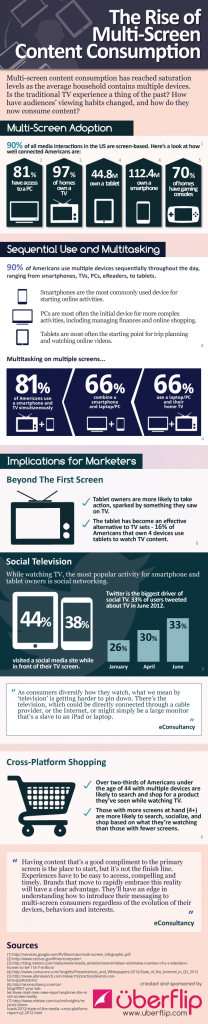
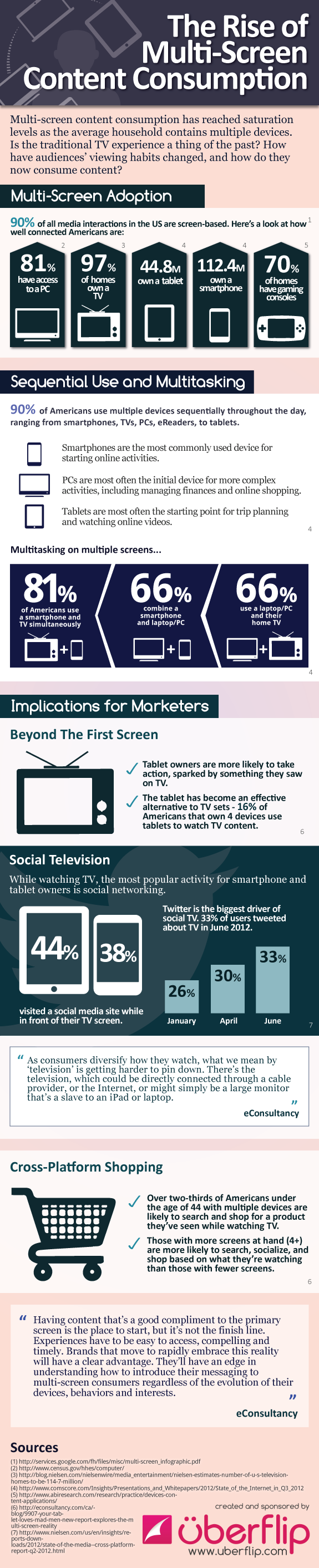
According to an infographic created and sponsored by Uberflip, 81% of Americans use a smartphone and watch TV simultaneously. The biggest use of the second screen appears to be social networking, and watching TV, it’s easy enough to see networks strive to make the connection. Nearly every reality show has related hashtags flash by occasionally, encouraging viewers to weigh in on Twitter, which is the biggest driver of social TV, with 33% of users tweeting about it last June.
See the full story here: http://www.uberflip.com/blog/infographic-the-rise-of-multi-screen-content-consumption
 Pest Control, the tongue-in-cheek-titled organization set up by the artist to authenticate the real Banksy artwork, also protects him from prying outsiders. Hiding behind a paper bag, or, more commonly, e-mail, Banksy relentlessly controls his own narrative. His last face-to-face interview took place in 2003.
While he may shelter behind a concealed identity, he advocates a direct connection between an artist and his constituency. “There’s a whole new audience out there, and it’s never been easier to sell [one’s art],” Banksy has maintained. “You don’t have to go to college, drag ’round a portfolio, mail off transparencies to snooty galleries or sleep with someone powerful, all you need now is a few ideas and a broadband connection. This is the first time the essentially bourgeois world of art has belonged to the people. We need to make it count.”
Read the full story here; http://www.smithsonianmag.com/arts-culture/The-Story-Behind-Banksy-187953941.html?utm_source=feedburner&utm_medium=email&utm_campaign=Feed%3A+smithsonianmag%2Farts-culture%2Fart-artists+%28Art+%26+Artists+%7C+Smithsonian.com%29
 Pest Control, the tongue-in-cheek-titled organization set up by the artist to authenticate the real Banksy artwork, also protects him from prying outsiders. Hiding behind a paper bag, or, more commonly, e-mail, Banksy relentlessly controls his own narrative. His last face-to-face interview took place in 2003.