philip lelyveld The world of entertainment technology

25Jan/13Off

The strange resurrection of Net neutrality

At the annual meeting of the Congressional Internet Caucus, the only issue that appeared likely to appear soon on lawmakers' agenda was an old one -- Net neutrality.

...But let's not kid ourselves. These are already fast lanes on the Internet, and Netflix its right to be deploying technologies to expand them as fast as possible. Critics who reflexively point to such developments as violating the spirit if not the letter of the FCC's Open Internet rules dangerously oversimplify a complex technical and business architecture. They aren't helping anyone, and certainly not consumers.

As U.S. Rep. Steve Scalise (R-La.) said in the closing keynote at State of the Net, "Our response to this newly converged marketplace should not be to level the playing field by extending legacy regulations to new entrants and technologies, but rather to let the Internet work and repeal the archaic and obsolete rules now on the books."

Scalise was talking about regulations that are unintentionally constraining the ability of legacy phone companies to replace their switched networks with new IP-based technologies. But, it seems, the FCC's more recent efforts to "preserve" the open Internet may have aged even more quickly.

Even if the FCC's Net neutrality rules survive the impending court challenge, they may prove to have little to offer Internet users -- little, that is, except for unfortunate and unintended consequences.

Read the full story here: http://news.cnet.com/8301-13578_3-57565561-38/the-strange-resurrection-of-net-neutrality/?part=rss&subj=news&tag=title

25Jan/13Off

Has Big Data Reached Its Moment of Disillusionment?
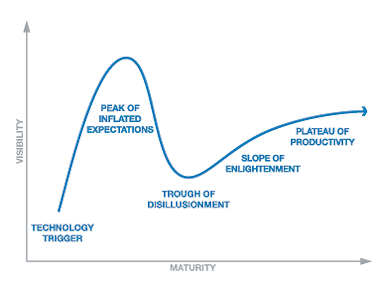
One source of that disillusionment, she writes, is that companies are struggling with a basic problem: What questions do you attempt to answer with your data in the first place? “Several days ago, a financial industry client told me that framing a right question to express a game-changing idea is extremely challenging,” Sicular wrote. “First, selecting a question from multiple candidates; second, breaking it down to many sub-questions; and, third, answering even one of them reliably. It is hard.”

Hadoop doesn’t exactly make that process any easier. Once you’ve decided to use it, getting anything useful out of it requires some pretty specialized knowledge and training, and finding the right people to do that isn’t easy. But the industry is beginning to respond to that need: Startups like Mortar Data have sought to make Hadoop more readily accessible to mainstream programmers, while another called Trifacta makes the resulting data easier to manipulate.

And versions of Hadoop itself are getting incrementally easier to work with.

Read the full article here: http://allthingsd.com/20130124/has-big-data-reached-its-moment-of-disillusionment/?utm_source=feedburner&utm_medium=email&utm_campaign=Feed%3A+mediaredef+%28jason+hirschhorn%27s+Media+ReDEFined%29

24Jan/13Off

Glass That Bends the Rules of Manufacturing

In 2011, a Corning researcher named Terry Ott faced a problem that nobody else had needed to solve in the company’s 160-year history: how to make sheets of glass that could be rolled onto spools.

The way Corning solved the problem of mass-producing Willow helps illustrate the extent to which technological innovation depends on close connections between R&D and manufacturing.

Chowdhury says the first devices that use Willow glass will appear in 2013.

See the full story here: http://www.technologyreview.com/news/509321/glass-that-bends-the-rules-of-manufacturing/?utm_campaign=newsletters&utm_source=newsletter-daily-all&utm_medium=email&utm_content=20130123

24Jan/13Off

NEW RESEARCH INDICATES TV EVERYWHERE IS NOT YET EVERYWHERE

According to a new study from research firm GfK Media, consumers are streaming online video more than ever before, but only a reported 17 percent of pay TV subscribers have watched cable programming online using TV Everywhere services. The study represents the “latest bad news” for the TV Everywhere initiative, reports theWall Street Journal.

See the full story here: http://blogs.wsj.com/digits/2013/01/18/despite-cable-companies-best-efforts-tv-everywhere-is-nowhere/

24Jan/13Off

[LA Entertainment / Tech Startup Scene] How Google’s Old Offices Are Becoming A Tech Hub, with ROC’s Walter Grieves
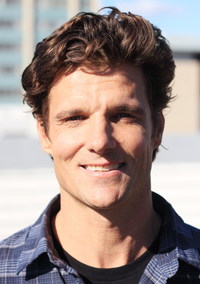
What's the mix of your clients?

Walter Grieves: We have 20 percent entertainment and about 50 percent tech startups.

How are you working with the universities?

Walter Grieves: We partnered with USC, UCLA, and Pepperdine, Loyola Marymount, Anderson, Annenberg Center, we have an internship program. Most of the companies here take interns, and we've organized things like that. We also hackathons and other events. We had the AT&T hackathon here in April, UCLA hackathon. The goal is to help the universities and students connect with companies.

See the full story here: http://www.socaltech.com/how_google_s_old_offices_are_becoming_a_tech_hub_with_roc_s_walter_grieves/s-0047346.html

23Jan/13Off

3D printing heads toward mainstream

At a 3,000 square feet factory in Kwai Hing--home of Hong Kong's production industry in the 90s before it drifted north to China--American expat Jon Buford has begun manufacturing and distributing what is touted as the world's cheapest 3D printer, the Makibox.

Buford hopes the US$200 device can help push this technology to the masses.

See the full story here: http://www.zdnet.com/3d-printing-heads-toward-mainstream-7000010176/

Filed under: 3D articles Comments Off
23Jan/13Off

Robot-assisted 3D printer aids march of the machines

The Bedford, Massachusetts, firm has filed a US patent on a way to rid 3D printers of the need for pesky humans, allowing robots to do all the post-printing work to make a complete product.

Enter iRobot's do-it-all robotic fabricator, comprising a twin-armed robot allied with a 3D printer, a milling machine and a drill, all on one platform. The platform is peppered with sensors so that a computer can choreograph all stages of manufacture, using the additive technique of 3D printing or the subtractive ones of milling and drilling, as needed. Both robot arms have dextrous grippers with six degrees of freedom, so one can hold a newly 3D-printed piece while the other secures another piece to it with glue, connectors or fasteners.

See the full story here: http://www.newscientist.com/blogs/onepercent/2013/01/irobots-3d-printer-patent.html

Filed under: 3D articles Comments Off
22Jan/13Off

Los Angeles Startup scene – interactive map

The map includes links to upcoming events.  See the map here: http://represent.la/#

22Jan/13Off

A $300k 3D-printed burger exists, because why not?

No matter what restaurant week specials they put out in your local town, none will compare to the stale taste of the $300,000 3D-printed hamburger Modern Meadow offers. The father-son startup company has figured out a way to combine the process of bioprinting with edible food so they can create a hamburger patty – albiet at an astronomically expensive price.


Of course, the resulting meat, such as patties and pork chops, created by the bioprinter will still need to be cooked on a frying pan to taste.

Read the full story here: http://www.digitaltrends.com/lifestyle/300k-3d-printed-burger/

22Jan/13Off

When the Internet Goes 3D

The Internet is having a mid-life crisis: Having just turned 40, it’s starting to go 3D. The transition is still in its early stages, but champions of the cause say it’s both natural and inevitable, with mass adoption expected within a few years. 3D will make the Web more social, they say, and it will introduce powerful new ways for people in education, business and medicine to interact with content and with each other.

What is the 3D Internet? Think of it as a set of interconnected virtual worlds that users can visit to consume services, “teleporting” from one world to another. It uses many of the same basic technology components as the 2D Internet—a browser, search engine and servers, for example. But what sets it apart is the use of 3D computer graphics and, in many cases, avatars—which Pirkola says will make it more social than the 2D Web.

“The 2-D graphical user interface has reached its potential and it’s time to move on and conquer the 3-D world,” says Ala-Mursula.

Will the 3D Internet replace the 2D Internet? Pirkola says not, and predicts people will use 2D and 3D apps side by side based on need.
See the full story here: http://www.cyberlightning.com/news/when-internet-goes-3d