RealD To Have 2,000 Screens In China Following Deal With Stellar International
The 3D technology company says this morning that it will install its systems at 100 screens operated by SMI Corporation’s Stellar International Cineplex. “This agreement adds to RealD’s growing traction in the Chinese exhibition market where we recently announced four new exhibitors, giving RealD a total commitment of 2,000 RealD 3D-equipped screens in China,” says RealD’s Edman Chan. Last month RealD announced a similar deal with HNA Group to equip up to 500 screens across HNA’s new theater circuit. Stellar has 250 auditoriums at 40 locations in 20 provinces and cities. Exhibition technology companies are eager to capitalize on the fast-growing demand for movies in China — especially since February when the government agreed to relax trade barriers on U.S. productions. RealD competitor IMAX has also been moving aggressively into the market.
See the original post here: http://www.deadline.com/2012/06/reald-to-have-2000-screens-in-china-following-deal-with-stellar-international/
DDD rolling out 3D gaming in China’s Internet café market
3D solutions company DDD will soon start beta testing its TriDef 3D game conversion software across an estimated 144,000 I-Café sites in China after achieving record financial results. ...
DDD’s TriDef software is a 2D to 3D conversion utility which has been licensed to TV, mobile and PC manufacturers with TriDef capturing an estimated 85% of the 3D PC market during 2011. Intel, Sony, LG, Samsung and HP have all licensed TriDef technology.
The company plan to expand its glasses free 3D mobile and tablet business with TriDef Mobile and recently signed two evaluation agreements with customers who are creating 3D reference designs for 3D smartphones and 3D tablet PCs. LG also launched its second generation Optimus 3D Max glasses-free smartphone in March, which uses DDD's TriDef Mobile Android software for 2D to 3D video conversion. TriDef 3D is now integrated in one million units after the first 9 months of launch. ...
See the full story here: http://www.3dfocus.co.uk/3d-news-2/3d-gaming/ddd-rolling-out-3d-gaming-in-chinas-internet-cafe-market/8709
ESPN Gears Up for 3D X Games
 A DAUNTING SET OF VENUES
Whether they employ a pair of HDTV broadcast cameras on a T-bracket, or a “beam splitter,” each 3D camera is a complex marriage of optics and electronics. In the same vein, 3D cameras are less forgiving of fast pans and cuts than their 2D cousins are. “Shooting in 3D requires more finesse and care than 2D does,” Orlins tells TV Technology.
Thanks to their pioneering work in live 3D sports coverage, ESPN has become a veteran in shooting such events. As a result, the network knows what works. In this case, it is the same production setup that they used so successfully in Aspen for the Winter X Games.
Two years after the launch of its ESPN 3D channel, ESPN has nearly 200 3D events to its credit. But this doesn’t mean that 3D production has become predictable, says Phil Orlins.
Growing box office but stagnant domestic film business, new study projects
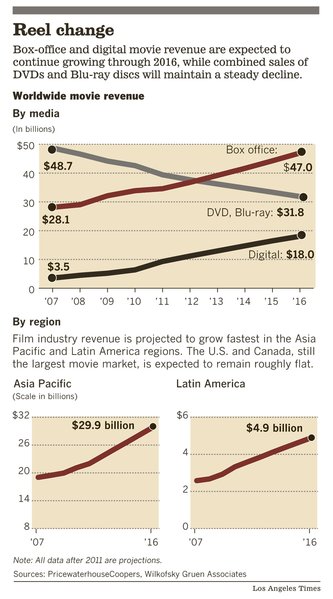 Movie ticket sales will boom 20% over a five-year span ending in 2016, but continuing revenue drops in the home entertainment sector will keep the overall U.S. and Canadian film business treading water, according to a new study byPricewaterhouseCoopers.
The consulting firm’s filmed entertainment outlook, set to be released Tuesday, predicts an acceleration over the next five years of trends with which Hollywood has recently been grappling. Those include growing digital revenue that can't keep pace with falling DVD sales and rentals, and faster growth of movie-related revenue in Latin America and Asia than in the rest of the world.
But a long-running trend of stagnant attendance at movie theaters will turn around as exhibitors, stung by consumers’ resistance to paying a premium price for 3-D films, will not boost prices as much as they have in the past, PricewaterhouseCoopers predicts.
See the full story here: http://www.latimes.com/entertainment/envelope/cotown/la-et-ct-pwc-film-study-20120611,0,2023536.story
Yet Another 3-Screen Study: Alternative Platforms Are Additive
 A majority of folks now have multiplatform video access, but they’re using second and third screens as an additive rather than as a primary viewing source, according to metrics from Arbitron and the Coalition for Innovative Media Measurement. The two paired up on a pilot program to analyze three-screen video consumption. Their findings bear out Nielsen’s most recent three-screen findings, as well as a those from the Television Bureau of Advertising:
“While a significant portion of the CIMM TV audience used PCs or Android/BlackBerry mobile devices to access the leading online video sites, broadcast and cable TV was by far the leading choice for video consumption in terms of aggregate time spent with TV and video sites across the measured three screens.”
See the full story here: http://www.tvtechnology.com/article/yet-another--screen-study-alternative-platforms-are-additive/213833

BBC tests ‘3D sound’
Engineers at the BBC are currently beavering away designing new 3D audio technologies. Soon, we will be able to enjoy our favourite radio and TV programmes in glorious three-dimensional sound. ...
So when can we hear it?
BBC press officers are currently keeping their cards close to their chest on this latest 3D audio research, but expect to find out a lot more about the Beeb's future broadcast plans later this year. ...
See the full story here: http://tech.uk.msn.com/audio/bbc-tests-3d-sound
MakieLab secures $1.4m in funding
 'Smart toy' outfit secures cash, with contributions from games and anime angels
MakieLab has secured £1.4 million in funding for its user-designed, 3D-printed action doll business model.
The company lets users design digital dolls via its website. The designs are then made physical with 3D printing, and sent to customers who pay for the dolls.
Currently in open alpha, the service will eventually expand to included dolls with various new features, and link the vitrtual world where the Makies are created with the physical product through social and gameplay mechanics.
See the full story here: