Toshiba finally launches glasses-free 3D TVs in Asia
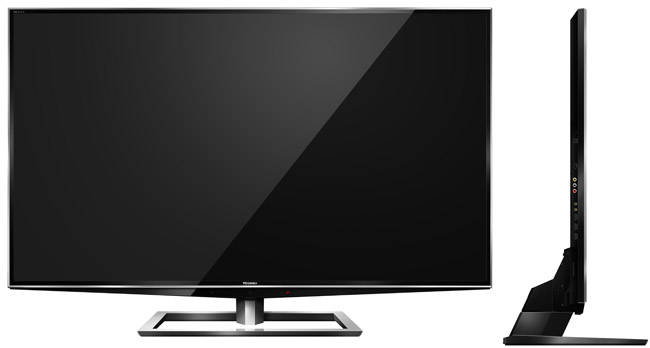 A new contender in the 3D TV market has arrived with the official launch of the Toshiba Regza 55RZ1. This 55-incher is possibly the world's first large-screen glasses-free 3D TV, which displays 3D content without additional active shutter or passive 3D glasses. Moreover, it is also a 4K TV boosting a staggering 3,840 x 2,160-pixel resolution that is four times higher than a typical full-HD model.
As far as 3D is concerned, the 55RZ1 employs a powerful Regza Engine Cevo Duo S engine and lenticular lenses to deliver up to nine effective viewing zones. An inbuilt face-tracking system is available to adapt these sweet spots to the sitting positions of the viewers at the touch of a remote button. Onscreen 3D resolution has also been bumped up to HD (720p) quality compared with its predecessors, thanks to 4K technology.
Another highlight is the panel's 4x Super Resolution+ function, which converts and optimizes 2D content to leverage on its 4K screen. These include standard-definition DVDs, as well as high-definition Blu-ray Discs. However, users can only view 4K photo files directly through the TV's USB media player, while an external A/V input box such as the THD-MBA1 is required to play native 4K videos. ...
Read the full article with product technical specifications here:
Apple Reveals Wildly Intelligent Multi-Tiered Haptics System
 ...a wildly intelligent multi-tiered haptics system. The system will actually allow an iDevice display to deform so that it could provide the user with a button, an arrow or even a geological map to physically pop right out of the screen to give it 3D depth. If that wasn't cool enough, Apple's patent discusses a flexible OLED display that could be used for video glasses. ...
Read all about it here:
Peter Jackson Considering Dolby Atmos for ‘The Hobbit’
 Peter Jackson is considering the new Dolby Atmos audio format to create the sounds of Middle Earth for The Hobbit, his two-part prequel to The Lord of the Rings.
“Dolby are coming down to New Zealand to give us a demonstration,” Jackson told The Hollywood Reporter. “Our particular postproduction schedule is reasonably tight (but) three dimensional sound would be fantastic. If we can do it I would be pretty keen.”
Jackson is already experimenting with advancing technology onThe Hobbit. The films are being shot in 3D and -- for the first time on a major Hollywood film -- at 48 frames per second.
The Dolby Atmos format is developed to create “lifelike” and “immersive” sound and involves the placement of speakers all around an auditorium as well as across the ceiling. The system is designed to transmit up to 128 simultaneous and lossless audio channels, and renders from 5.1 up to 64 discrete speaker feeds, according to Dolby. ...
see the full story here:
Kickstarter Project Turns The iPad Into Apple’s First Touchscreen Laptop
 WITH $400,000 RAISED ALREADY, YET ANOTHER PRODUCT CREATES A COMPANY OVERNIGHT.
...
It’s a clip-on iPad keyboard with a milled aluminum chassis and integrated speaker that ostensibly converts the iPad into a MacBook. ...
Apprently there is some room in the market for that premium keyboard. In a week, Brydge raised over $400,000, promising units at an introductory price of $150 (about the same cost as a refurbished Kindle Fire). ...
See the full story here: http://www.fastcodesign.com/1669671/kickstarter-project-turns-the-ipad-into-apples-first-touchscreen-laptop
Unveiling of “Glasses Free” 3D TV Advertising Network
Elixir XES 3D announces phase 1 of the world’s first glasses free 3D TV advertising network, located at the Tropicana Resort and Casino in Atlantic City, NJ. Through the Elixir XES 3D proprietary technology brilliant images literally dance off the screen in front of the viewer – without the need for 3D glasses. Elixir XES 3D has partnered with Viaduct International for sales and distribution of this state-of-the-art, industry changing advertising opportunity. Elixir and Viaduct share the excitement of the Tropicana Resort and Casino in introducing the world’s first deployment of their autostereoscopic 3DTV. ...
See the full post here:
Handheld 3D Scanner Let’s You Digitize Objects And Rooms In Minutes
 A Silicon Valley startup wants to give you the power to “scan your world” with a handheld scanner that rapidly creates 3D maps of objects and rooms, complete with colors and textures. While it may seem like you’d have to have a steady hand and move slowly through a room to scan it, a demo video of the device from MatterPort implies that the 3D maps can be generated by simply passing it through the space, sort of like virtually painting a room. Just imagine you’re using a squeegee and you get the idea. Inone of its promotional videos, the startup even claims, “MatterPort does for 3D modeling what photography did for painting.”According to co-founder Mike Beebe, the device is 20 times faster than other 3D scanners on the market.
And if you think it looks like a hacked Kinect sensor attached to a handle, you’re not too far off — Kinect was used in the prototype....
Read the full story here:
Peter Jackson Responds to ‘Hobbit’ Footage Critics, Explains 48-Frames Strategy
 ...“A lot of the critical response I was reading was people saying it’s different. Well, yes, it certainly is,” Jackson, speaking by phone from New Zealand, said. “But I think, ultimately, it is different in a positive way, especially for 3D, especially for epic films and films that are trying to immerse the viewer in the experience of a story.”
Jackson’s epic, which Warners will release Dec. 14, will be the first major motion picture to be made in 48 fps – a different aesthetic look that Jackson believes can result in smoother, more lifelike pictures.
While many at the crowded showroom at Caesars Palace applauded the depth and detail in the large-scale battle sequences, some found more intimate daylight sequences too crisp and bright, complaining that they looked more like HD video and that the new process sacrificed a traditional “cinematic” feeling.
A number of bloggers, whose opinions quickly ricocheted across the web, found fault with the 48 fps footage. ...
Jackson acknowledged that the short, ten-minute clip package -- ranging from action sequences to quieter moments between Martin Freeman’s Bilbo Baggins and Andy Serkis‘ Gollum – may have been too brief for viewers to acclimate to the new process.
“It does take you a while to get used to,” he said. ...
Because of that, he isn’t planning to release a 48 fps trailer for the movie. ...
"You get used to it reasonably quickly,” he said, commenting that now when he views traditional 24 frames footage, “I’m very aware of the strobing, the flicker and the artifacts."...
Because production is not scheduled to wrap until July, the customary postproduction that affects the overall look of a film has not yet been done, so the clips were unfinished. They were not yet color corrected, nor had the visual effects been completed. (In various scenes the actors were shown performing in front of a greenscreen.)
Jackson explained that his original The Lord of the Rings used various postproduction techniques to create a certain look for the movies, including “extensive” digital color grading, “added texture, and we took out highlights."
“We’ll do the same with The Hobbit, to make it consistent and give it the feeling of otherworldliness – to get the mood, the tone, the feel of the different scenes,” he said. “We are certainly going to experiment with different finishing techniques to give the 48 frames a look that is more organic. But that work isn’t due to start until we wrap photography in July (both Hobbit films are being shot simultaneously)."
Jackson is also lensing the movie – which is being shot in 3D, a first for the franchise – using Red Epic cameras with 3Ality Technica 3D rigs.
The Red Epic, Jackson explained, allowed him to shoot in 5K resolution. (5K refers to the number of horizontal pixels that compose a frame.) Today, movies are generally lensed and projected at 2K, though the industry is moving in the direction of 4K.
“It is very clean. On a 5K camera you are seeing very crisp pictures,” he said. ...
In contrast to the first wave of skeptical tweets, a sampling of reaction from exhibitors, studio executives and producers at Cinemacon found many saying that 48 fps represents the wave of the future.
At one panel, Regal CEO Amy Miles said her circuit is committed to 48 frame rates, and that technological advances are key to a thriving in the exhibition business. ...
Read the full story here;